

Around 717 million years ago, Earth entered one of the most extreme climate episodes in its geological history. Ice advanced across the continents, reached the tropics, and sealed much of the ocean beneath a frozen shell, a state scientists refer to as Snowball Earth. The event, known as the Sturtian glaciation, lasted until approximately 660 million years ago. That duration, 56 million years, has long posed a problem for researchers: standard climate models struggle to account for a freeze that prolonged.
A study published in the Proceedings of the National Academy of Sciences now offers a revised explanation. Rather than a single, unbroken deep freeze, Earth may have passed through a recurring cycle of glaciation and thaw throughout the Sturtian, driven by shifts in atmospheric carbon dioxide and the chemical weathering of volcanic rock.
The Carbon Cycle at the Center of the Puzzle
To understand why the Sturtian lasted so long, researchers at Harvard University built a coupled model linking ancient climate conditions to the global carbon cycle, the system by which carbon moves between the atmosphere, oceans, rocks, and living organisms. The team, led by graduate student Charlotte Minsky alongside colleagues Robin Wordsworth, David T. Johnston, and Andrew H. Knoll, focused on a vast volcanic region in what is now northern Canada known as theFranklin Large Igneous Province.
According to the researchers, the Franklin Province erupted shortly before the onset of the Sturtian, depositing enormous quantities of basalt across the surface. Basalt is chemically reactive: as it weathers in contact with rain and air, it draws carbon dioxide out of the atmosphere and locks carbon into minerals and ocean sediments. The Harvard team’s simulations suggest this weathering process pulled CO₂ levels low enough to initiate a global glaciation.
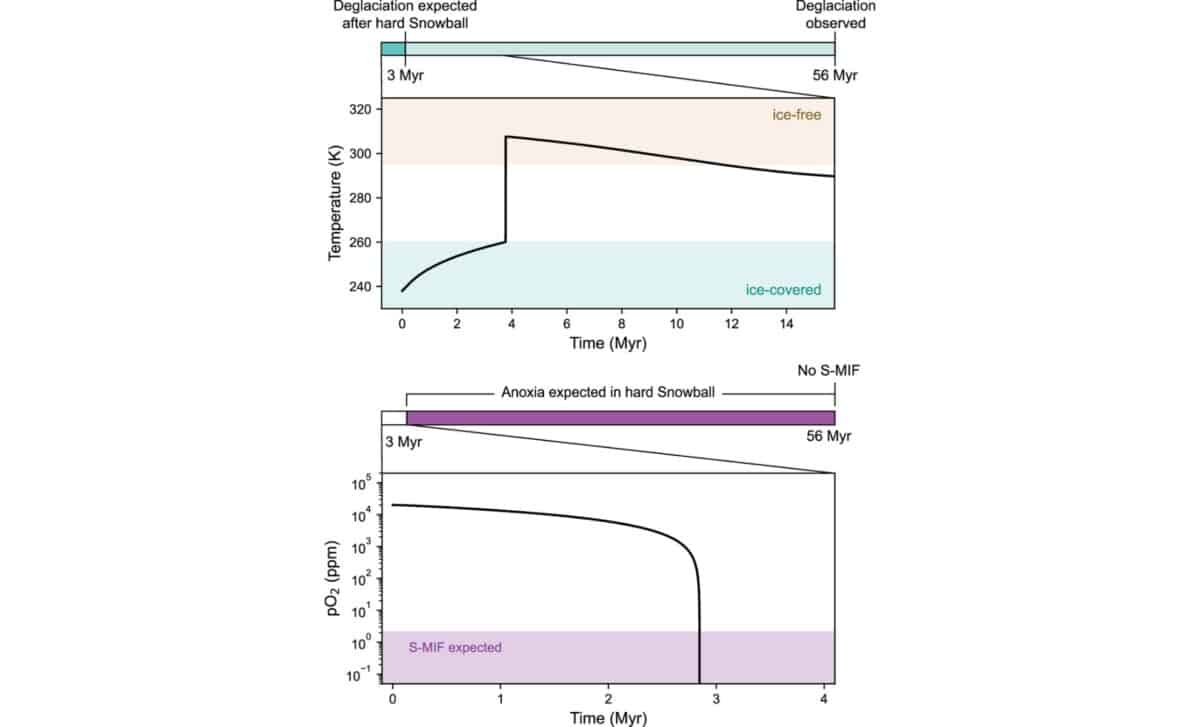 Standard Snowball Earth model vs. Sturtian glaciation: CO₂ buildup and oxygen collapse under a continuous freeze ©PNAS
Once ice covered much of the planet, however, weathering slowed, rain and air could no longer access large areas of exposed rock. Volcanic activity continued releasing CO₂ into the atmosphere, and with weathering suppressed, the gas accumulated. As the greenhouse effect strengthened, temperatures rose, ice retreated, and fresh basalt was again exposed to the surface. Weathering resumed, CO₂ declined, and the planet cooled again. The cycle then repeated.
This feedback mechanism, the study argues, could naturally sustain glacial and interglacial swings across tens of millions of years, providing a plausible explanation for the Sturtian’s unusual length without requiring the planet to remain locked in a continuous freeze.
Implications for Life and the Rock Record
The freeze-thaw model also addresses two additional puzzles that have complicated scientific understanding of the Sturtian. The first concerns the geological record itself. Sedimentary deposits from the Cryogenian period (the broader era in which the Sturtian occurred) contain mixed signals: some layers indicate the presence of glaciers, while others suggest intervals of open water. A climate that alternated repeatedly between frozen and thawed states would be consistent with that pattern.
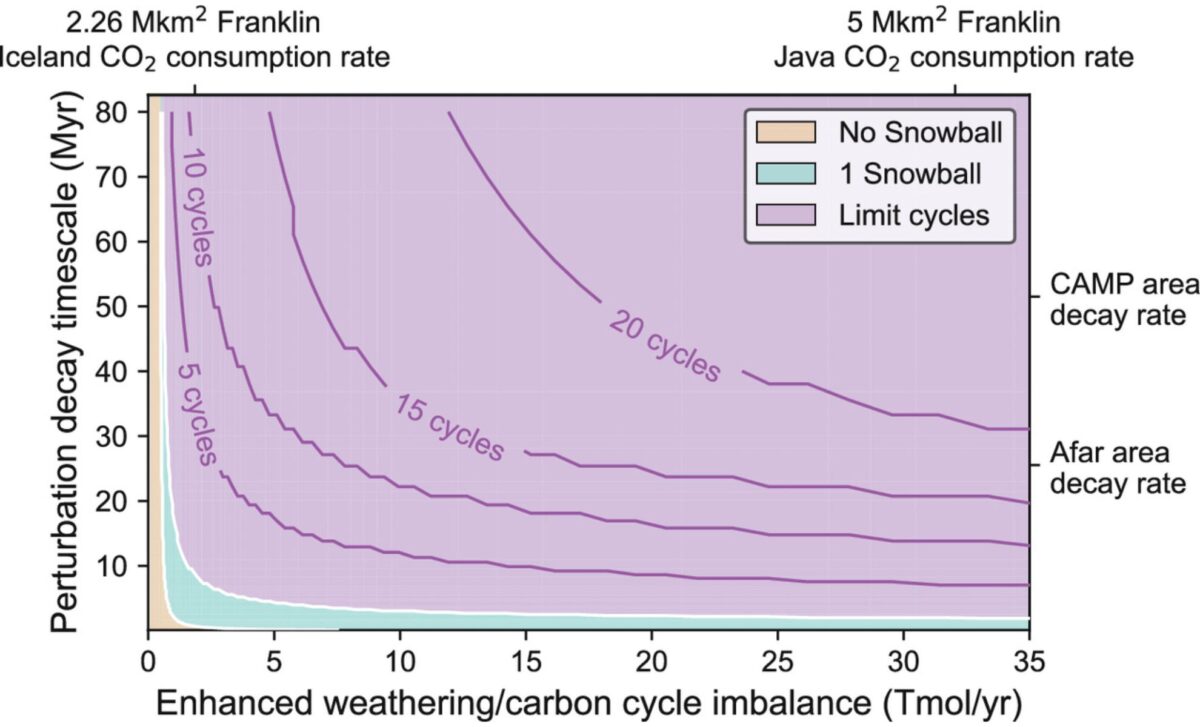 Repeated Snowball cycles emerge across a wide range of carbon weathering rates and volcanic timescales ©PNAS
The second concerns the survival of oxygen-dependent life. At the time of the Sturtian, Earth was populated almost entirely by microorganisms. Many of these single-celled life forms required oxygen, and a continuous global freeze lasting 56 million years would have placed severe strain on the atmospheric and oceanic systems that maintained oxygen availability. Under the Harvard model, life would not have faced an unbroken frozen interval but rather a succession of harsh yet temporary freezes separated by warmer, ice-free windows. “This could help explain how aerobic life persisted through such an extreme interval,” Minsky said.
The research also carries implications beyond Earth’s own history. According to the study’s authors, similar carbon-cycle-driven oscillations could potentially occur on rocky exoplanets with active volcanoes, exposed basalt, and functioning carbon cycles. A frozen planetary surface, they suggest, need not indicate a permanently dead world, it may instead represent one phase within a longer, self-regulating climate cycle.