

For generations, scientists and philosophers alike have treated the newborn brain as something close to a blank slate, a tabula rasa, in the classical sense, waiting for experience to fill it. But a recent study published in Nature Communications is pushing back on that idea in a meaningful way. The research points instead to what could be called a tabula plena: a brain that arrives already densely wired, and that gradually prunes itself into the structure we carry into adulthood.
The stakes of that distinction are not trivial. The hippocampus, the region at the center of this study, is the primary area of the brain linked to forming memories, and plays a fundamental role in learning and spatial recognition. Understanding how it develops from birth onward touches on some of the most basic questions in neuroscience: when does the brain begin to function, and how does it become what it is?
A Question of Timing, and Two Very Different Answers
The research was led by neuroscientists Peter Jonas and Victor Vargas-Barroso of the Institute of Science and Technology Austria. Their team set out to investigate how the CA3 neural network, a group of neurons exclusive to the hippocampus, develops in the period between birth and adulthood. That network is thought to be central to how the brain encodes, stores, recalls, and updates memories, doing so through synapses that are highly plastic and capable of adapting to change.
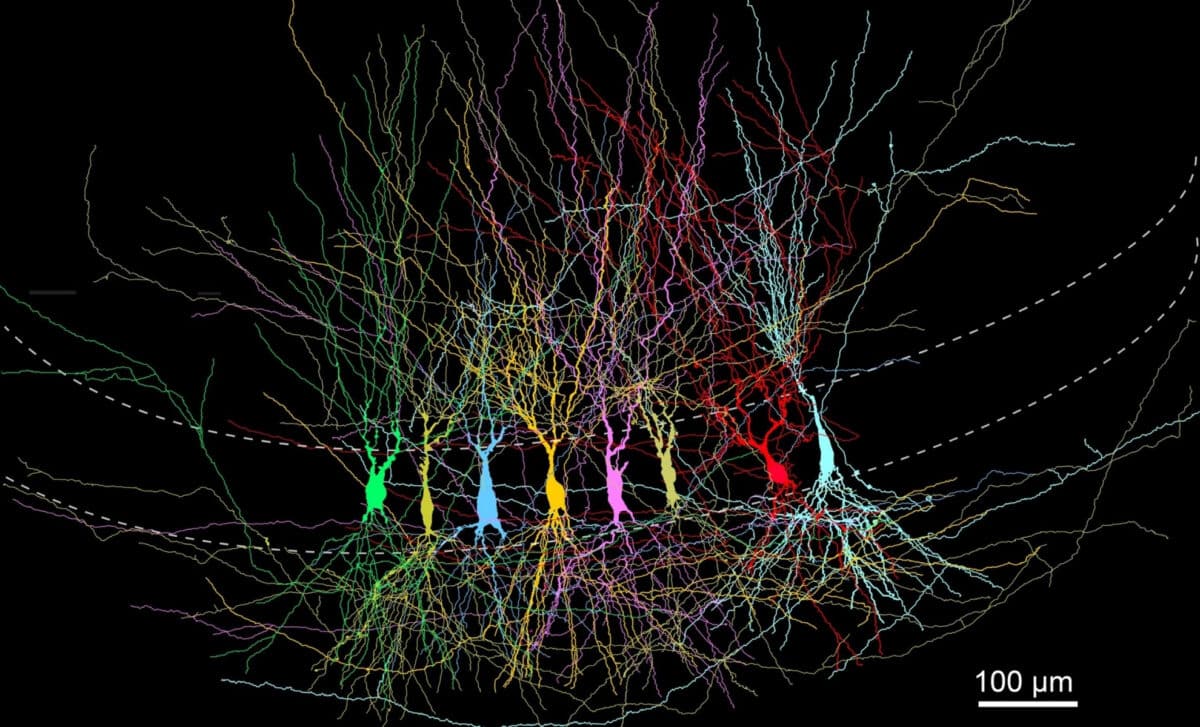 Neurons filled with biocytin, a tracer that labels them during recording, are fixed and stained to allow full reconstruction of their shapes – © Jose Guzman / Jonas group at ISTA
Two competing hypotheses have long framed the debate. Under the tabula rasa model, synaptic connections would be scarce at birth and would accumulate over time. The pruning model predicts the opposite: a brain dense with connections from the start, which are then selectively trimmed as the animal matures. According to Jonas and Vargas-Barroso, as stated in their paper, “tabula rasa and pruning models make different predictions of how connectivity will change over developmental time,” and how structured connectivity actually comes to be “is not clear.”
What Mice Revealed, Stage by Stage
To test both models, the team studied mice at three distinct developmental stages: shortly after birth, between 7 and 8 days old; during adolescence, between 18 and 25 days old; and in adulthood, between 45 and 50 days old. Those windows were chosen specifically to bracket the period during which the hippocampus shows its highest level of plasticity.
The method used was the patch-clamp technique, which allows for the precise recording and measurement of electrical signals as they pass through neurons, from presynaptic terminals, which are the ends of neurons that convert electrical signals to chemical signals by releasing neurotransmitters, all the way to dendrites, the branched extensions that receive incoming signals and relay them to the body of the neuron.
When the recordings were analyzed, the results were consistent: mice were born with a vast abundance of connections between CA3 neurons. Those connections decreased as the animals matured, with the CA3 network gradually becoming more structured and less random. Individual synapses were also surprisingly strong in young mice, capable of triggering spikes on their own, whereas in adult animals, many weaker inputs had to combine simultaneously just to fire a single neuron. Mature CA3 neurons also fired less often than immature ones.
Structure Changes, Too, Down to the Branches
The electrical data alone was enough to support the pruning model, but the team went further. Microscopic analysis of the same neurons revealed corresponding shifts in physical architecture. Axons, the long fibers that carry signals away from a neuron, grew shorter and developed fewer branch points as the mice aged. Dendrites, on the other hand, grew longer and increased in density over the same period.
According to the researchers, these changes align with “a transition of hippocampal higher-order computations,” and could be linked directly to the shift from dense, random CA3 connectivity in infancy to the more spaced-out and structured network seen in adults. Taken together, the electrical and microscopic evidence both point to the same conclusion: the neonatal brain, at least in mice, begins life in a tabula plena state rather than a blank one.
Whether any of this applies to humans is a question the study leaves open. The mechanisms that drive synapse pruning are still not well understood at the cellular or molecular level, and as Popular Mechanics reported, the researchers themselves acknowledged that “direct testing of these hypotheses will require more work in the human hippocampus.” What the data does suggest, for now, is that the inability to remember infancy has nothing to do with the brain being empty at the time.