
Photo-Illustration: by The Cut; Photos: Getty Images, Olivia Rodrigo/Youtube
If you need proof of how quickly recent history can be flattened or forgotten, look no further than the thousands of people melting down over Olivia Rodrigo’s dress this week. Over the weekend, a video of Rodrigo performing “Brutal” for Spotify’s Billions Club Live concert in Barcelona went viral. One X user captioned the video with “Maybe I’m too woke,” while many of the nearly 2,000 commenters zeroed in on one thing: her outfit.
Rodrigo’s fashion choices throughout the rollout of her third album, You Seem Pretty Sad for a Girl So in Love, have been the source of pretty rampant discourse on social media. In Barcelona, she wore a Génération78 floral puff-sleeve top as a minidress that exposed matching ruffled bloomers as she crawled on the floor singing, “And they’d all be so disappointed / ’Cause who am I, if not exploited?” The outfit looked like an extension of every other look she’s worn during this album-release cycle, including the Petra Collins–directed video for “Drop Dead,” in which she ran around the Palace of Versailles in Chloe babydoll dresses and exposed bloomer shorts.
Both babydoll dresses and bloomer shorts have been trending for the last few years. Vogue ran a piece last summer about the pop-star resurgence of the babydoll, as seen on Sabrina Carpenter, Addison Rae, Kacey Musgraves, and, even back then, Rodrigo. The dress was even seen on multiple spring 2025 runways during various Fashion Weeks. And bloomer shorts have been on the rise for several years, as part of an underwear-as-outerwear trend. They’ve been pushed by magazines, influencers, and more high-fashion runways as well.
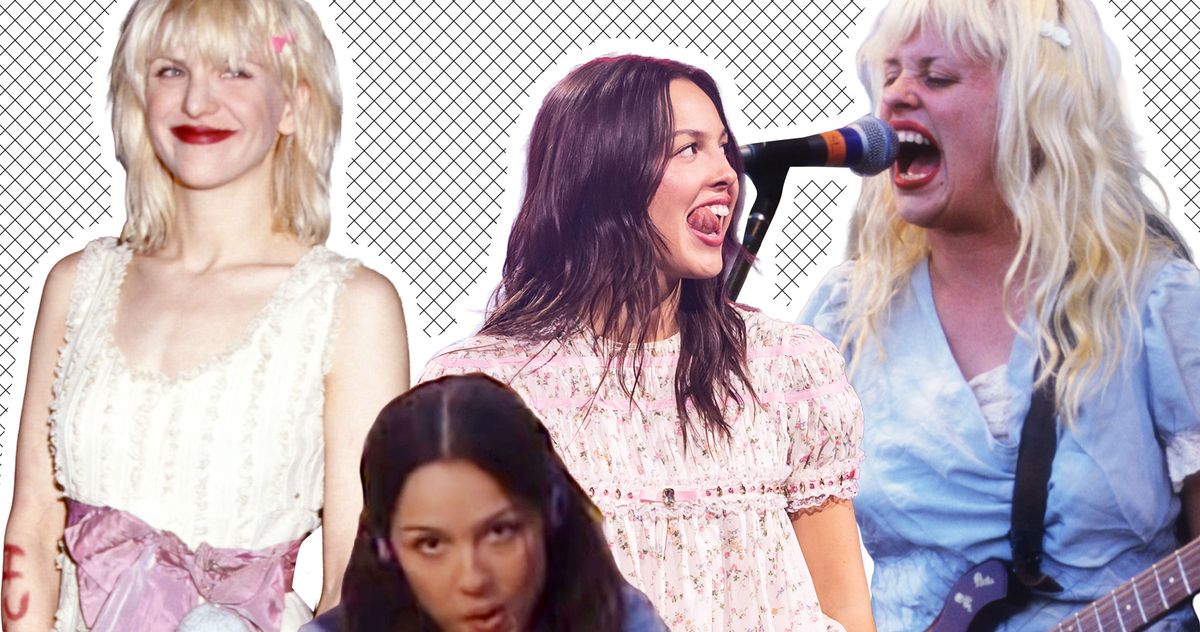
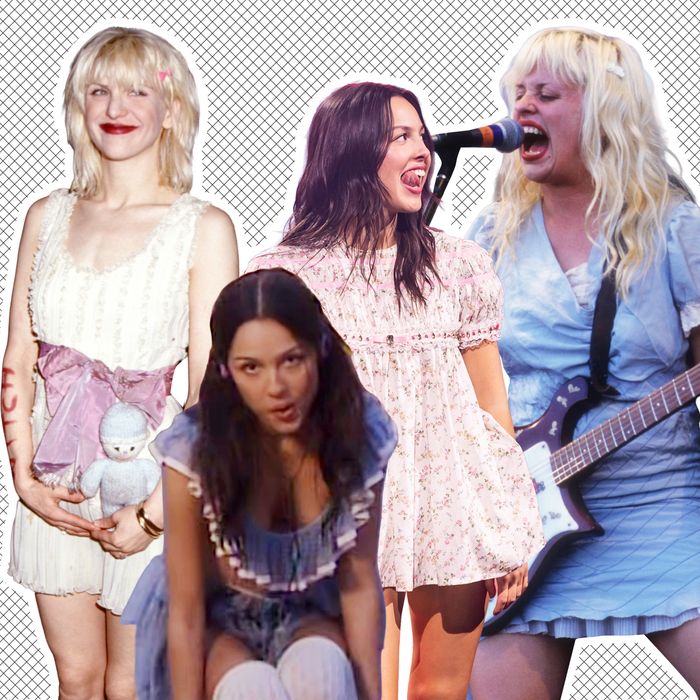
Famously, this is not the first class of musicians to repopularize the vintage style. Rodrigo is a student of ’90s punk, grunge, and riot grrrl-era bands like Hole and Babes in Toyland, who have been commonly cited in her defense this past week. The use of babydoll dresses in those eras — deemed “kinderwhore” — was defiant, tongue-in-cheek commentary on the exploitation of women and girls, flipping the notion of this retro, girlish lingerie being fetishized when worn by ferocious women with unkempt hair, smeared makeup, and guitars slung around their chests. They also wore Doc Martens with their dresses — which Rodrigo has made part of her brand over the years. She paired her floral babydoll in Barcelona with a chunky knee-high pair.
The Gen-Z star has been specific in citing her Gen-X mood board. “I really love the idea of a babydoll [dress],” she told Vogue in an interview previewing her performance in Barcelona, which was arriving in tandem with her FC Barcelona jersey collaboration. In the press image for the Rodrigo x FC Barcelona jerseys, she’s wearing bloomers as well. “I just remember being younger and having pictures of Courtney Love and Kat Bjelland from all these riot grrrl punk bands in their babydoll dresses, just owning it. I always thought that that was really cool, and so I like that there’s an element of that. I also like that it kind of feels a little pajama-y.” (Notably, lingerie designer Sylvia Pedlar invented the babydoll-nightgown style in 1942 in response to the fabric shortages of World War II. She hated the name.)
Rodrigo’s fashion statement comes at a tense time culturally, when both conservative and liberal netizens have united in mutual paranoia verging on hysteria about the sexualization of young people. Conspiracies about Hollywood sex-trafficking rings seem less far-fetched after Me Too and the exposure of the Epstein files, spawning even more conspiracies to run rampant online. Younger generations, especially those who lean more left, have developed a particularly modest relationship with pop-culture provocations. In TikTok, X, and Instagram comments, they have grown obsessive with boundaries around sexual expression. Terms like grooming are thrown about with ease, even when two consenting adults with some form of age gap date. Meanwhile, Stan Twitter often argues over sexualized performance styles at concerts, especially if an artist was recently a teen idol, may have underage fans, and, most notably, is a woman. Just last year, the internet was up in arms over Carpenter’s Man’s Best Friend album cover, where she’s depicted on all fours with a man gently tugging her hair. The art, and some of her photo shoots, were deemed too sexual for her audience.
Reasonably, the younger people who worry they’re “too woke” to see 23-year-old Rodrigo in a babydoll dress or a light Lolita film reference from 27-year-old Carpenter have come of age in the post–Me Too era, where it’s clear powerful people tend to get away with exploiting vulnerable, and often underage, girls and boys. They certainly have a right to be fearful and cautious, though it may be amplified by a tenuous relationship with sex itself. Younger generations have been having less sex than older generations, due to changing technology and the ever-present ramifications of more than a year locked in their homes during their formative years. Those kids who were deemed “puriteens” are now young adults with even more strained relationships with how sex in pop culture is handled.
Rodrigo’s teenage ascent happened to coincide with the cultural reckoning around the way teen idols of yore lacked agency as their youth was commodified, sexualized, and taken advantage of by major labels and devious managers in order to appeal to the male gaze. Critics wondered how much say someone like a 17-year-old Britney Spears had when she wore a schoolgirl outfit for the “… Baby One More Time” video or posed for a sexy Rolling Stone cover shoot while holding a Teletubby in 1999, a whole four years before Rodrigo was born. There are no shortage of examples in pop-music history where young women have been fetishized for an older audience, moments that created uproar in their eras but often befell the women themselves, not the adults who were making decisions in the room. In this case, however, Rodrigo is an adult woman referencing clothing trends popular with other adult women of the present and the past. There’s a context and a history that has quickly been overshadowed by the internet’s desire to feel immense rage at all times.
This news cycle suffers from two strikingly common issues in pop-star discourse. The first is that Rodrigo is a young woman in music, crystallized at the age she became famous and expected to never grow up, though she and her fans are both doing so in tandem. The second issue is that the purpose of this particular style reference is unclear. If she’s nodding to the ’90s feminist icons who molded her, the babydoll is a better fit for her “Brutal” performance and its teenage rage than it is for the romantic, twee single she dropped to promote her new album. While a fun and big pop moment from Rodrigo, there’s no punk edge or radical messaging that makes the reference work as possibly intended. More fitting are the vintage ’70s pieces her stylists have pulled for her and the Sofia Coppola–style dreamy opulence evoked in Collins’s video.
Still, Rodrigo’s work since she debuted in 2021 with “Drivers License” has often played with themes of innocence lost, fetishized youth, and nostalgia. There could be a bigger picture that won’t be complete until her third album is out. Or maybe she just wants to wear pajamas.
Stay in touch.
The latest in style, self, culture, and power in your inbox.
Vox Media, LLC Terms and Privacy Notice
Related