
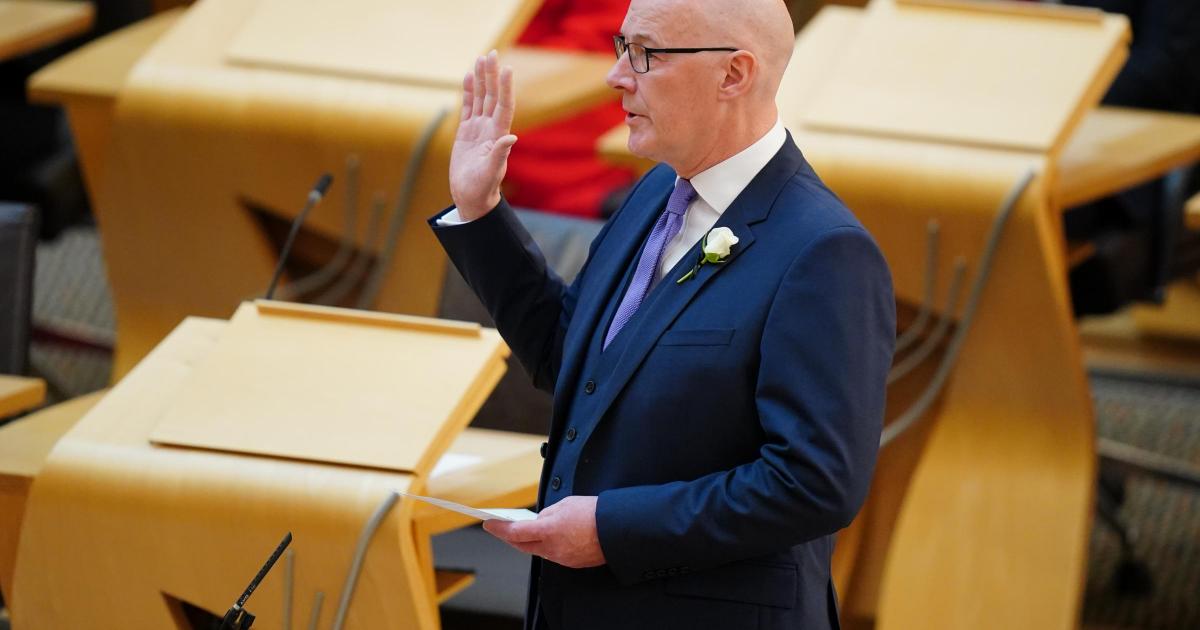
SNP leader John Swinney said his “primary loyalty” was to the Scottish people as he was sworn in as an MSP again.
Swinney, who is expected to be formally re-elected as first minister next week, was the first of 129 MSPs to take the oath at Holyrood after last week’s election.
He wore a white rose on his lapel, with each of the 58 also wearing one.
Here is the story behind the white rose they are wearing.
The white rose was originally the emblem of the Jacobites — supporters of the exiled House of Stuart after James VII was removed from the throne during the Glorious Revolution of 1688.
The movement reached its most famous moment under Charles Edward Stuart during the 1745 uprising, which ended in defeat at Battle of Culloden.
Over the following century, writers including Walter Scott used the Jacobites into romantic symbols of lost Scottish sovereignty, Highland resistance and national memory and the white rose became synonymous with it all.
READ MORE: Live updates as MSPs take their oath amid Labour leadership challenge
What is the link to the SNP?
Poet Hugh MacDiarmid was one of the intellectual architects of modern Scottish nationalism before the SNP became electorally dominant. Through poetry, essays and activism, he argued Scotland needed not just political self-government but a cultural rebirth.
He frequently drew on older Scottish symbols and traditions, including Jacobite history, though often in complex and contradictory ways.
(Image: Hamish Campbell)
When the Scottish National Party was founded in 1934, combining several nationalist groups, including movements heavily influenced by literary and cultural nationalism, the rose was often used symbolically.
The symbolism proved useful because it connected modern constitutional politics to a much older story about sovereignty, identity and resistance.
Is the white rose controversial?
The relationship is not straightforward.
Historians point out Jacobitism was not a nationalist movement in the modern sense. Many Jacobites wanted a restored British Stuart monarchy, not Scottish independence. Many Scots also fought against the Jacobites.
READ MORE: Scottish Government hits back at Keir Starmer’s attempt to roll back referendum talks
And within today’s independence movement, some see Jacobite romanticism as overly nostalgic or exclusionary.
Modern SNP leaders rarely invoke Jacobite imagery directly, preferring the language of civic nationalism, democracy and European-style self-government.
But culturally, the white rose still resonates.