
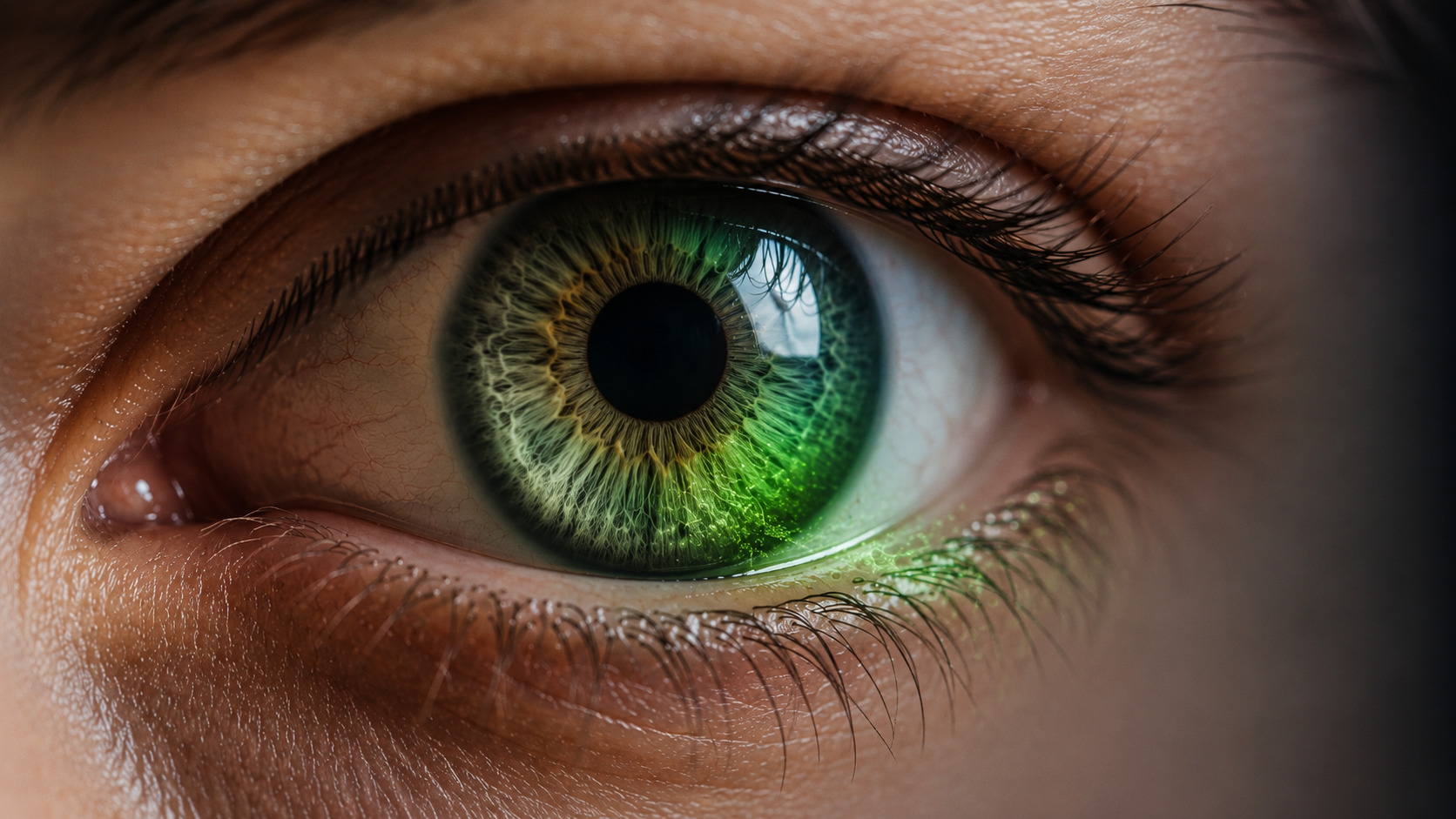
 AI-generated image.
Photosynthesis is one of the most astonishing processes on Earth. Without it, we wouldn’t have plants. Without plants, most life as we know it would collapse.
Mammals, of course, can’t photosynthesize. That is why we need to eat. But in a new study, researchers borrowed a small piece of that green machinery and put it to work in mammalian eye cells.
In a study published in Cell, the team took nanoscale light-harvesting particles from spinach and inserted them into eye models. The goal was not to make eyes produce their own food. It was stranger, and in some ways more practical: use light to generate chemicals that help fight dry eye disease.
Transplanting Photosynthesis
Plants, algae, and cyanobacteria can photosynthesize. Animals cannot. But there is one exception: sacoglossan sea slugs.
These remarkable sea slugs, which can regenerate a new body from only a head, eat algae and keep some of the algae’s chloroplasts, the organelles that carry out photosynthesis. They store them inside their own tissues and can use them for a while. It is not photosynthesis in the full plant sense, but it is probably the closest animals get.
This ability got researchers thinking. Could we transport that ability into other animals? Perhaps, say, humans?
 Assoc Prof Leong and his NUS team extracted and transplanted the plant machinery responsible for photosynthesis into the eye’s corneal cells via eye drops to treat dry eye disease. From left to right: Ms Chen Yinglu, Dr Xing Kuoran, Associate Professor David Leong, Mr Glebert Cañete Dadol, Ms Tong Siye. Image credits: NUS.
The eye was a logical place to start. It already deals with light all day. Photons pass through the cornea and lens before reaching the retina, where they are converted into electrical signals. But the eye is also vulnerable to oxidative stress, a chemical imbalance that can damage cells and inflame tissue.
That oxidative stress plays an important role in keratoconjunctivitis sicca, better known as dry eye disease. The condition is common, frustrating, and often difficult to treat. According to the researchers, it affects around 1.5 billion people worldwide.
×
Thank you! One more thing…
Please check your inbox and confirm your subscription.
Photosynthesis offered a possible solution.
A Tiny Spinach Battery Charger
Photosynthesis has two major stages. First, plants use light to charge chemical “batteries.” One of these is NADPH, a molecule cells use to manage damage from harmful reactive molecules. Then, in the second stage, plants usually spend that stored chemical power to make sugars.
In this study, the researchers didn’t want the sugar-making part. They wanted only the light-powered battery charger.
So they took spinach chloroplasts and kept the tiny light-catching structures called thylakoids. Then they removed much of the surrounding material that would normally use up NADPH to make sugar.
The result was LEAF, a tiny spinach-derived particle that mammalian cells could absorb.
A Leaf for the Eye
After working out the chemistry, the team tested LEAF in cells. In macrophage-like cells treated with bacterial lipopolysaccharide to trigger inflammation, the particles were rapidly taken up. When the cells were exposed to light, LEAF restored intracellular NADPH within 30 minutes.
“This is an exciting finding as we have, for the first time, demonstrated that plant photosynthetic machinery can be transplanted into mammalian tissue to generate biologically useful molecules, powered entirely by the same light that enables our vision. We, too, can have limited photosynthetic abilities.” said Dr Xing Kuoran, the first author of the work.
The researchers tried the system in eye-like inflammation models and using animal models. When LEAF was inside the eye, it used light to make NADPH. This in turn helped the eye fight oxidative stress and inflammation.
Basically, they got the eyes to use light to cure themselves. Not exactly photosynthetic eyes, but close enough to feel like science fiction.
“With LEAF, we now have a technology that harnesses ambient light to directly restore the molecule that dry eye disease depletes,” added David Leong, one of the study co-authors. “As it is derived from spinach, delivered as a simple eye drop, requires no external device or power source and using the ambient light that is used for vision, we believe it has a strong potential for clinical translation. It is almost surreal when thinking of a possible future reality where human cells can have some limited but beneficial form of photosynthetic ability not only in the eye but elsewhere, too.”
How Would This Work In a Real Trial?
The researchers didn’t try this on humans just yet. That is a proof-of-concept claim, not a human-treatment claim. However, they claim the approach has real clinical potential. They think it could eventually become a human dry-eye treatment, probably as eye drops.
It would work as a “neo-organelle”.
Basically, this isnt a drug in the classical sense. It’s not a molecule that’s aimed at a receptor. It’s a functional biological molecule. It does complex work, sensing light and producing metabolites.
It’s basically an engineered version of what the sea slug does, except instead of using it for nutrition, it’s being used to generate useful treatments. But while the potential is exciting, and there are many instances where this approach would be useful, the safety questions are also serious.
How long would these particles persist in human tissue? Could they trigger an immune response? What happens after repeated use over months or years? And could light itself become a problem?
Real-world light exposure is messy. People move between sunlight, indoor lighting, screens, and darkness. Any future treatment would need to define how LEAF switches on, how much NADPH it produces, and whether too much reducing power could create a different kind of imbalance.
Still, the concept is remarkable. The researchers took a biological machine evolved in spinach and used it to do useful work in mammalian cells.
That is astonishing.
It is also practical in its ambition. Dry eye disease is common, stubborn and frustrating. Current anti-inflammatory therapies can be slow, expensive or irritating for some patients. A light-powered redox therapy, if it ever proved safe and effective, would attack the problem from a different angle: not by blocking one inflammatory pathway, but by restoring the chemical balance that inflammation disrupts.
For now, however, LEAF remains an experimental platform. The leap from cells and animal models to human medicine is long. Many dazzling ideas fail there.
The study was published in Cell.