
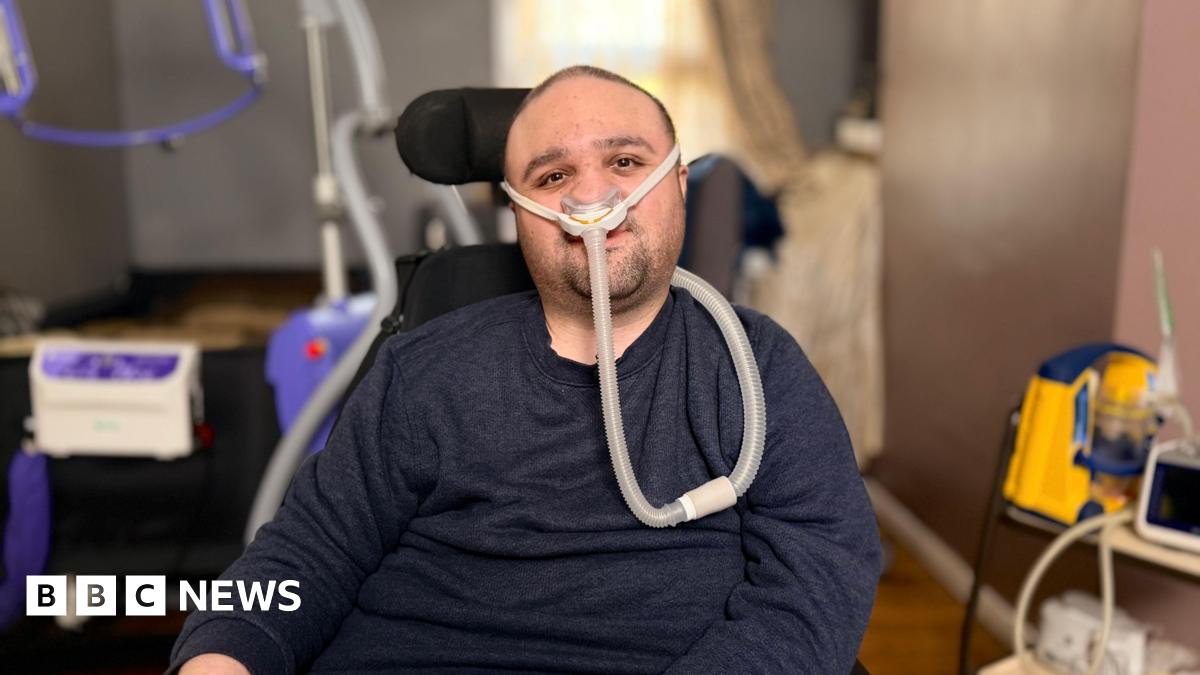
He previously had a personal health budget (PHB) – NHS funding designed to give people more flexibility to create the support they need to live their life. But it was terminated by the ICB, which is responsible for planning and funding local health services.
Mehta believes his care board wants him to accept a model of care that is cheaper or more restrictive than the one he says he actually needs.
He told the BBC he is now being “pressured” by the NHS to go into a care home, instead of back to his family home, where he had a job, went to football matches and saw his friends.
Mehta says the support he would receive in a care home would make his life much more restricted.
“I feel like they see me as the person that needs too much care and support – more than they want to give.”
NHS South East London ICB said they “strongly refute any suggestion that decisions in this case have been driven by cost.”
The BBC has seen letters to Mehta suggesting that if he did not accept the offer of a care home he may be charged daily rates for staying in hospital.
If he self-discharged, he says he was told all his care would be terminated.
“I’m stuck between a rock and a hard place,” Mehta says. “There are moments when I genuinely fear I’ll never leave.”
NHS South East London ICB did not respond to these specific allegations when approached by the BBC.
The BBC has heard from other disabled people who say they too are being left “stranded” in hospital as disputes over their NHS-funded care outside of hospital go on for months.
Campaigners and patients believe care boards are increasingly scrutinising complex care packages, such as Mehta’s, to save on costs.
This means he, and others, are being pushed towards more traditional, risk-averse options, like agency care or a care home, say complex care experts.
Although Mehta’s ICB has denied their decision-making in his case has been driven by cost, the BBC has seen a letter to Mehta’s representative from NHS South East London’s lawyers, citing “cost-effectiveness” as a reason why a package of care in someone’s own home might be refused “in some instances”.
A former NHS leader, Frances Tippett, said that for some disabled people needing the highest support, “it feels like the clock is being turned back” away from support that is planned together with the person living it and towards more restrictive types of care.