
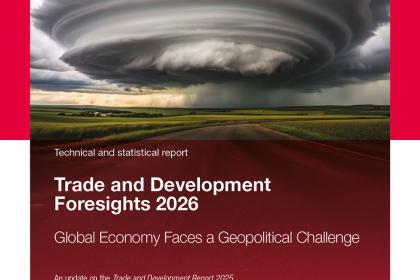
The global economy entered 2026 stronger than expected, supported by dynamic trade, expanding industrial production in developing economies and strong investment linked to artificial intelligence (AI).
But the outlook changed quickly after geopolitical tensions intensified in late February 2026. Conflict in the Middle East disrupted energy markets, financial conditions and major shipping routes, including through the Strait of Hormuz, a critical route for global oil and gas trade.
The report warns that global growth is now expected to slow as uncertainty weighs on trade, investment and supply chains. In real terms, world merchandise trade growth is projected to fall from 4.7% in 2025 to between 1.5% and 2.5%.
The report highlights three growing concerns:
Slower growth and rising living costsHigher financial instability in developing economiesDeeper disruptions to global trade and financeGeopolitical tensions are now the main global risk
The report points to a major shift in global risks. In 2025, uncertainty centred mainly on trade policy. But by early 2026, geopolitical tensions had become the main concern, especially as armed conflict in the Middle East raised concerns over energy flows and maritime transport through the Strait of Hormuz.
Armed conflicts worldwide have reached historic levels, putting pressure on an already fragile global economy.
The outbreak of conflict in the Middle East in early March 2026 triggered immediate economic shocks:
Oil prices surged by more than 60%Gas prices more than doubledFinancial volatility rose sharply across bond, equity and currency markets
Developing economies are under mounting pressure
Many developing economies are especially vulnerable because they depend heavily on imported fuels, food and fertilizers. Higher energy prices and disruptions linked to the Strait of Hormuz increased import costs and added pressure to inflation and external balances.
Some developing countries have introduced measures to manage rising fuel costs, stretch supplies or cap prices. These include Bangladesh, Brazil, Egypt, Ethiopia, India, Indonesia, Mexico, Pakistan, Philippines, Sri Lanka, Thailand and Viet Nam.
Financial conditions also worsened:
Developing country currencies weakened against the dollarEmerging market equities fell by more than 12% between 28 February and 29 March 2026External sovereign bond yields increased for both emerging and frontier-market economies
The report warns that frontier-market economies are especially vulnerable in a prolonged conflict because their financial markets are smaller and less liquid.
AI-driven trade remains strong, but momentum is slowing
World merchandise trade started 2026 on a strong footing. Chinese exports grew by more than 20% in dollar terms in January and February compared with the same period a year earlier. Global air cargo expanded by 7.2% in January and 11.6% in February. Seaborne cargo grew by 5.3%.
But much of the growth was concentrated in AI-related products such as servers, semiconductors and high-performance computing equipment. These categories recorded especially rapid growth across East Asia, Northern America and parts of Europe.
In the United States, automatic data processing machines accounted for about three quarters of nominal import growth in 2025. In China, growth in these imports almost offset declines in other imported products.
The report also highlights the growing disruption caused by tensions around the Strait of Hormuz. Reduced shipping volumes, rising insurance costs and higher risk premiums pushed up maritime freight rates, especially for oil and liquefied natural gas carriers.
Clean energy investment is becoming a question of economic security
The report says the crisis strengthens the case for faster investment in renewable energy and critical technologies. A comparison of newly commissioned utility-scale electricity capacity showed that renewables were already cheaper than the cheapest new fossil fuel alternative in 91% of cases in 2024.
Yet investment remains deeply uneven.
For example, Africa is home to 60% of the world’s best solar resources but received only 2% of global clean energy investment in 2024.
The report calls for stronger national and international policies to:
Accelerate investment in renewable energyExpand production of critical industrial components such as chips, batteries and electric motorsReduce exposure to future energy and geopolitical shocksA more fragile global outlook
Trade and industrial production remained resilient through 2025 and into early 2026, but that momentum is weakening.
The report concludes that the global economy remains highly exposed to geopolitical shocks, energy disruptions and financial instability. It calls for stronger investment in clean energy and critical technologies to build a more resilient and stable global economy.