
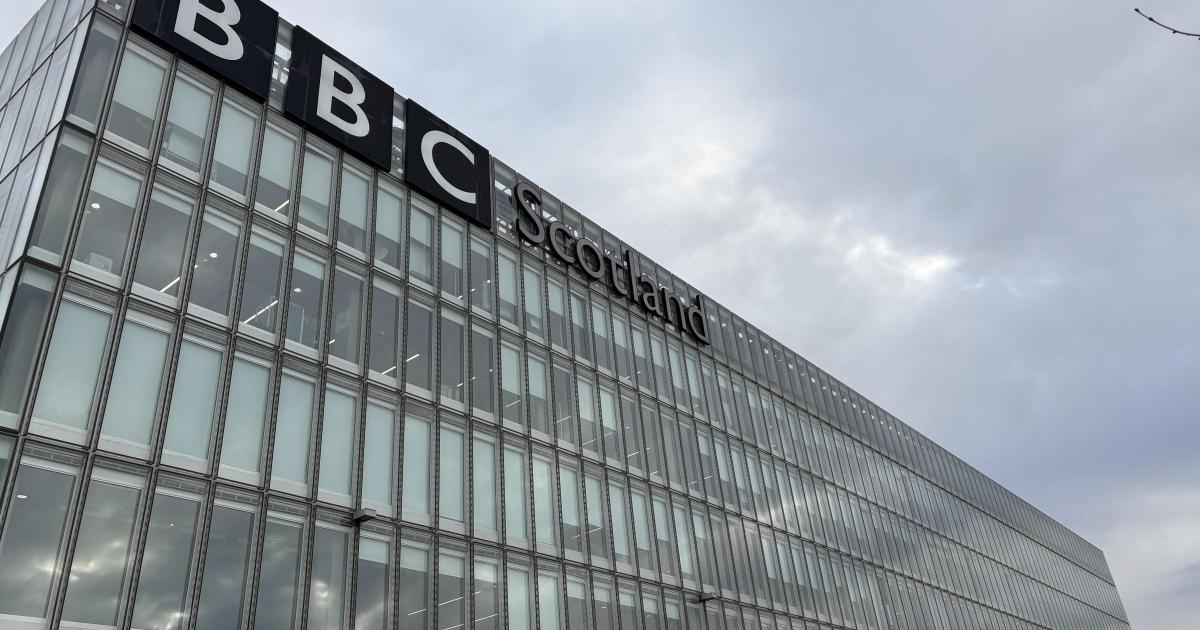
It can be revealed that under Ofcom rules, productions can qualify as Scottish without most spending or staff being based in Scotland, with the BBC acknowledging some shows can qualify “solely” because of the location of their production office.
And a memo seen by ministers from Screen Scotland, says that all a company may need is a small Scottish office — potentially staffed by just one person — for the production to qualify under Ofcom’s system, even if much of the real work and money remain elsewhere in the UK.
The revelation has ignited fresh debate over how the BBC measures its commitment to Scotland — with some warning the system is being used to inflate production figures while real jobs, money and creative control remain concentrated in London.
Research commissioned by the body tasked with growing the nation’s film and TV sector found that only five of the top 15 producers of programmes classed as Scottish between 2014 and 2022 were actually headquartered in Scotland. The remaining 10 were based in London but still qualified under Ofcom rules because they operated what is known as a “substantive base” north of the border.
The same research also found that 80 per cent of episodes made for the BBC by those top producers were commissioned from London-headquartered companies.
Traitors was filmed in Scotland
The briefing from David Smith, director of Screen Scotland which has been circulated to some MPs, warned that the current rules allow the BBC to “fully comply” with its Scottish production obligations “while commissioning projects which provide limited employment in Scotland, have little economic impact within the Scottish economy and which do not directly support Scotland’s creative economy”.
According to Screen Scotland, a so-called “substantive base” “need not be the headquarters of the company, it need not be where the production team is based, and it can be staffed by as little as one person if they nominally fulfil the requisite roles.”
It accuses the current system of allowing the BBC to “fully comply” with its quotas while commissioning projects that provide “limited employment in Scotland”, have “little economic impact” and “do not directly support Scotland’s creative economy” .
At the centre of the row is the BBC’s obligation to produce and spend outside London. Under its operating framework, the broadcaster must ensure a significant proportion of its network TV output comes from the nations and regions, a policy designed to spread jobs and investment across the U But the rules governing how that is measured — overseen by Ofcom — allow productions to qualify as “Scottish” if they meet just two out of three criteria covering spend, staffing and location of base.
That flexibility, designed to reflect the realities of modern TV production, is now at the heart of a growing industry storm.
The BBC itself has acknowledged the complexity of the system, noting that a programme can qualify as Scottish “solely on account of the location of its production office” — even if much of the budget is spent elsewhere.
Read More articles by Martin Williams
Scottish Enterprise arms summit role sparks backlash after Gaza emails
Scots regulator pushes non-drug dementia care amid sedative safety concerns
ScotGov’s four-vessel award plan faces legal and workload concerns
The concerns have been raised by Screen Scotland, which is funded primarily through the Scottish Government and the National Lottery, and has helped promote the nation as a filming destination for blockbuster productions ranging from Outlander to The Batman and Indiana Jones and and Indiana Jones and the Dial of Destiny.
The issue has become increasingly politically sensitive following scrutiny of BBC productions including The Traitors, filmed at Ardross Castle in the Highlands.
Questions have been raised at Westminster after concerns emerged over how many Scotland-based workers were actually employed on the hit reality series.
And one parliamentary committee asked Screen Scotland to give its assessment of the BBC’s progress in supporting Scotland-based television professionals and increasing production spending in Scotland.
Mr Smith’s briefing has now intensified pressure on both the BBC and Ofcom ahead of negotiations over Charter Renewal — the process that determines the broadcaster’s future responsibilities and public service obligations.
Mr Smith argued that the BBC’s approach over the past decade has relied heavily on commissioning London-based suppliers before moving enough production activity to Scotland to satisfy Ofcom’s rules.
(Image: BBC)
The briefing cites research it commissioned from Oliver & Ohlbaum examining productions classified as Scottish between 2014 and 2022 found that 97 per cent of episodes counting as Scottish produced by the top qualifying companies were commissioned either by the BBC or Channel 4.
But Screen Scotland argues the BBC and Channel 4 adopted sharply different approaches.
While three of the four companies most heavily used by Channel 4 were formed and headquartered in Scotland, only two of the 11 major suppliers used by the BBC were Scottish-based firms.
The memo claims that the approach has helped reinforce London’s dominance over the UK television industry.
“This approach to BBC commissioning against its Out of London quotas was not restricted to the BBC’s commissioning against its Scottish output quotas, and it is a major factor in why London remains the UK’s only IP rich TV/media cluster of scale in 2026,” Mr Smith said. The BBC itself has publicly acknowledged the complexity of the system.
In a memo published last year, the broadcaster said: “Ofcom’s criteria for what counts as an ‘out of London’ production is complex.” BBC statement on regional production rules The BBC added that productions can qualify through different combinations of spending, staffing and production-office location, and acknowledged that “in a small number of cases” a programme could be categorised as Scottish “solely on account of the location of its production office”. The corporation has also pledged to strengthen local spending requirements by ensuring qualifying regional productions invest at least 70 per cent of their budgets locally.
But Mr Smith argued that still leaves the BBC free to focus on London-based suppliers.
“Our concern has long been the lack of BBC origination in Scotland against its Scottish output quotas,” the briefing states.
It adds that Screen Scotland hopes the BBC will focus more on “the creative origination of its Scottish qualifying output from within Scotland, rather than concentrating its efforts on displaced production from London-based suppliers.”
The document also argues that the concentration of commissioning power and senior management roles in London is “limiting UK-wide creative sector growth” and “preventing the development of IP-rich creative clusters elsewhere”.
One industry insider said: “The real issue here is not whether the BBC has technically broken any rules — but whether the rules themselves have drifted so far from their original purpose that they no longer deliver meaningful economic benefit to Scotland.
“Ofcom’s regional production system was designed to decentralise the UK television industry and spread jobs, spending and creative power beyond London. But it is clear that broadcasters can satisfy those requirements in a highly technical way while still concentrating commissioning power, ownership and long-term value in the capital.
“There is a big difference between productions being filmed in Scotland and Scotland developing a self-sustaining television industry with long-term economic and creative power.”
The remarks land at a crucial moment for the broadcaster with the BBC’s Royal Charter currently under review, opening the door to major changes in how the corporation operates.
At the same time, ministers have repeatedly pledged to spread economic growth beyond London and strengthen creative industries across the nations and regions.
A BBC Scotland spokesman said: “Our commissioning strategy has been a major driver of the development of the television production sector in Scotland. Powered by around £1bn of BBC investment in network production in Scotland since 2014, we have made programmes loved by audiences, such as Shetland and Vigil, with new dramas including Counsels, chronicling the lives of young lawyers, the comic thriller, Grams, and a second series of Rebus, all set to air in the near future.
“The quality and economic value of titles such as these were not as obvious in the O&O research, as it was focused more on the number of episodes produced rather than the value of them to Scotland. Our funding of network productions in Scotland has helped the creation of hundreds of jobs and boosted inward investment which has led to overall growth in the sector.”