
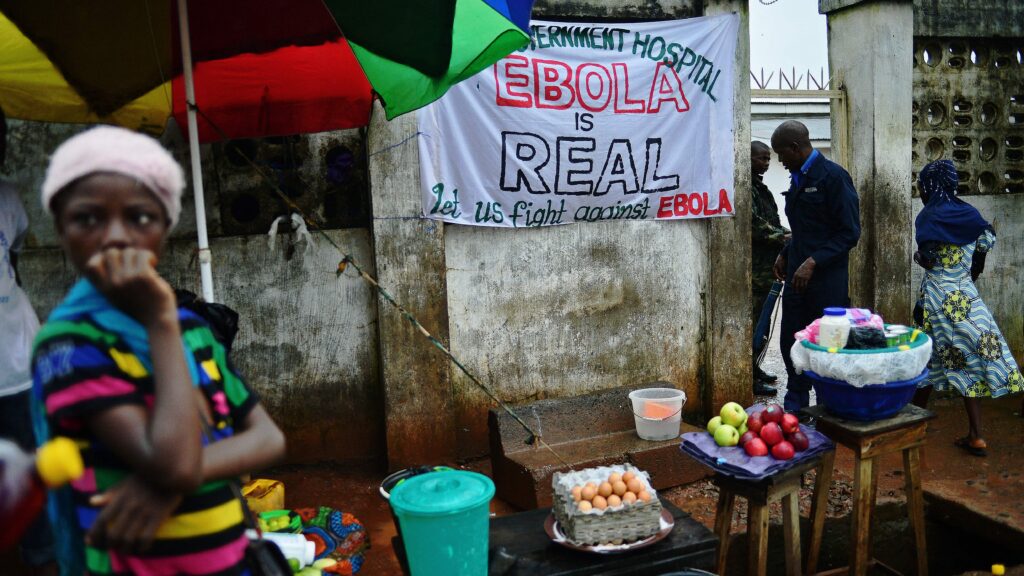
Amid another Ebola outbreak, hundreds of Africans are sick, displaced, fearful, or dead. Health care workers across Central Africa are once again caring for patients in overstretched hospitals with limited supplies, uncertain staffing, and enormous personal risk. Yet, as has happened before, the story has suddenly become about an American — in this case, a missionary and physician who became infected.
His suffering matters. But it’s frustrating to watch public attention during Ebola outbreaks gravitate toward the Western aid workers who become infected, while the local health care workers who sustain the response under far more difficult conditions receive far less recognition. Many work longer, with fewer resources and greater personal risk, yet their suffering remains largely invisible beyond the communities they serve.
After a critique from Rubio, WHO defends work on Ebola response
I know that shift firsthand. In December 2014, after months caring for Ebola patients in Sierra Leone, I returned home and became a suspected Ebola patient myself. For the first time I understood, from the inside, what my patients must have faced: the isolation, the loss of control, the feeling of being seen as a danger rather than a person.
For months, I helped run an Ebola Treatment Unit (ETU) in Sierra Leone during what is still the largest Ebola outbreak in recorded history. I cared for hundreds of patients, each leaving behind stories and images permanently etched into my memory.
I returned to the United States on Christmas Day, the frigid Midwestern air hitting my face as I walked out of the airport carrying my bags. Among my most treasured possessions was a lapa — a wraparound skirt — with handprints of survivors from our ETU, the people who had endured unimaginable suffering and lived. To this day, it remains one of my most prized possessions, a lasting reminder of resilience, humanity, and the profound impact of that experience.
 The lapa the author brought home from Sierra Leone in 2014.Krutika Kuppalli
The next morning, the local health department arrived to review the rules of home quarantine: twice-daily temperature checks, do not leave the house, do not leave the state.
Later that afternoon, I developed sinus pressure. At first, I ignored it. I was exhausted, dehydrated, jet-lagged, and emotionally drained. As the day went on, the pressure increased and my symptoms worsened. Eventually I checked my temperature: 100.8 degrees Fahrenheit.
As a physician who had spent months caring for patients with Ebola, I was confident I did not have the disease. I understood the nature of my exposures — the patients I had cared for and whether there had been any breach in protection. I had rigorously followed strict personal protective equipment (PPE) protocols and underwent supervised donning and doffing procedures designed to prevent infection.
I also knew Ebola intimately from both a clinical and personal perspective — I had seen hundreds of cases firsthand and understood how the disease typically presents, including the progression of fever, profound fatigue, gastrointestinal symptoms, bleeding complications, and rapid clinical decline.
U.S. bans entry from Ebola-affected countries as American patient is identified
Still, when my fever appeared, I knew I could not ignore it. There had been intense public scrutiny, fear, and national debate in the U.S. surrounding Ebola and returning health care workers. I did not want it to appear as though I was trying to circumvent the very public health policies and procedures designed to protect others. I understood my responsibility to report my symptoms immediately and follow the system frontline responders themselves had asked the public to trust.
After notifying public health, discussions quickly escalated among local, state, and federal authorities. Given my unique position as a physician and patient, I was permitted to listen in on some of those conversations. I could hear the uncertainty in real time: Should I stay home? What if I deteriorated? Could I expose others? Could I have both Ebola and another infection? Ultimately, they decided I would be admitted and be evaluated for Ebola.
Late that night, an ambulance arrived outside my apartment. I pleaded with responders to let me walk out quietly. The crew would be protected regardless, and I worried a public hazmat scene would unnecessarily alarm neighbors. They agreed.
I stepped into the cold darkness and saw two EMS personnel in full-body protective equipment waiting beside the ambulance.
I stepped into the cold darkness and saw two EMS personnel waiting in full-body protective equipment waiting beside the ambulance.
When we arrived at the hospital near midnight sirens blaring, another group of health workers in PPE was waiting. I remember the wheelchair coming toward me and the dozens of people staring as I was rushed into the isolation unit. In that moment, I no longer felt like a physician or a person — I felt like a threat.
My room in the isolation unit had a large observation window where they could watch and monitor me. There was little privacy — not to change clothes, use the bathroom, or even to sit quietly with my thoughts. I understood why I was there; isolation was medically justified, and I would have made the same call had I been the physician on the other side of that glass. But the way we isolate people is a choice, and it has consequences.
First hantavirus, now Ebola: What two outbreaks reveal about global preparedness
As testing continued overnight, I thought about the extraordinary resources being mobilized for me: the ambulance, PPE, isolation unit, laboratory testing, and personnel. I could not stop thinking about my patients in West Africa who often lacked basic supportive care, IV fluids, medications, adequate staffing, or reliable electricity. The contrast was impossible to ignore.
What haunted me most was not the fear of a positive result. It was realizing, for the first time, what my patients in Sierra Leone may have felt: isolated, watched, and stripped of control. Until then, I had experienced the outbreak from the clinician side of the isolation barrier. Now I was on the other side of the glass.
Eventually, the results returned: I was infected with a virus that causes the common cold, not Ebola, exactly as I had suspected. Although I was medically OK, the experience changed me.
For years, I believed the trauma I carried came solely from my time in Sierra Leone — watching countless patients die before me, from the images of patients slumped over beds too weak to move as the virus ravaged their bodies, and from the little girl who survived Ebola only to lose both of her parents. Those memories followed me home and replayed themselves at night while I sat alone in quarantine trying to process the scale of suffering I had witnessed.
Over time, however, I realized the trauma also came from what happened after I returned home: the isolation, the fear, and the experience of suddenly becoming someone people viewed as dangerous. The trauma was not singular. It was layered. There was the weight of what I had witnessed in West Africa, but there was also something harder to name: the disorientation of returning to a country that mobilized enormous resources around my single suspected case. Meanwhile, the people I had just left behind — hundreds of patients and dozens of local health care workers — received only a fraction of that attention and care.
During outbreaks, we often celebrate health care workers as heroes while failing to reckon with the psychological toll of what we ask them to endure. We praise their sacrifice publicly but frequently abandon them emotionally once the crisis fades from the headlines. And too often, we only pay close attention when the suffering feels familiar to us — when the patient is American, European, or otherwise close to home.
I want to say clearly: I was one of the lucky ones. I was American. I spoke the language. I had professional credentials that gave me standing to push back. I eventually had a colleague who could drive me home.
Many health care workers served longer, harder deployments than mine — Sierra Leonean nurses, Guinean contact tracers, Liberian community health workers — and carried equal or greater burdens, yet Americans rarely heard their stories. Some of them died. Those who survived often had no institutional support, no mental health resources, no colleagues writing op-eds about their experience. Their trauma was real, but because they were African and far from the cameras, it largely went unnamed and unacknowledged.
That is why what is happening now in the Democratic Republic of Congo matters so deeply. As another Ebola outbreak unfolds, we cannot repeat the mistakes of the past — valuing some lives more visibly than others, focusing only when a person from a high-income country becomes infected, or treating frontline health care workers as expendable once the headlines fade. The doctors, nurses, laboratorians, burial teams, and community health workers responding in Congo today deserve more than our attention in moments of crisis. They deserve sustained investment, protection, mental health support, access to high-quality care, and the assurance that the world will not abandon them while asking them to stand between Ebola and the rest of us.
Because behind every person in PPE is a human being carrying the weight of what they have seen. And long after outbreaks end, they carry those memories with them forever.
Krutika Kuppalli is an infectious diseases physician in Dallas. Her work focuses on emerging infectious diseases, outbreak response, vaccine policy, and clinical care of complex infections. She has extensive experience with Covid-19, mpox, and Ebola, including working for the World Health Organization.