
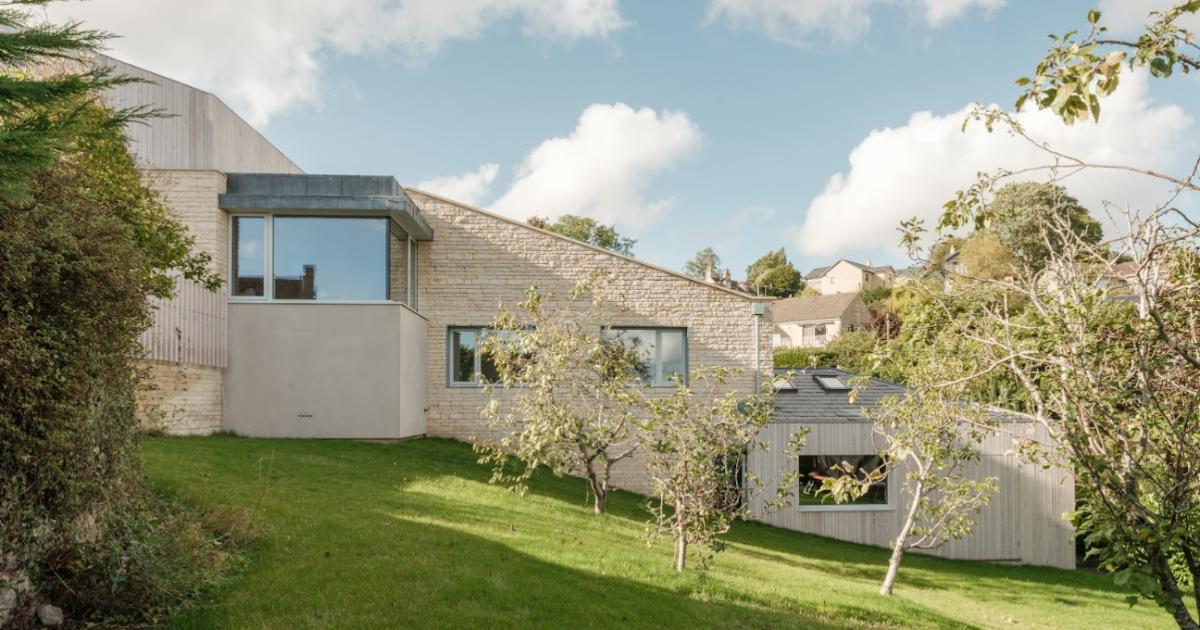
Sky House, designed by Klas Hyllen Architecture, whose practice is based in Bradford on Avon, took home a RIBA South West and Wessex Award 2026, and the RIBA South West and Wessex Sustainability Award 2026 at Royal Institute of British Architects’ (RIBA) South West and Wessex awards ceremony on the evening of May 7.
The home is described as “a modest stepped 1970s bungalow nestled into a [South West] hillside,” having been renovated by the architects with a strong focus on environmental principles.
According to the firm’s own description of the home, “the vast majority of the original building fabric has been retained. Layers of new insulation and re-cladding have transformed both the house appearance and performance.”
The description continues: “Designed to achieve a 90 per cent reduction in operational energy use, the project bettered this on completion, and in its first year of use operated on only 36kwh/m2/year.
“All residual energy demand is met through a fossil-free air-source heat pump, whilst an MVHR system ensures consistent indoor temperature, excellent air-quality and stable humidity levels throughout the year.”
Describing the design concept behind the project, Klas Hyllen says: “The clients approached KHA wanting to transform a tired 1970s dwelling to better suit modern family life and to create a home environmentally fit for the 21st century.
“Within its protective new envelope of super-insulated walls and triple-glazed windows, the house now offers exceptional thermal performance while preserving the original structural core.”
The south west home before the transformation. (Image: Dave Watts Photography/Klas Hyllen)
Full access to all of our articles online and on the app, fewer adverts, a better reading experience, exclusive competitions and more – all for less than the price of a cup of coffee. ☕️Subscribe now! – https://t.co/t7A1ayW7mR pic.twitter.com/Dk1fvaFm1K
— Wiltshire Times (@wiltshiretimes) April 13, 2026
Alongside Sky House, a home built from rammed earth, Passivhaus student housing for the University of West England, and the transformation of a former concert hall in Bristol, were among the 11 winners of the 2026 RIBA South West & Wessex Awards.
This year’s cohort is particularly significant as the awards mark their 60th anniversary. Since 1966, the RIBA Awards have recognised the best architecture across the UK, capturing the shifting expectations of what architecture can contribute to society.
The 2026 South West & Wessex awards were announced at a ceremony this evening (7 May), at which Bristol Beacon by Levitt Bernstein was named as winner of RIBA South West & Wessex Building of the Year Award 2026.
The jury praised it as a “remarkable civic achievement and a testament to the dedication of a committed client, an exceptional team of architects and engineers, and a city that chose to invest in its cultural future by the reinvention of its past.”
The winning projects were selected by an expert jury, who visited all shortlisted projects.
The outside of ‘Sky House’ post-renovation (Image: Dave Watts Photography/Klas Hyllen)
RIBA South West and Wessex jury chair, Sam Goss, founding director at Barefoot Architects, said: “Visiting the Southwest and Wessex region’s award-winning projects was a powerful and often moving experience.
“A unifying thread across the winners is their engagement with a continuum of time. Many buildings were neither wholly old, nor new – but rather a careful weaving of historic fabric with contemporary intervention across buildings, landscapes and cityscapes.
“Together, they present a compelling picture of architecture in the region as thoughtful, responsive and deeply rooted in space and time.
“Indeed, these outstanding projects show that to build well today is to operate within a trajectory; balancing past, present and future needs with confidence, collaboration and care.
“The result is architecture that is sensitive, sustainable and richly engaging – uplifting places, people and the human spirit.”
RIBA president, Chris Williamson, said: “This is a landmark year for RIBA as we mark 60 years of our Awards and the impact of past winners on society.
“Over six decades, the Awards have charted a cultural journey across the UK, reflecting how architecture has responded to changing needs in education, industry, work and home life.
“Today, as in 1966, we celebrate architecture that sets new standards for how we live and shape our communities – and reminds us just how important it is to keep raising the bar.”