
Tree rings have become one of science’s best tools for tracking ancient solar storms. When the Sun hurls charged particles at Earth, the evidence ends up locked inside wood – detectable centuries later. Researchers have spent years chasing those signals.
The ones they’ve been catching are the giants. Mid-range storms – strong enough to kill an astronaut in space – were too faint for older measurements and were essentially invisible.

A team in Japan built a technique sensitive enough to find one hiding in 800-year-old buried wood.
Tracking a hidden storm
The clue came from Meigetsuki, the diary of a thirteenth-century poet and courtier named Fujiwara no Teika.
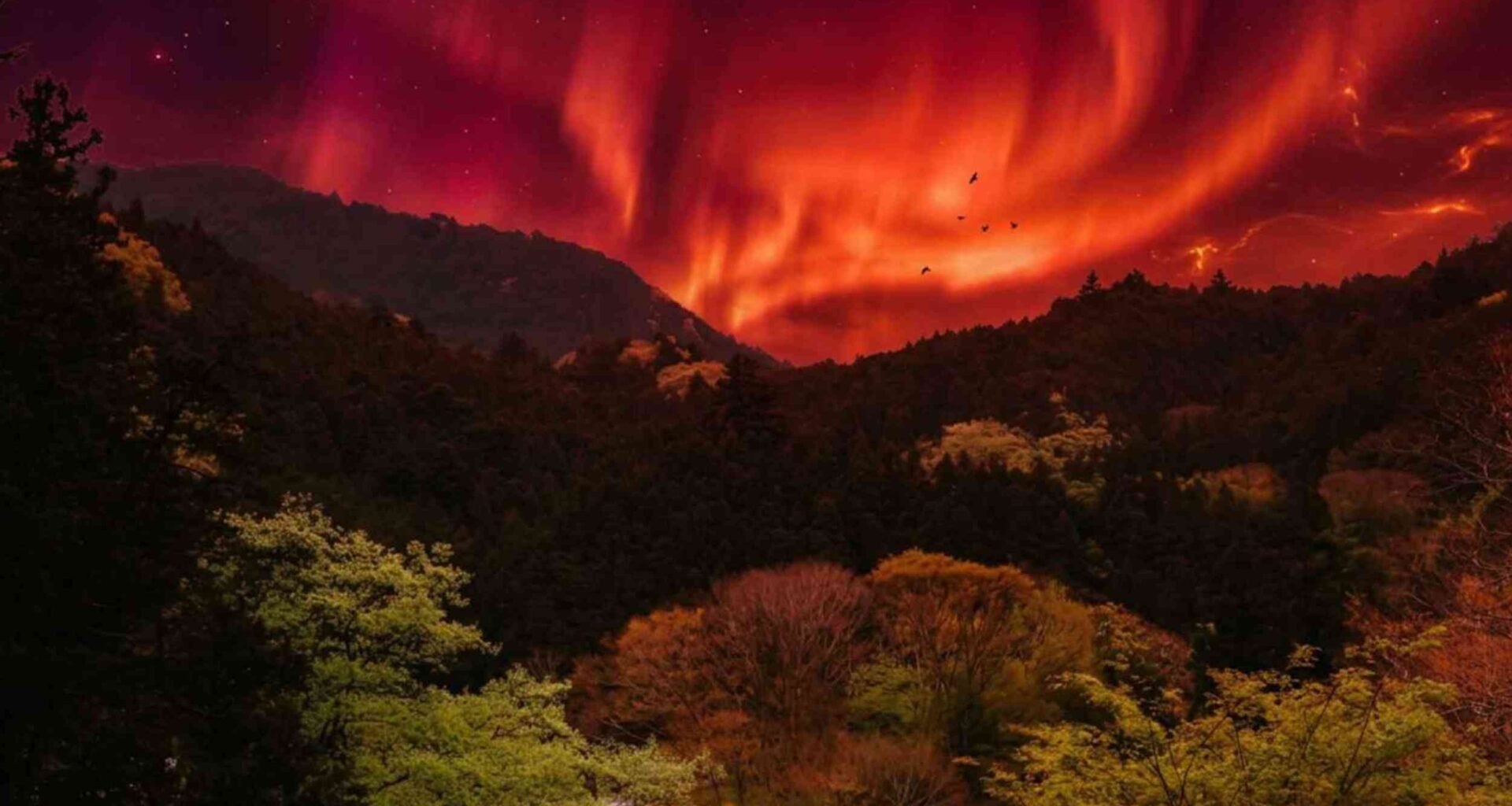
In an entry from February 1204, Teika described red lights flickering across the northern sky over Kyoto. Strange skies usually come from the Sun.
Hiroko Miyahara, a professor at the Okinawa Institute of Science and Technology Graduate University (OIST), wanted to know which solar event Teika had actually witnessed – and whether it left any trace beyond the page.
The biggest eruptions on the Sun fling charged particles outward as solar storms. When they reach Earth, they drag the aurora far south of where it usually sits and pump dangerous radiation into space beyond the planet’s magnetic shield.
A poet’s strange note
Teika’s diary mention was one of several medieval observations of red lights from Northeast Asia between 1200 and 1205.
Chinese chronicles described similar low-latitude auroras. Other court astronomers recorded unusually large sunspots. Something dramatic was happening on the Sun.
Words on a page don’t tell you the size of a solar event, and medieval calendars don’t align cleanly with modern ones.
To pin down what happened, Miyahara’s team needed a physical record from the same period.
Wood with memory
That physical record sits inside trees. When violent solar outbursts hurl high-energy particles into Earth’s upper atmosphere, they collide with air molecules and produce carbon-14. It is a heavier, radioactive form of carbon.
The carbon-14 mixes into the air, gets absorbed by living plants, and ends up locked inside each year’s growth ring. A single year’s ring is a sealed time capsule.
For more than a decade, the OIST team has refined a technique that measures the carbon-14 signal at a finer precision than older methods allowed.
The new method picks up smaller, more common flares that earlier work missed – events 10–30% the size of the largest cases, but still strong enough to harm astronauts.
Earlier tree-ring research had already used carbon-14 spikes to identify the most violent solar events in human history. Those smaller ones slipped through.
The signal in 1200
Buried beneath soil in Aomori Prefecture, in northern Japan, lay preserved logs of asunaro – a tree related to the Japanese cypress.
The team worked through the wood one growth ring at a time, measuring the carbon-14 captured in each year’s layer.
They found nothing unusual around 1204, the year Teika wrote about the red sky. The poet’s strange entry didn’t line up with a major solar event after all.
What they found instead sat a few years earlier. A clear spike appeared in wood that grew between the winter of 1200 and the spring of 1201.
Comparing those rings with regional climate patterns confirmed the timing. A Chinese record of a low-latitude red aurora from the same window matched.
The most likely explanation is a solar proton event – a burst of charged particles from one of those documented eruptions. It was not catastrophic, but it would have been dangerous to anything in space.
The Sun in 1200
Pinning down that date did more than identify a single storm. Year-by-year carbon-14 measurements let the team rebuild the rhythm of the Sun across the entire century around 1200.
Today, the Sun cycles between calm and active phases roughly every 11 years. Back then, the cycle ran only seven to eight years – a sign that the Sun was working at much higher intensity.
That storm appears to have struck at the peak of one of those short cycles. But some long-lasting low-latitude auroras in medieval texts seem to fall near a cycle’s low point – right when the Sun should be quiet.
“We’re excited to look further into what solar conditions could cause this,” said Miyahara, who called the pattern unexpected.
Stakes for Moon missions
The interest in this is not academic. In August 1972, between the Apollo 16 and Apollo 17 missions, a series of solar outbursts blasted radiation across the inner solar system.
If astronauts had been on the lunar surface that week, the dose could have been lethal. That intensity of space weather hasn’t struck a crewed mission since. Artemis flights and future trips beyond Earth’s magnetic field face the same risk.
Until this study, smaller solar proton events from the deep past were essentially invisible. No one had a way to find them.
With the higher-precision carbon-14 technique now in hand, researchers can map how often mid-size events occur, when they tend to strike, and what conditions produce them.
That changes the baseline for risk planning. The medieval poet who saw a red sky and reached for his brush could not have known he was filing a report for astronauts who would not exist for another 800 years.
The study is published in Proceedings of the Japan Academy, Series B.
—–
Like what you read? Subscribe to our newsletter for engaging articles, exclusive content, and the latest updates.
Check us out on EarthSnap , a free app brought to you by Eric Ralls and Earth.com.
—–