
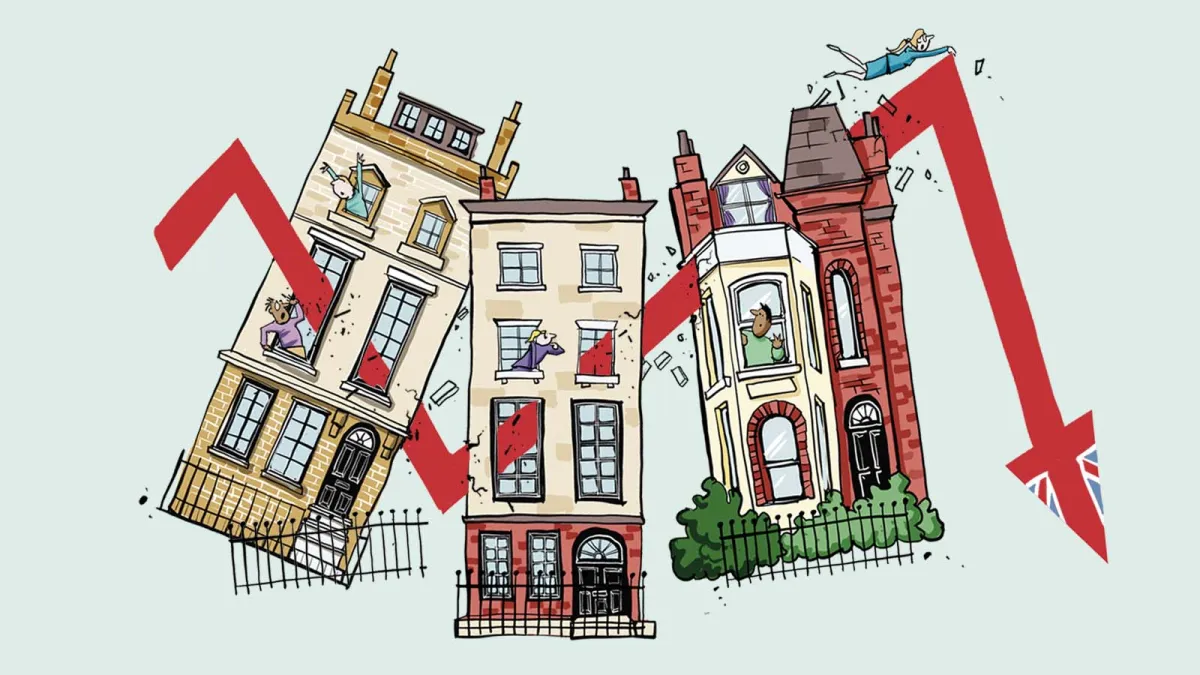
Borrowers in Britain love a short-term home loan, it seems, with 95 per cent of the mortgage deals taken out in March being fixed for five years or less.
But homeowners in other countries tend to pick deals that last ten years or more.
Only 410 out of a total 89,710 loans made by UK banks in March were fixed for more than five years — 0.46 per cent. The highest share of the market they have had in the past two decades was 6 per cent in June 2017, according to the industry body UK Finance.
And this tendency to pick short-term deals leaves us exposed. The war in the Middle East has hit homeowners in the UK sooner than Americans or Europeans. The average two-year fixed rate has gone up 0.91 percentage points to 5.75 per cent here while longer term rates in the US have risen by 0.38 percentage points.
Short-term fixes may be a good option for those who think they can overpay their loan to qualify for cheaper rates when the deal ends, or those who think that rates will eventually come down. But they can leave you vulnerable to rate rises and do not offer long-term certainty.
Money newsletter
The latest personal finance and investment news from our money team.
Sign up with one click
Someone who took out the average 2.21 per cent two-year fixed rate in June 2022 would have had to pay an average of 4.71 per cent on a new fix in 2024, according to UK Finance. On a £200,000 25-year loan, their monthly repayments would have gone up £268 to £1,136.
And if they had been hoping that rates would have improved by the time that deal ended, they would be in for disappointment. Fears of higher inflation have pushed up rates and the best two-year fix for someone remortgaging is now 4.55 per cent from Leeds Building Society, available at a maximum loan-to-value (LTV) of 65 per cent.
Rachael Hunnisett from April Mortgages, a Dutch-owned UK lender that offers five to 15-year fixes, said: “Most UK banks are funded in ways that make longer-term fixed rates expensive and riskier than offering short-term fixed rates. Homeowners are then left shouldering the majority of the risk of rate fluctuations.”
So why can’t we do what other countries do? We take a look.
US security
American borrowers like a fixed rate as much as the British do — 92 per cent of households were on them in 2019, according to the US Federal Reserve — but they tend to fix for 15 or even 30 years.
While UK home loans are funded from bank deposits, US mortgages are largely funded by investors, who are more attracted to the security of regular long-term returns.
US-style longer-term fixes are often seen as a shield against rate shocks, but there are drawbacks, particularly if you have to take one out when rates are high.
The main problem, though, is that these mortgages, unlike in the UK, cannot be taken with you to a new property if you move. Instead the mortgage has to be repaid and a new loan taken out, although you will not have to pay early repayment charges if you are moving. This lack of portability is something the Trump administration has reportedly looked at changing.
Thomas Ryan from the consultancy Capital Economics said: “30-year fixed terms mean US borrowers avoid the cash-flow shock faced by UK homeowners, who are often forced to remortgage at higher rates, but it creates a strong financial disincentive to move when rates rise.
“This has contributed to what is now known as mortgage rate ‘lock-in’, where housing supply is constrained because fewer homeowners are willing to sell, leaving the market heavily clogged up.”
Home sales plummeted when the Federal Reserve started to raise interest rates in March 2022, according to the National Association of Realtors, the US trade body for estate agents.
There were more than 5 million home sales every month from 2019 to July 2022 (excluding April, May and June 2020 during the Covid pandemic). Sales have not exceeded 5 million since, and hit a low of 3.47 million in September 2024.
Ryan said that the UK’s shorter fixed deals are better when rates are falling because borrowers can easily move to cheaper deals.
Even better in Europe
Homeowners in most of Europe, including Belgium, Denmark, France, Germany and the Netherlands, tend to take out fixed-rate mortgages lasting up to 30 years. But unlike in the US, long-term fixes in countries such as Germany and the Netherlands are usually portable. In Sweden and Norway, homeowner have multiple mortgages, with a mix of variable and fixed rates.
Mortgages on the Continent are often backed by insurers, pension funds or investors. If the UK wants to offer similar deals, mortgage lenders may need to introduce new funding models — something that is slowly happening.
April Mortgages has a 15-year fixed rate mortgage and all its loans are funded by an asset manager, while Perenna, another lender, has a 15-year mortgage rate backed by a type of bond investment widely used by banks in Europe. Kensington Mortgages, a specialist lender bought by Barclays in 2022, offers fixed rates lasting between 11 and 40 years, funded by the life insurer Rothesay.
In the UK, fears that inflation and interest rates will rise make it harder for banks to find investors to back long-term loans, while high early exit fees make them less attractive to homeowners.
Perenna’s 15-year fix at 60 per cent LTV, for example, has an interest rate of 6.1 per cent for someone remortgaging, and 5.96 per cent for someone buying a home. The early repayment charge is 9 per cent of the outstanding balance for the first five years, then falls gradually to 2 per cent in the last two years of the fix.
Andrew Montlake from the mortgage broker Coreco said: “When you speak to clients, it’s very difficult for some of them to think about where they’re going to be in five years, and certainly ten or 15. The fixed rates of that length often have big exit penalties too.
“But if the market changed, and there were long-term fixes with no penalties and which were well priced, things might change.”
Flexible Aussies
In Australia fewer than 5 per cent of loans are fixed. Most homeowners have variable rates that change with the Reserve Bank’s cash rate — which rose from 4.1 to 4.35 per cent this month.
But the Australian system offers homeowners the flexibility to offset their savings against their mortgage. According to the University of Sydney about 40 per cent of Australian mortgage holders have an offset deal, where money held in a linked savings account is deducted from your mortgage balance when interest is calculated, meaning you pay less. This perk is a lot more rare in the UK.
Aimee McLean from the Sydney-based broker Mortgage Matcher said: “You can save thousands a year in interest just by getting paid and not touching that money for a few days while it offsets the mortgage.”
Offset loans have largely disappeared in the UK since the 2008 financial crisis. Virgin Money and Intelligent Finance used to offer current account-linked mortgages, where your balance would save you interest on your home loan, but Virgin withdrew its account in 2009 and Intelligent in 2012.
Clydesdale Bank, now rebranded as Virgin Money, became the latest to pull out when it withdrew offset deals for new customers in October. Offset mortgages account for 1 per cent of new loans, down from 10 per cent in April 2008, and only a handful of lenders including Barclays, and Coventry and Yorkshire building societies still offer them.
If the UK didn’t reinvent its mortgage system entirely, then offering more offset mortgages could at least help the homeowners who have the savings to make them work.