
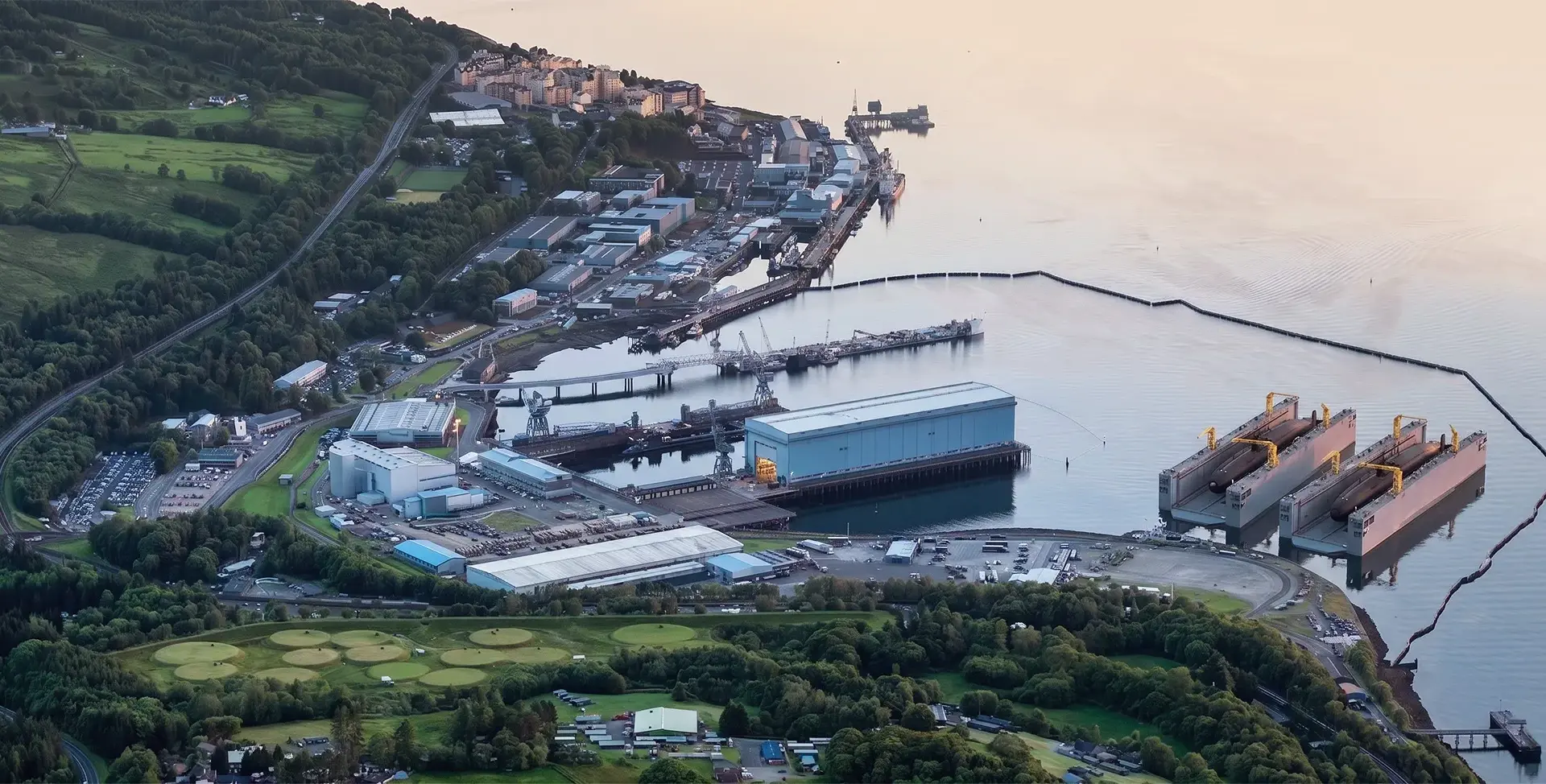
HM Naval Base Clyde is now the sole operating base for the Royal Navy’s entire submarine flotilla. A newly framed Clyde Transformation Programme is an ambitious upgrade project that must rebuild many aspects of the facility while at the same time sustaining ongoing submarine operations.
For most of its life, Faslane has mainly been regarded merely as a fixed backdrop to the submarines that sail from it, rather than as a system requiring major investment in its own right. The base was built in the 1960s for Polaris and the Resolution-class SSBNs, with a major addition in the late 1980s to support the second generation of Trident-equipped Vanguard-class SSBNs. Little of structural significance has changed since.
The high-voltage distribution network, utilities and waterfront services the site depends on are now around six decades old, and successive decisions to defer spending have left parts of the base in poor condition. This includes jetties, which need reconstruction to support Dreadnought and SSN-A class boats. Many assumed that the transition from Vanguard to Dreadnought would be straightforward, but the condition of much of the infrastructure demands major renewal rather than patching up or minor adaptations. Speaking at CNE 2026, Andy Tims, Deputy Director, Clyde Capital Programmes, said: “We’ve reached the end of the road. You can’t just fix it a bit and it’ll be fine.”
Similar redevelopment challenges will have to be overcome at RNAD Coulport, the nuclear weapons handling facility on Loch Long, to the west of Faslane, but no details are permitted in the public domain.
Untangling the knot
The programme is best understood as three strands drawn together under the umbrella now called the Clyde Transformation Programme. The first is the Clyde Infrastructure Programme, started in 2016 and made up of roughly 17 discrete projects delivering specific pieces of infrastructure across Faslane and the armament depot at Coulport. The second, formerly Clyde 2070 and now called the Transformation Programme, is a fundamental reassessment of everything the platform-focused work does not cover, from utilities and services to the high-voltage systems. The £1.8Bn Infrastructure Programme is the most mature, and it remains scheduled for completion in April 2032, intended to sustain the Continuous at Sea Deterrent, through to 2067.
The third is Programme EUSTON, a separate capability programme rather than an infrastructure one, which will provide new out-of-water engineering facilities built on the last undeveloped part of the site. The programme aims to deliver at least one, probably two, floating dry docks, more than doubling the base’s docking capacity. There was a floating dry dock secured at the southern end of the base until the 1990s, but the plan is for the new docks, along with shoreside facilities and connecting infrastructure, to be built at the northern end adjacent to the shiplift. Funding for EUSTON is awaited in the Defence Investment Plan.
Building before demolition
The defining problem is that there is only one submarine operating base and it cannot stop working while it is being rebuilt. Maintaining operations is the programme director’s primary duty, and reconciling that with a construction effort of this scale is the single hardest demand on the whole enterprise. The team’s answer is a detailed master planning exercise covering the entire base, intended to move the question from what can be squeezed into the available footprint to what the site should ultimately contain, and in what order it can be delivered without interrupting the deterrent.
Geography sets a hard limit on what can be done at Faslane. The site is hemmed in by the Gareloch on one side, the railway line on the other and high granite ground behind, leaving a long, narrow strip with almost no room to expand outwards. Usable space is scarce, something to be rationed rather than spent. The constraints are regulatory as well as physical, since the base operates at once as a harbour authority, an industrial site bound by health and safety law, a licensed nuclear site and a location where explosive weapons are stored, each layer adding its own rules to any change. Even the daily rhythm of operations is governed by tides and daylight, with the working day in a Scottish winter cut short by darkness arriving in mid-afternoon. The combined effect is that the base cannot build its way out of trouble, and every new facility has to be fitted into ground that is already occupied, which is why the order in which things are demolished and rebuilt requires careful sequencing.
The intention is to create a complete digital twin of the base. Many of the legacy facilities on the site are poorly documented and it will be a large task to acquire this data accurately, although new construction will be easier to add to the model. The digital twin can then be used to sequence the redevelopment itself as well as identify risks and inefficiencies, by simulating operations such as submarine movements, vehicle flows, logistics or security incidents.
An end to making do
For years, the naval base was treated, in effect, as a cost that could be trimmed to make individual platform programmes look more affordable, with resilience traded away in the process. The Second Sea Lord has stated that this era is over, and that the base must be treated as a capability in its own right with its own claim on investment, rather than as an accounting offset for the submarines it serves. The early evidence is a business case the programme has put forward that is more expensive than many expected, yet has been accepted within the MoD on whole-life grounds.
Choices about single points of failure that were once tolerated are now to be designed out, with questions asked about whether particular functions need to sit inside the wire at all or could be dispersed to reduce risk. Senior officers frame the change in stark terms, drawing on the argument made elsewhere in the RN that the country is no longer operating in peacetime conditions and must invest accordingly. Whether that resolve survives contact with future spending rounds is the real test, but for now, resilience and readiness are being written into investment decisions rather than bolted on afterwards.
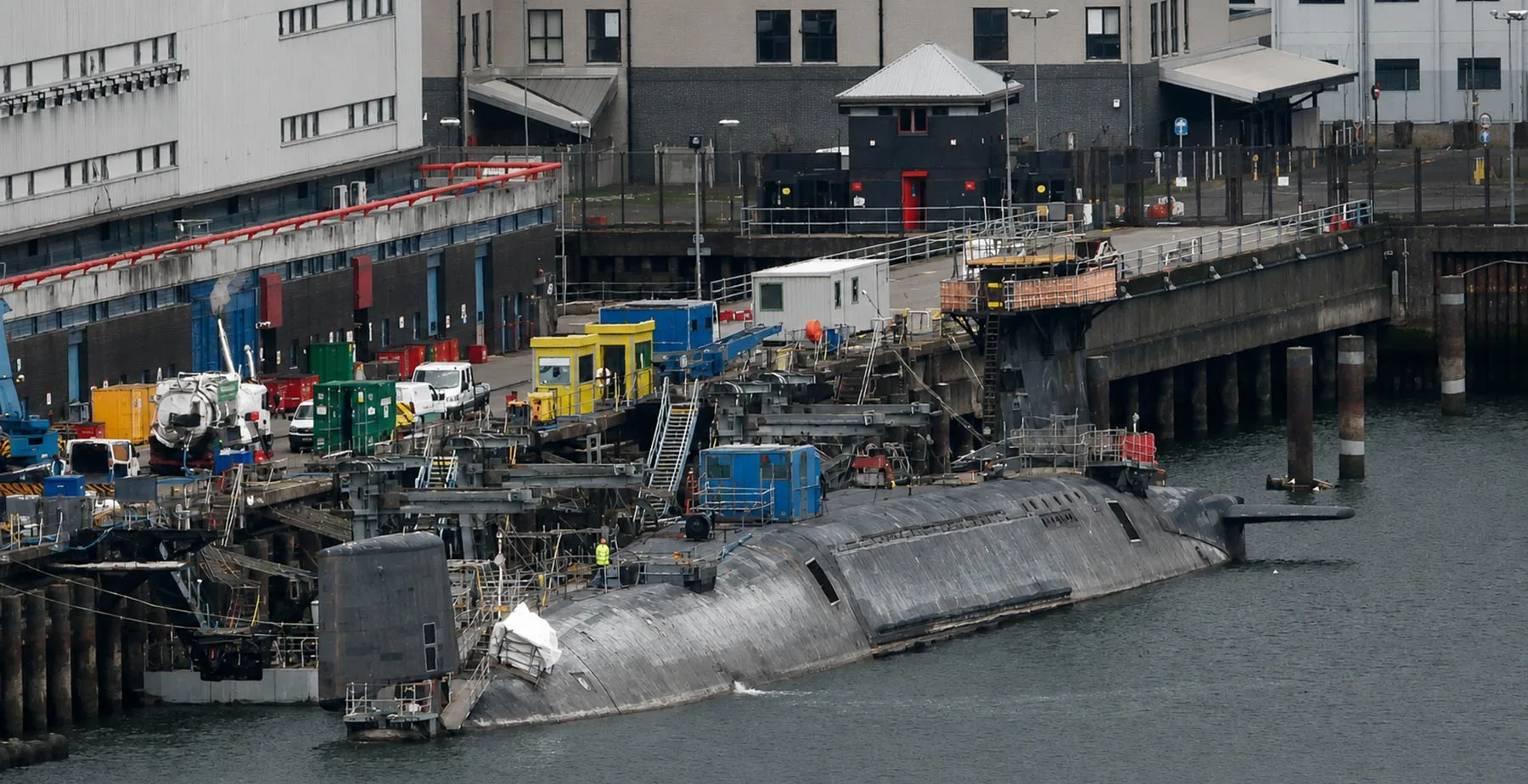 Vanguard-class submarine alongside undergoing maintenance (Photo: Chris Caine, May 2026).Risks
Four risks dominate the programme director’s assessment, and none of them is primarily about hardware. The first is planning and consent. Surprisingly, the MoD currently has no special dispensations to speed up the planning process, and major infrastructure schemes in the UK routinely require years to obtain consent. The political sensitivity around a nuclear site in western Scotland makes sustained engagement with the Scottish government, local authorities and regulators essential rather than optional. The second is the legacy of underinvestment itself, since assets in poor condition must be kept running and supported for another five to ten years before replacements arrive, adding complexity to every decision.
The third risk is sequencing, the constant balancing of change against the need to keep the base safe and operations flowing. The fourth is pace, limited by the availability of skilled people, not only in Navy teams but across the industry base able to support nuclear work, and compounded by recruitment controls and restrictions on external support. The remote location and a tight labour market add to the difficulty. The programme is deliberately not structured like a conventional MoD project, jointly sponsored at the level of the First Sea Lord and the Defence Nuclear Organisation, advised by senior figures who delivered major national projects, including the London Olympics. As we have long advocated, there is also intent to use a recent review of defence nuclear regulation to avoid the gold-plating that has slowed past work.
Faslane is the second largest single-site employer in Scotland and the nuclear sector alone added an estimated £1.5 billion to the Scottish economy in 2024. HMNB Clyde and its supply chain supported around 11,800 jobs in 2024 and the infrastructure programmes will see the number rise further.
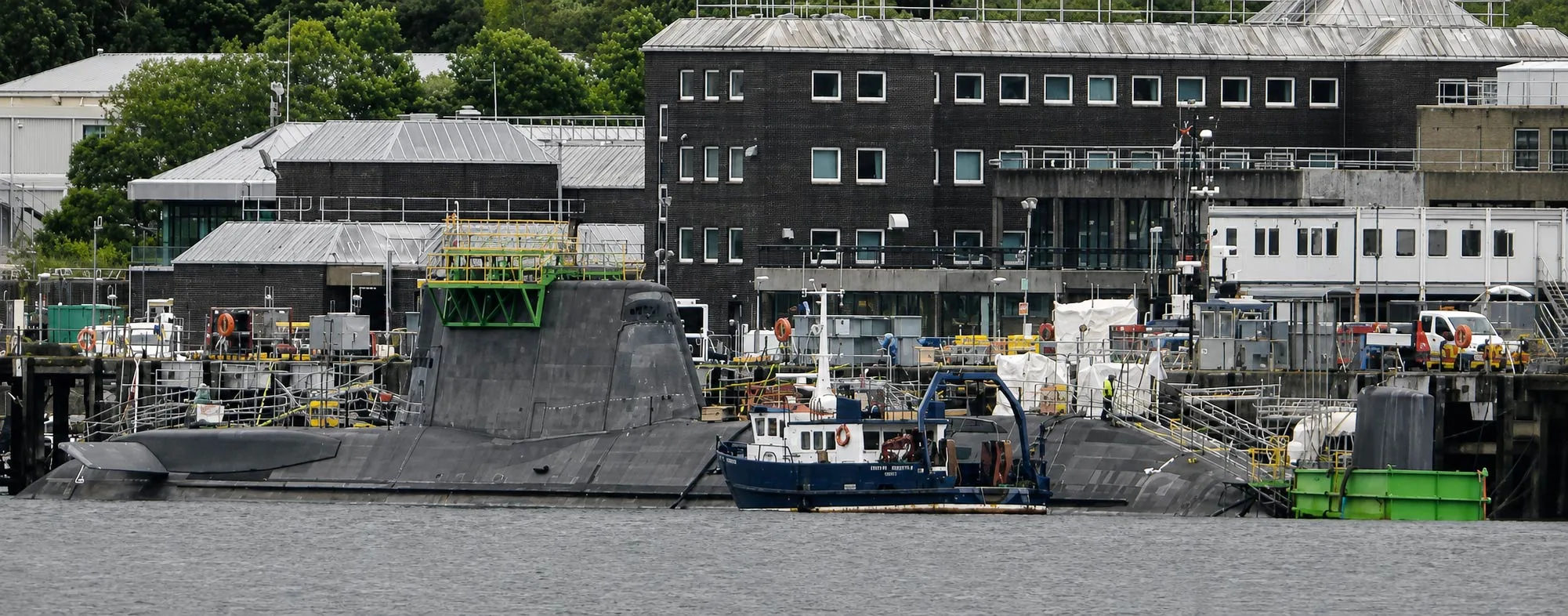 HMS Artful alongside in Faslane, more than 3 years since she last put to sea (Photo: Chris Caine, May 2026).Quick wins
While much of the transformation will be measured in years, ClydeX is a small innovation cell created on the recommendation of Director Submarines to make life better for base users in the near term. This is a recognition that submariners often feel unheard and that change can reach corners of the organisation that conventional management cannot. Long-term investment, however welcome, does little for retention in the short and medium term and people need to feel improvement now. In this instance, ‘X’ does not stand for experimentation but for multiplication, working with the organisation. New initiatives must, of course, fit within the base regulatory structure and wider plans, as Captain Paul Barker, director ClydeX, explained: “Bypass the system and you’re left with a white elephant.”
The method is to listen, then fix small things visibly and quickly. Riding the base bus and working the queue at the on-site bakery surfaced the real pain points, and when a sailor suggested lockers for personal electronic devices nearer the security zones, where phones must be handed in, they appeared soon after drawing on groundwork the team had quietly laid over two months. The single biggest request was better parking. A multi-storey car park was treated as the wrong answer since it would swallow scarce space to treat a symptom rather than a cause. Instead, the team is working with train and bus operators to cut the number of people who need to drive in at all, freeing space for the base to build on. The wider aim is a connected place with quick wins, such as digital visitor notification borrowed from problems already solved elsewhere. For more complex challenges, ClydeX can draw on partners with larger resources, including Navy Digital and UK Strategic Command.
The most visible proof that something better is coming is the £166 million Single Living Accommodation project, three new blocks for 639 personnel, with the first due to open in 2026 for trainees on the Submarine Qualifying Course, replacing some of the worst quarters on the base.
The Clyde transformation is not simply an engineering effort but also a problem of doctrine, sequencing and organisational discipline. Although funding appears less constrained than in many other areas of the RN, the harder questions are whether the base can be rebuilt without disrupting critical submarine operations, whether enough skilled people can be recruited and retained to sustain the effort, and whether the current determination to treat Faslane as a capability in its own right survives future pressure on defence spending.
Main image: Navy Lookout mock up showing approximate position of new floating dry docks