
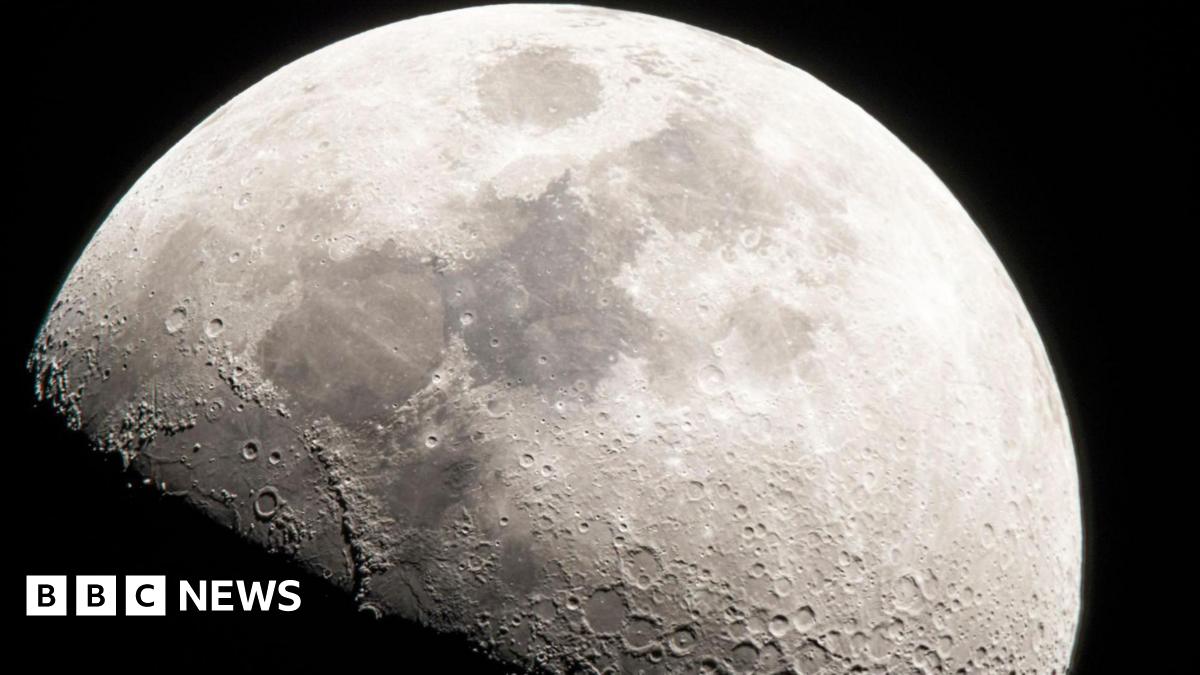
China is forging ahead with its own plans to land humans on the Moon by 2030.
On Monday it launched its Shenzhou-23 spacecraft, sending a crew of astronauts to the country’s Tiangong space station.
In March, Nasa announced a $20 billion programme to construct a permanent base powered by nuclear and solar energy at the Moon’s south pole by 2032.
Nasa administratorJared Isaacman said on Tuesday that the announcements mean the US will “never give up the Moon again”.
A base would allow the US to carry out scientific experiments, potentially mine valuable resources, and travel to Mars more easily.
But most experts agree that Nasa’s timeline is unrealistic.
Despite the US’s success in sending four astronauts around the Moon in its Artemis II mission in April, some scientists believe China is likely to be the next country to land humans on the lunar surface.
“It would not surprise me at all if China gets there first,” Dr Simeon Barber, Lunar Scientist at Open University, told BBC News, citing Nasa’s setbacks in securing a craft that can land humans on the Moon.
Nasa’s Ignition Moon Base programme has three phases.
Before humans travel there, the space agency wants to send robotic landers and hopping drones to explore and map the Moon’s challenging terrain.
Delivery vehicles would also be taken that could drive astronauts over the lunar surface and carry communications and scientific instruments.
On Tuesday, Nasa said companies including Blue Origin, Intuitive Machines, and Astrobotic have been awarded the contracts to build the machines.