

For decades, researchers operated under the assumption that living a long life was mostly a matter of circumstance. Diet, environment, access to healthcare, the occasional stroke of luck, these were the forces thought to steer the needle. Genetic inheritance, meanwhile, was treated as a secondary player, present but not decisive. That picture is now being significantly revised, and the implications reach well beyond the laboratory.
The question is not merely academic. Aging research draws enormous funding and public attention, and the direction of that research, whether scientists prioritize genetic mechanisms or environmental interventions, depends on how the science actually lines up. Getting the heritability estimate right, in other words, matters quite a lot.
A Figure Twice as Large as Previous Estimates
According to a study recently published in the journal Science, biologists Uri Alon and Ben Shenhar from the Weizmann Institute of Science in Rehovot, Israel, analyzed extensive data and used mathematical models to determine that genetic heritability could account for at least half of what influences human lifespan. The figure they arrived at, around 55%, is roughly double what the scientific literature had previously suggested.
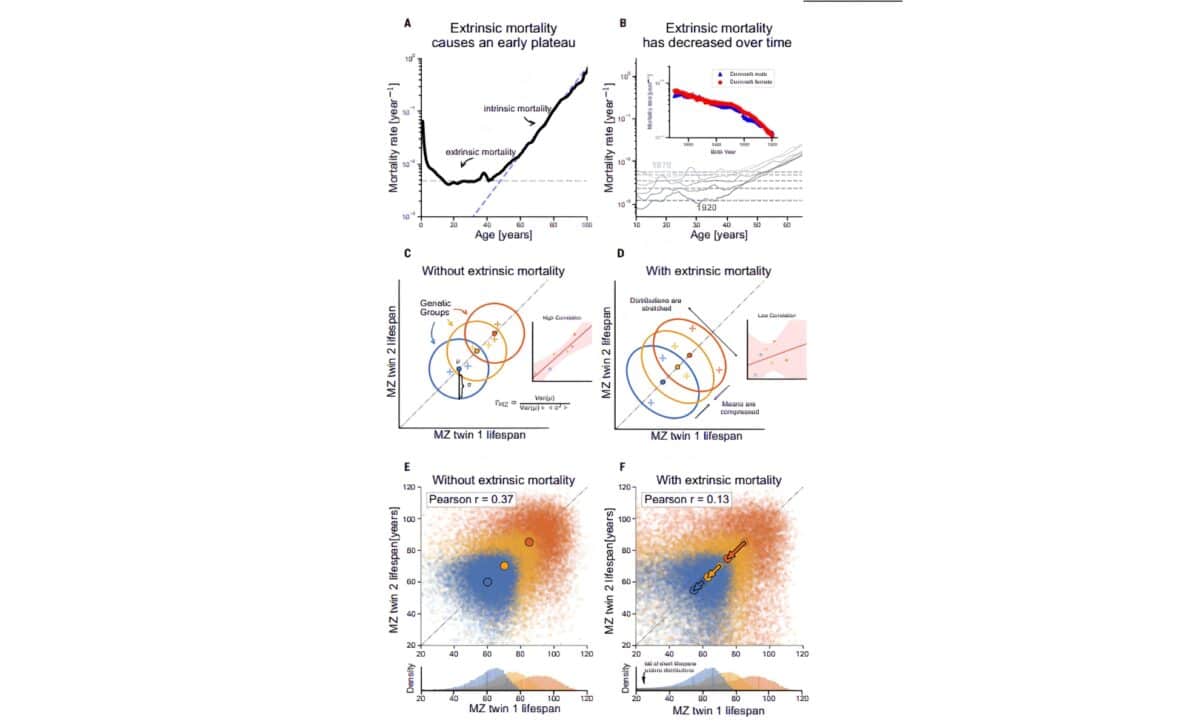 Extrinsic mortality masks life-span correlations in twin cohorts – © Journal Science
The researchers examined three separate twin studies, which followed twins raised both together and apart, allowing them to tease apart nature from nurture across different conditions. They also looked at a variable that, as they noted themselves, had not been systematically investigated before: the cutoff age, meaning the minimum age at which individuals had to be alive to be included in a given study. Both the cutoff age and the level of extrinsic mortality, they found, had been quietly distorting heritability estimates for years.
Separating What the Body Does from What the World Does
At the center of their methodology is a distinction between intrinsic and extrinsic mortality. Extrinsic mortality encompasses deaths caused by factors outside the body, accidents, infections, homicides, environmental hazards. Intrinsic mortality, by contrast, refers to processes happening within the body: genetic mutations, age-related decline, diseases tied to the aging process itself. Earlier studies had struggled to cleanly separate the two, in part because of how historical datasets were structured.
As medical knowledge improved and technology advanced during the 19th and 20th centuries, extrinsic mortality fell considerably. But older datasets were often biased toward extrinsic causes of death and frequently lacked information about how individuals had died, making it harder to isolate the genetic signal.
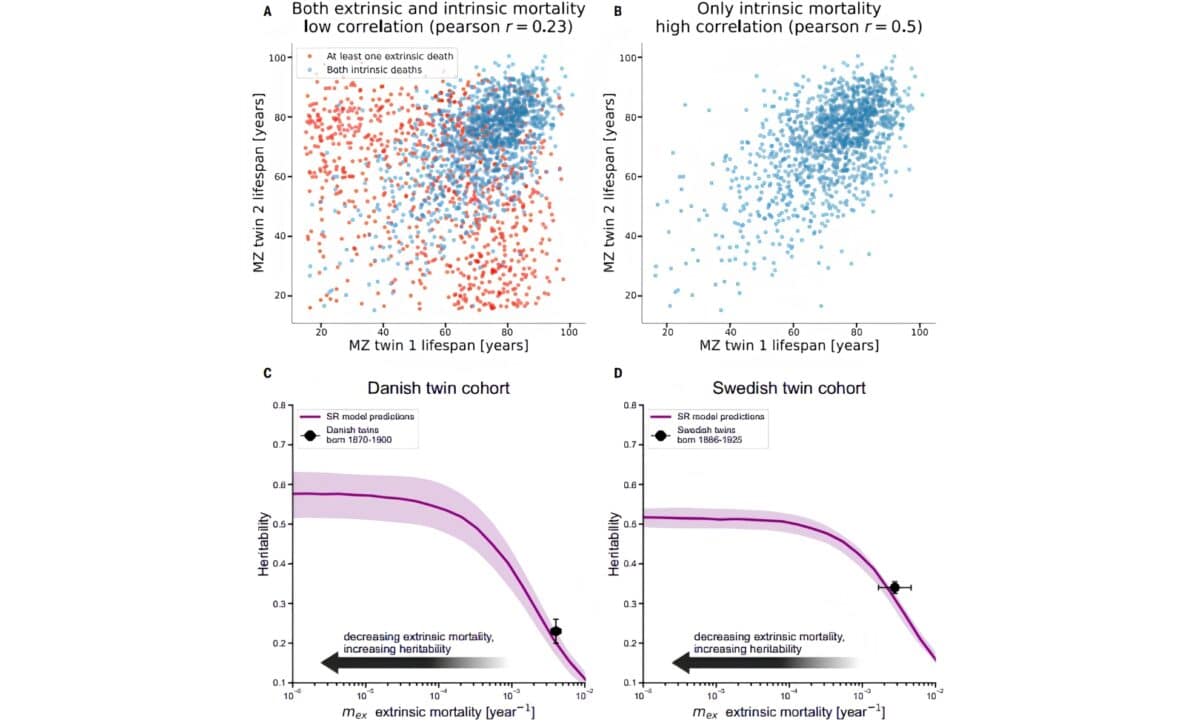 Life-span heritability increases when accounting for extrinsic mortality – © Journal Science
To work around this, the team built mathematical models and ran computer simulations of both identical and fraternal twins, incorporating genetically distinct groups and systematically removing extrinsic mortality from the analysis. As extrinsic mortality decreased in the simulations, lifespan correlations between twins increased until heritability plateaued at around 50%.
The researchers also flagged the role of frailty in complicating the picture. In elderly populations, frailty can turn what appear to be extrinsic deaths, a fall, an infection, into what are effectively intrinsic ones, since it is underlying biological decline that makes such events fatal.
Centenarian Siblings and Scandinavian Data Converge on the Same Answer
Data from a Scandinavian twin study validated the simulation results. When the researchers compared birth cohorts with progressively lower extrinsic mortality, measured heritability rose accordingly. Raising the cutoff age in historical cohorts produced the same effect, since it filtered out early deaths that were predominantly extrinsic in nature.
To verify that the findings were not specific to Scandinavian populations, the team turned to a separate dataset entirely. According to Popular Mechanics, which reported on the study, the researchers analyzed siblings of American centenarians and found that those siblings had dramatically higher odds of reaching 100 themselves, a result consistent with the same 55% heritability estimate.
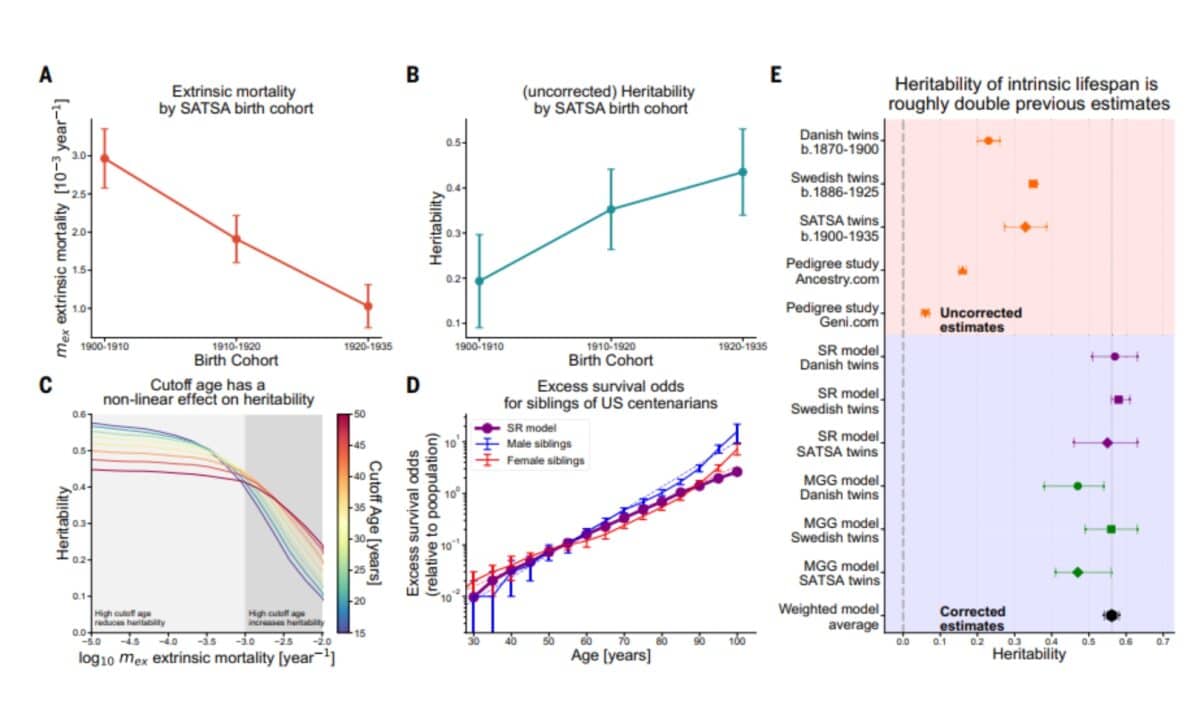 Heritability of intrinsic life span: Data and model comparisons – © Journal Science
“Correcting for extrinsic mortality raises the estimate for the heritability of human lifespan in twin and sibling studies to approximately 55%, more than twice previous estimates and in line with heritability of most human traits,” Alon and Shenhar concluded.
Some aspects of mortality, they acknowledged, still elude full explanation, among them those tied to lifestyle, healthcare access, socioeconomic conditions, and what they described as random biological phenomena. “Identifying the genetic variants underlying this heritability,” they wrote, “would help us to understand the fundamental mechanisms of human aging.”