
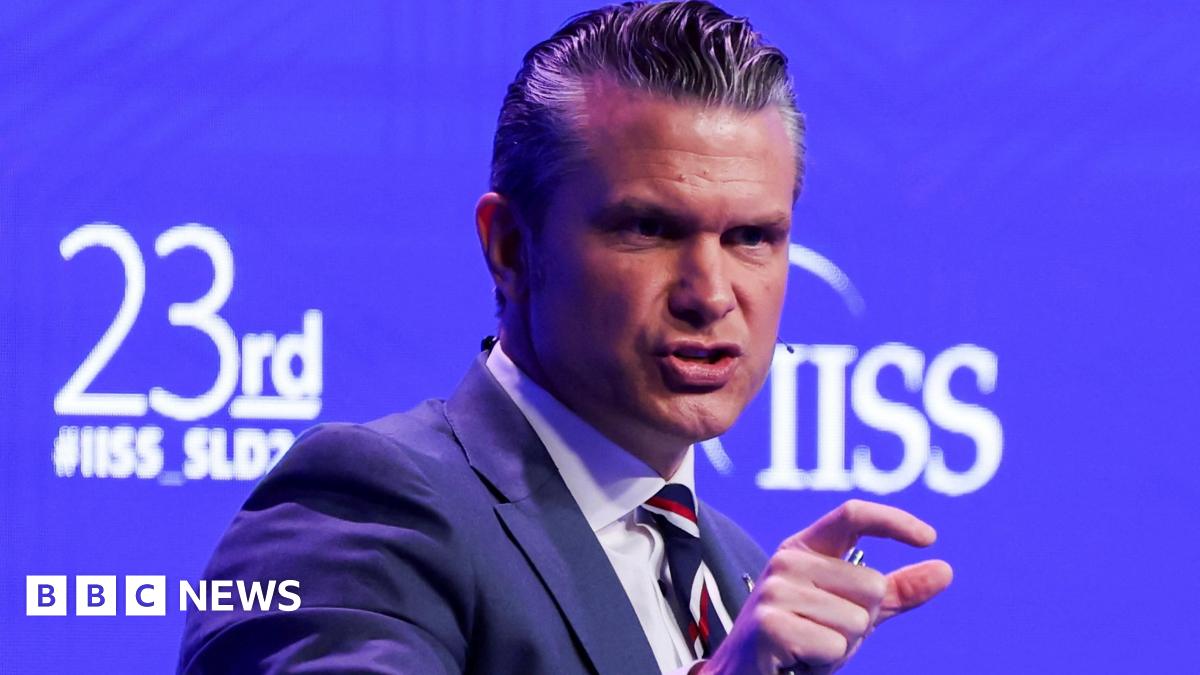
At the Shangri-La Dialogue on Saturday, Hegseth was asked by Japan’s defence minister to address concerns about US commitment. Shinjiro Koizumi said “some countries might underestimate” that level of commitment and may want to “drive a wedge” between the US and its allies.
Hegseth replied that part of the US national defence strategy was aimed at “power projection” in the Pacific and working with allies.
“People want to conflate that we have global obligations with the turning of our backs to this region,” he said, denying that was the case.
“We can do two things at one time,” he insisted, saying the US was “quietly but very strongly” working with allies with a “substantive, serious approach” to the Pacific, while maintaining “global obligations to ensure that, say, Iran doesn’t get a nuclear weapon”.
Separately, a dialogue participant raised the question of the US’s ability to fulfil arms deals with its partners after suspending a $14bn (£10bn) package to Taiwan in order to conserve munitions for the war in Iran.
Hegseth said he would “very much decouple the two” issues, insisting the US was in a “very good place… very strong position” in terms of its overall munitions stockpile and ability to produce more if needed.
In his speech, Hegseth emphasised the US’s “strong, quiet and clear” approach to the region – its capacity to wield a “big stick” but “speak softly”.
Central to this approach was more weapons, he insisted, instead of “empty globalist rhetoric about the rules-based international order”.
“Rules are great, but if you can’t back them up with hard power, the rules are not worth the paper they are written on,” he said. “We don’t need more conferences, we need more combat power… less Shangri-La Dialogue, more ships and more subs.”
His comments came hours after Vietnam’s President To Lam called for more dialogue to resolve tensions in the region, in the defence summit’s keynote speech.
Reiterating a demand which he made in last year’s speech, Hegseth called on Asian allies to spend more on defence, setting 3.5% of their GDP as a target.
He heaped praise on countries who have in recent months increased military spending and co-operation with the US, namechecking allies such as South Korea, Japan, Australia, and Philippines among others.
Hegseth also criticised “freeloaders”, categorising New Zealand as such in response to a question later, while warning that “Europe and Nato have some big decisions to make”.