
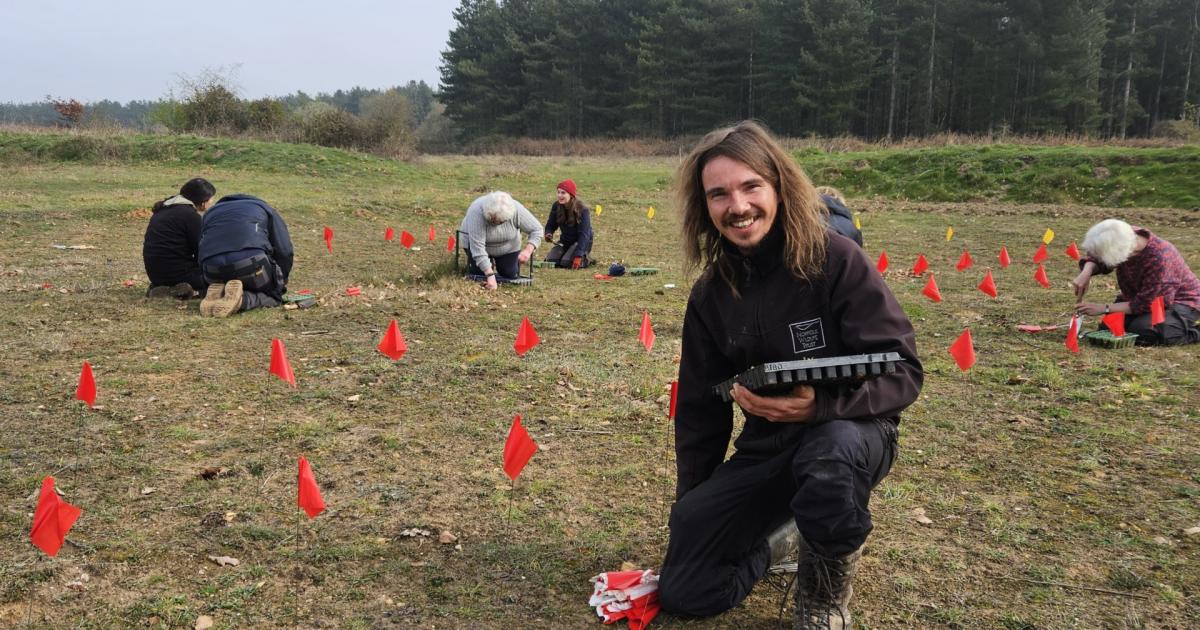
In early spring, Norfolk Wildlife Trust (NWT) staff, Plantlife UK members, and Breckland Flora Group volunteers were down on bended knees for the benefit of one of the UK’s rarest plants.
The Spanish catchfly Silene otites is found nowhere else in Britain but the Brecklands.
Even here, it is restricted to a handful of sites – and the population has significantly declined over the last few decades.
Spanish catchfly. Silene otites (Image: RSWT)
However, recent NWT habitat improvement work has created an opportunity to translocate the species to an area where it was formerly found.
The Spanish catchfly, if it were not for its rarity, would be considered a plain, unassuming plant, although its flowering stem can grow to ninety centimetres tall and is garnished with small delicate yellowish-white flowers.
Like other members of the Silene family, the top of the stem has sticky hairs.
Rather than catching flies, this is probably more likely for stopping a particular weevil from climbing up and eating the plant’s seeds.
A combination of issues means that few traditional Breckland habitats remain, particularly close-cropped grassland and bare disturbed ground – the favoured habitat of the Spanish catchfly and many other specialised Breckland plants.
Tray of Spanish catchfly plugs (Image: R.Morgan)
NWT’s James Symonds has been leading the project to increase the Brecklands’ Spanish catchfly population.
He explains: “Spanish catchfly is a special plant requiring a particular habitat that is akin to the steppe-lands [dry grassy plains] you might find on continental Europe.
“In the UK, similar conditions are only found in the Brecks due to its unique climate and geology.
“For me, this plant represents a key part of the natural heritage of Breckland, but sadly its rapid decline in the 20th century means it is now exceptionally rare.
“This decline in population is primarily due to the loss of heathland to agriculture and the creation of Thetford Forest plantation.
“In addition, the species experienced further decline in recent years, as the few surviving heathlands became unsuitable due to crashes in the rabbit population, the loss of traditional grazing practices, as well as neglect and an increase in nitrogen deposition.
“All this resulted in more rank vegetation and less bare ground.”
At Middle Harling Heath, near Thetford, three plots were scraped off with a digger to reveal bare sandy soil; preparation for a Spanish catchfly introduction.
Last year, Spanish catchfly seeds were collected, with consent from Natural England, from a site with a healthy population.
Vipers bugloss (Image: UK moths)
James has managed the project with help from several other organisations; he describes the process: “Kew Garden’s Millenium Seedbank has been involved by kindly processing the seeds by cleaning them, counting them and storing them.
“They then sent back to us the number of seeds we needed for our project.”
During the autumn, James and his team carefully planted 1,500 individual seeds.
Then, in March this year, greenhouse-grown Spanish catchfly plugs were planted out.
James has been very particular with his methodology, to ensure that he can judge the best method and survival rate.
“We initially sowed 1,500 seeds in trays for growing into plugs,” he says.
“This makes it a fair experiment, as it is the same number we sowed directly onto the introduction areas.
“From these, 1,200 plug plants survived to the point of introduction.
“Five hundred plugs were grown by myself, and this allowed me to record important data such as timing of germination and percentage of seed successes or losses.
“The remaining two thirds were grown for us by Sue Wooster at Bellflower Nursery, who is also a Breckland Flora Group volunteer and has a wealth of experience.”
This summer will tell if James’s translocation has been successful, although it will be some time before we discover whether the species is fully established and thriving.
As is the case with the natural world, flora and fauna are linked in a myriad of ways.
James concludes: “Spanish catchfly is also a special plant because it’s the caterpillar food of the viper’s bugloss moth.”
Once a relatively common moth in the Brecklands, this attractive species became extinct in Britain in the 1970s.
James concludes: “If we ever want to consider a reintroduction of this moth, we must first improve the conservation fortunes of its foodplant.”
Recovering a species such as the Spanish catchfly, by creating suitable habitat that it can thrive in, has benefits for so many other species too.
The diversity of plants that have already established themselves at Harling Heath’s Spanish catchfly plots is incredible.
Many of the seeds of unusual Breckland flora have sat in the soil for years, sometimes decades, just waiting for conditions to improve.
There is also a whole community of associated invertebrates that responded to the reappearance of previously scarce and declined plant species.
I think James is right, Spanish catchfly is part of our county’s heritage and it is our duty to save it, and all other natural treasures, for future generations.
Call to action
If you want to learn more about NWT’s Centenary year, Norfolk Wildlife, the One Hundred Species List or take part in our ‘Do one thing for wildlife’, details are available from our website norfolkwildlifetrust.or.uk/DoOneThing.