
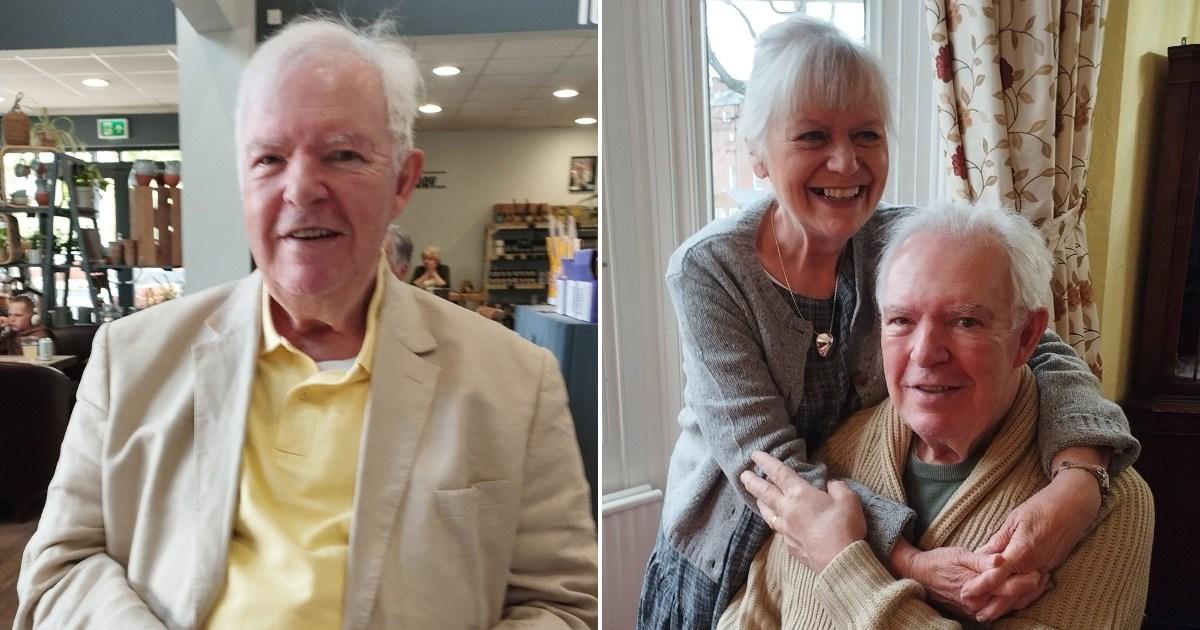
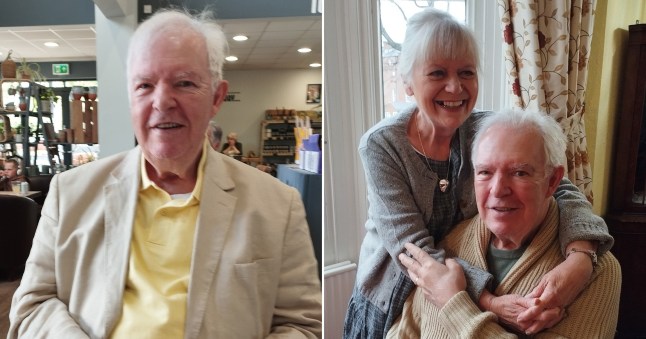
Eventually, we went for tests and an MRI scan; which showed Colin had Alzheimer’s (Picture: Jane Jennings)
‘There’s never a pen in this house!,’ grumbled my husband, Colin, as he rushed to the shops.
We had plenty of pens; but Colin was dashing out, yet again, to buy another huge bundle of biros – as many as 50 at a time.
I sighed. This bizarre behaviour was common at this point – because Colin had been diagnosed with Alzheimer’s disease at just 68 years old.
I met Colin one Sunday in April 1978 at my local pub. I liked everything about him; he was clever and attractive, with a lovely smile and a great sense of humour.
Eight months later, I married him.
I put my career on hold because we wanted to start a family; but this was not to be. I couldn’t conceive. We tried IVF, which failed – I was later diagnosed with severe endometriosis and then suffered a premature menopause.
But we got past it together. As the years rolled on, life was good – we were best friends and fancied the pants off each other –until 2021, when something happened that changed our lives forever.
At this point, we were living peacefully in France, having moved there when Colin retired; when one day, wholly uncharacteristically, when he was around 65, Colin suddenly started repeating himself.
Every time he said something, he would say it again a minute or two later. He got to the point where he kept on repeating whatever it was he had first said, as though he was stuck in a groove.
He’d also stopped processing anything I was saying – he’d just stare at me as though he couldn’t understand. Our conversations became entirely cyclical.
Metro Lifeline 2026
This year Metro is proudly supporting Alzheimer’s Society for our 2026 Lifeline campaign.
As well as raising awareness through a series of articles sharing people’s experiences, on Saturday 13 June 2026, a group of Lifeline trekkers – made up of readers, staff and families directly impacted by dementia – will be taking on an incredible challenge: an epic hike through the stunning Cotswolds countryside.
Their aim is to raise as much money as possible to help Alzheimer’s Society support people living with dementia, as well as their loved ones.
Every penny raised will go towards:
Providing support to those impacted by dementia from day one
Funding vital research
Campaigns and influencing change
Last year alone donations to the charity allowed them to…
Make 34,000 calls to combat loneliness through their Companion Calls, fuelled by brilliant volunteers.
Provide vital support 6 million times to people accessing their services
Speak to 71,000 people via their Dementia Support Line.
If you would like to support Team Lifeline and help raise money for Alzheimer’s Society, please click here.
Eventually, we went for tests and an MRI scan; which showed Colin had Alzheimer’s.
To say I was devastated would be an enormous understatement. I knew how serious the diagnosis was – both my parents (and, later, my brother) died of complications from Alzheimer’s.
Colin, on the other hand, again just shrugged it off. In fact, he was in complete denial.
At first, the avalanche of odd instances – like rushing out to buy endless packs of biros – seemed almost laughable. Until he started getting up at 3:00am to make breakfast; lighting all four jets on the gas hob and leaving them lit. Not laughable.
And persuading him back to bed was all but impossible, given Colin had suddenly become uncharacteristically angry. He became violent, smashing glasses, ornaments and crockery.
But Colin is not – and never has been, in any way – a violent man.
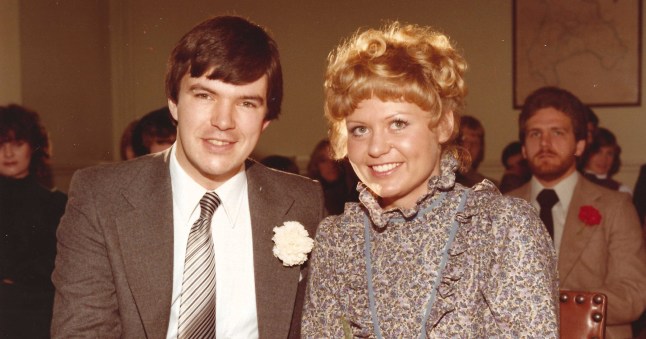
Colin and Jane on their wedding day (Picture: Jane Jennings)
If, during the day, he tried to leave the house, I could not calm him. But he was at risk out on his own.
Once, on a trip back to England, he disappeared to fetch something from our car and didn’t come back for four hours. When, eventually, he returned it was in a state of collapse.
Back home in France, he deteriorated further.
Nurses were coming in three times a day to check on him. He was on some form of tranquillizer to keep him calm; but nothing helped. He only got worse.
Colin was now leaving the house at all hours of the night. I became afraid to sleep. I tried locking all the doors and windows and hiding the keys – whereupon he smashed a window.
Anger had turned into physical violence with me whenever I attempted to check him. But I knew it wasn’t Colin attacking me; it was Alzheimer’s disease attacking him.
Colin and I have lost everything; our home, our life together, everything we have lived and worked for
Quote
Quote
On 1st January 2023, just as we were sitting down to lunch, he suddenly stormed out of the house.
The police brought him home the following morning – he had overturned our car, totally writing it off.
By some miracle Colin was not injured; nor, mercifully, was anybody else. But we’d reached the end of the line, and he was admitted to full-time care.
Even with nurses coming in three times a day, I could no longer safely look after my husband at home.
Colin was very angry about going into care. He kept saying he was perfectly all right; but he had no self-awareness of his condition.
For me, again, it was devastating. We hadn’t been apart for 46 years.
In April 2024 I hired a private ambulance to bring Colin back to England, to a care home seven miles from the pub where we’d first met. I thought returning to my home territory where I still have friends and family would help us both; and it has worked out very well.
Now, Colin has stabilised. He is very settled in care and often tells me he is happy.
I go to see him every day, and he is mostly calm and cheerful. Sometimes I take him out for coffee and cake.
But he has no functioning memory, short or long-term. He still recognises me – but, although I try with all my might not to think of it, I know there will almost inevitably come a time when he does not.
The anger is still very much there; in the last year, Colin has suffered three episodes when he has been violent and difficult to calm.
He doesn’t know where he is; the day of the week; the time on his wristwatch.
Overall, he is still lovely – but he’s a different person.
Learn more about Alzheimer’s disease
For more information and to find support, you can visit the Alzheimer’s Society website here.
You can also call their dementia support line on 0333 150 3456; learn more about their support line here. (If you are in an emergency situation, call 999 or 111.)
Today, there are around one million people suffering from dementia in the UK, and this figure is expected to rise to 1.4 million by 2040. Not to mention, the annual cost of social care for people with dementia is £17.2 billion, and these costs are expected to rise to £40.7 billion by 2040.
Successive British governments have failed to appreciate this is not an approaching crisis; the crisis is happening now.
Alzheimer’s Society is campaigning tirelessly for the government to deliver a bold and ambitious plan that demands better for everyone affected by dementia.
They’re campaigning, for example, for a long-term investment in dementia diagnosis, which could improve treatment pathways for people with dementia, as well as for significant investment in social care.
It’s a question of priorities, and dementia is a crisis soon to become a catastrophe. It’s the biggest killer in the UK; it has destroyed my husband.
Colin and I have lost everything; our home, our life together, everything we have lived and worked for.
Action is needed; and needed now.
Do you have a story you’d like to share? Get in touch by emailing jessica.aureli@metro.co.uk.
Share your views in the comments below.
Arrow
MORE: The date was great – until I saw how he treated my dog
Arrow
MORE: He told me I had to be hairless – I told him I wasn’t a child
Arrow
MORE: Apparently, this is the nonsexual act that men find insanely attractive
Comments
Add Metro as a Preferred Source on Google
Add as preferred source
The Slice
Your free newsletter guide to the best London has on offer, from drinks deals to restaurant reviews.