
Your support helps us to tell the story
From reproductive rights to climate change to Big Tech, The Independent is on the ground when the story is developing. Whether it’s investigating the financials of Elon Musk’s pro-Trump PAC or producing our latest documentary, ‘The A Word’, which shines a light on the American women fighting for reproductive rights, we know how important it is to parse out the facts from the messaging.
At such a critical moment in US history, we need reporters on the ground. Your donation allows us to keep sending journalists to speak to both sides of the story.
The Independent is trusted by Americans across the entire political spectrum. And unlike many other quality news outlets, we choose not to lock Americans out of our reporting and analysis with paywalls. We believe quality journalism should be available to everyone, paid for by those who can afford it.
Your support makes all the difference.Read more
Seven active wildfires are burning near major oil sands sites in northern Alberta, raising fears of production disruption in a region that supplies a significant share of the world’s crude oil.
Canada is the world’s fourth-largest oil producer, and the bulk of its production is clustered in northern Alberta’s boreal forest. Wildfires, which have always occurred in this environment but are more common now due to climate change, have become a perennial threat to Canadian oil output.
So far this year, there have been no significant disruptions to Canadian oil company operations due to wildfire. But on Sunday, there were about seven active blazes burning in the Fort McMurray and Lac La Biche areas of northern Alberta, with some of the fires within 20 kilometres (12.43 miles) of major oil sands sites such as Cenovus Energy’s Christina Lake and Canadian Natural Resources’s Jackfish.
A forecast for heavy rain was expected to aid firefighters’ efforts throughout the day, and an evacuation alert issued on Saturday for the nearby small community of Conklin was lifted on Sunday.
While no other communities were under threat from existing blazes, the risk of new fires starting due to warm, dry conditions remains “extreme” in the Fort McMurray area, according to fire officials.
The recurring risk of fire in Canada’s oil sands region adds a level of uncertainty to company production forecasts in the spring and summer.
Last year, fires forced Canadian oil companies to temporarily shut in some 344,000 barrels per day of oil sands production, or about 7 per cent of the country’s overall crude oil output.
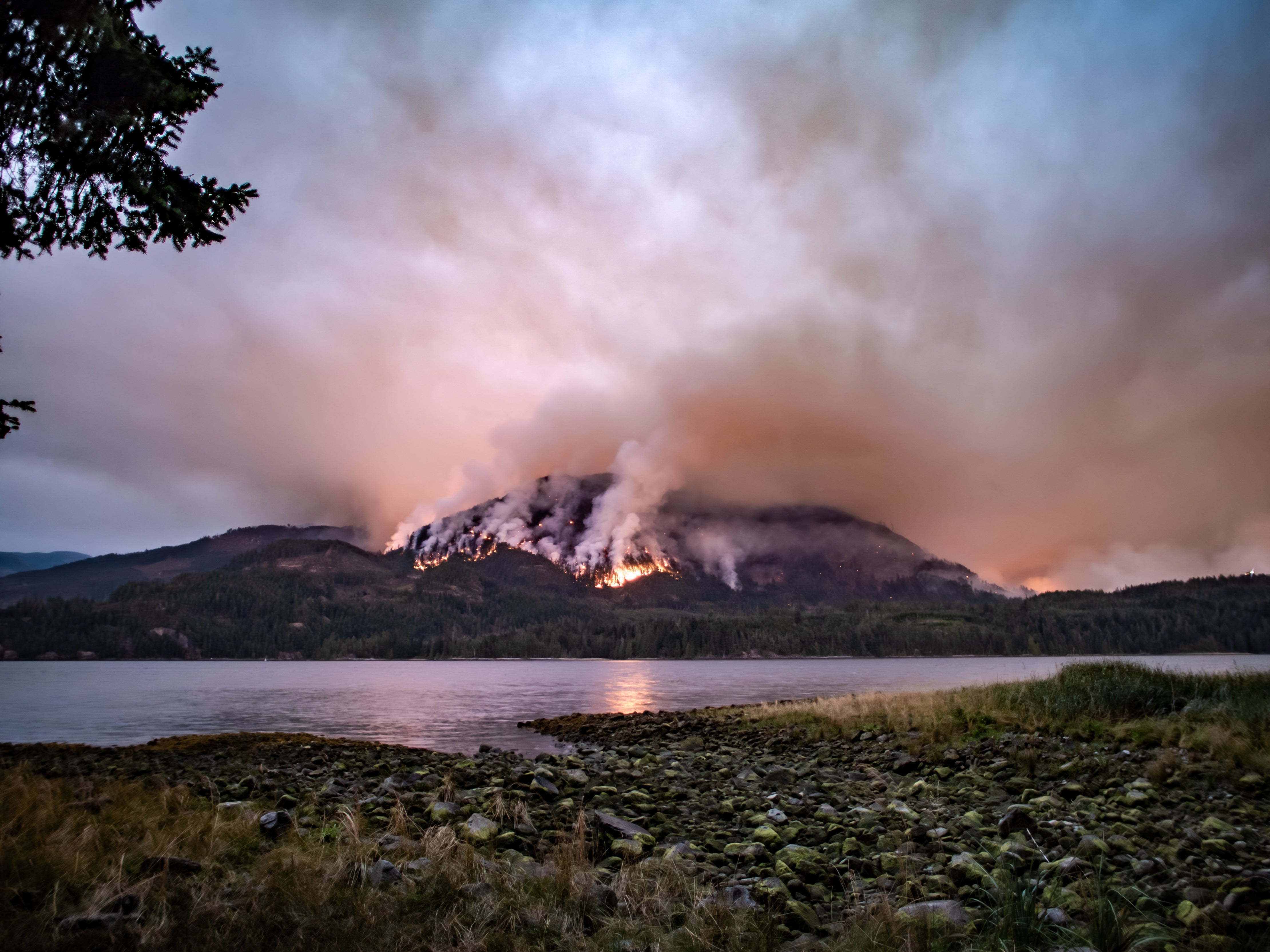 A wildfire burns on Mount Underwood near Port Alberni, on Vancouver Island, British Columbia in 2025 (AFP/Getty)
In May of 2023, companies shut in at least 319,000 barrels of oil equivalent per day, or 3.7 per cent of Canada’s total production, as more than 100 wildfires burned in Alberta.
The most extreme example occurred in 2016, when thousands of oil sands workers were evacuated as a monster wildfire destroyed part of the community of Fort McMurray.
At the height of the disaster, companies were forced to reduce their oil output by a million barrels per day.