
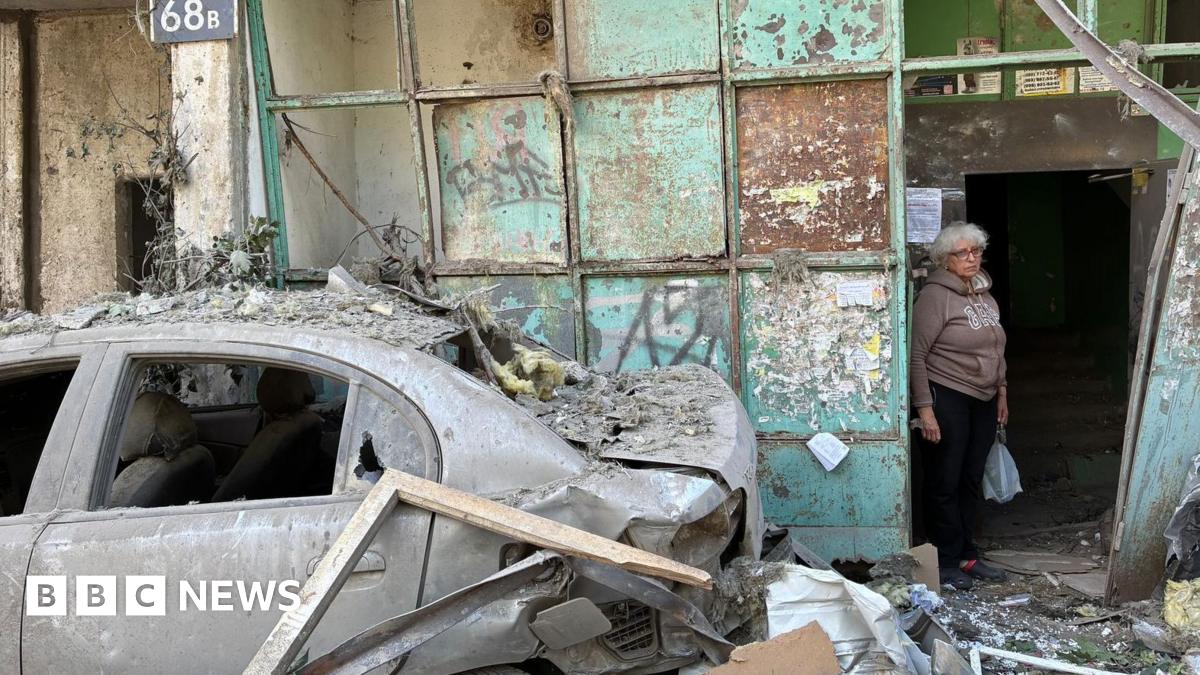
Anna lives in a nine-storey apartment block right next to the epicentre of one of the explosions. Tearfully, she told me that one of the cars completely destroyed by the blast was hers. But it is not just her car or her house that she is worried about.
“They’ll fix the building, but not our souls,” she said. “The whole of the building, the whole of Ukraine is in grief. What have we done to deserve this?”
The attack was followed by a massive effort to clean up the damage and help the survivors.
Outside Anna’s house, rescuers were making sure everyone was physically OK, while government psychologists were talking to shell-shocked and sometimes tearful locals, and volunteers handing out free food and drink.
Police were shooing everyone away from the high-rises as shards of glass were still falling out of broken windows.
Nearby, neighbourhood boys joined municipal workers in clearing rubble from a children’s activity centre, with painted purple butterflies still visible on what is left of its windows.
But step away from the epicentre of the blast, and a sense of normality begins to return. Around the corner from Anna’s house, a couple of children were playing on a swing, looking in disbelief at all the bustle in their neighbourhood.
Even further away, road workers were laying new tarmac and buses were running as if nothing out of the ordinary was happening just a short distance away.
This is Kyiv’s way of dealing with the war: no matter how hard it gets hit, the city still goes back to its daily routines.