
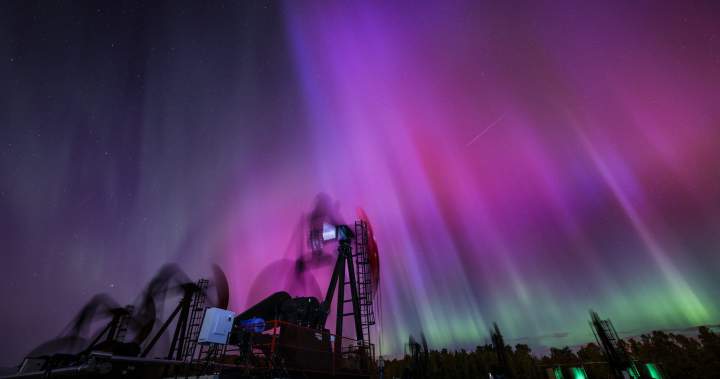
Much of Canada might be able to see the northern lights dance across the skies over the coming nights.

The U.S. National Oceanic and Atmospheric Administration’s (NOAA) northern lights forecast signals “strong” G-3 magnitude geomagnetic storms Thursday and Friday night.
“On June 3, multiple coronal mass ejections (CMEs) erupted from the sun, and are projected to reach the Earth sometime in the next 24 hours,” said Taylor Cameron, a space weather duty forecaster for the Canadian Hazards Information Service, in an emailed statement to Global News.
The Canadian Hazards Information Service is part of Natural Resources Canada.
With these particles from space colliding with atoms and molecules in Earth’s atmosphere, they can cause the colourful glow called auroras.
“When a [coronal mass ejection] interacts with the Earth’s magnetic field, it can trigger a geomagnetic storm. These storms can cause issues with technologies such as radio communications, GPS, and in very extreme cases, with the power grid. They can also trigger brilliant auroral displays in locations farther south than normal,” Cameron said.
Story continues below advertisement
When will the best chance to see the aurora be?
The Northwest Territories have the most exposure to the lights, as, according to the Spectacular Northwest Territories.

Get breaking National news
Get breaking Canada news delivered to your inbox as it happens so you won’t miss a trending story.
Yukon is very similar in this regard, with Whitehorse anchoring the territory’s northern lights tourism. Thanks to vast wilderness, minimal light pollution, and high latitude, conditions for viewing the lights are extremely suitable.
Destination Canada has also regarded Ontario’s Manitoulin Island and Pukaskwa National Park as places where Canadians can “occasionally” see the auroras, especially on autumn nights.
Previous Image
Next Image
Close Modal Gallery
More on Canada
More videos
Cameron said Canadian officials are “currently forecasting an arrival and subsequent storm starting in the late evening, but the CMEs could arrive hours earlier or later.”
Story continues below advertisement
“We have declared a major geomagnetic storm watch for the auroral zone from 20:00 EDT tonight to 10:00 EDT tomorrow morning,” he said.
With a G-3 geomagnetic storm, that means much of Canada may be able to see the aurora.
Geomagnetic storms are ranked by their strength on the following levels:
G-1: Minor, aurora may be seen across the PrairiesG-2: Moderate, aurora may reach down to southern OntarioG-3: Strong, aurora may be seen across CanadaG-4: Severe, aurora may be seen down to AlabamaG-5: Extreme, aurora may be seen down to Florida
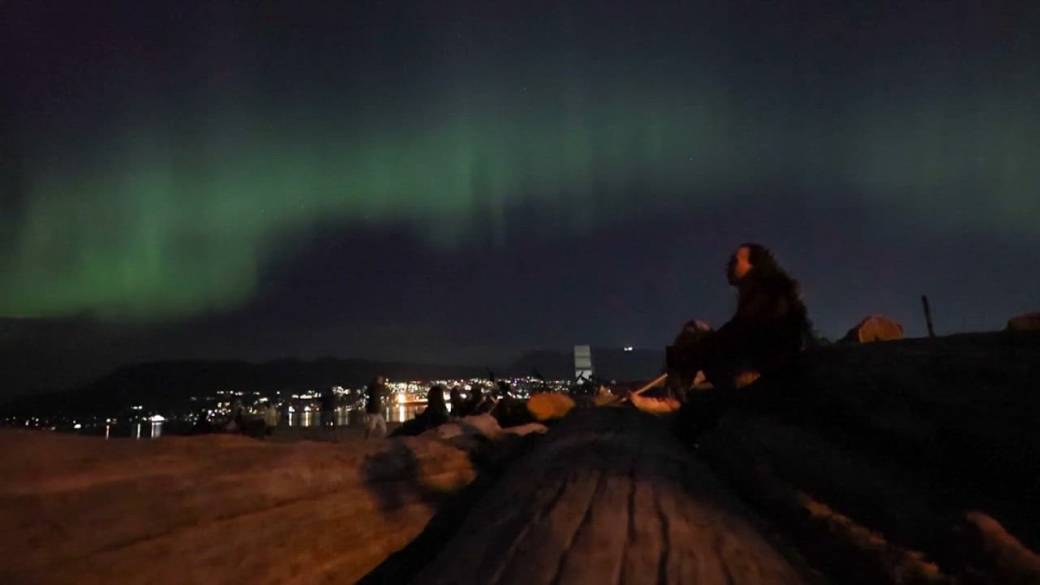
2:18
Northern lights seen as far south as Kingston amid solar activity surge
These storms typically occur 15 days out of the year, with events being more frequent during solar-maximum years.
Cameron says those looking for the best chance to see the lights should “get as far away from city lights as possible, find clear skies, and to look north.”
Story continues below advertisement
“The brightness of the aurora can change quickly from minute to minute during a storm, so it can help to be patient,” he stated.
He also stated that the aurora will be difficult to see with the naked eye but will be “clearly visible” through a phone camera.
© 2026 Global News, a division of Corus Entertainment Inc.