
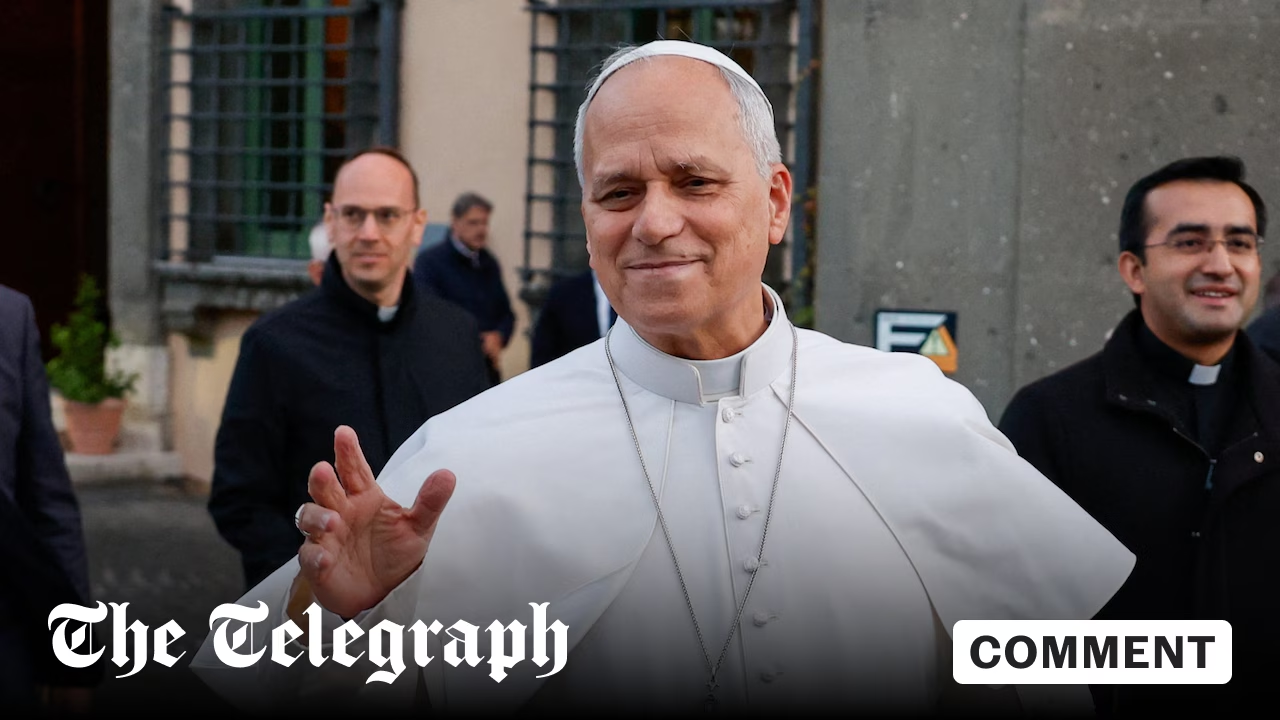
Pope Leo XIV’s much-anticipated first encyclical on safeguarding the human person in the time of AI was released last month to much fanfare and discussion. A renewal of the Rerum Novarum of Pope Leo XIII (1891), this encyclical sought to speak of the “res novae (new issues) of our time” – such as AI.
As he writes: “Humanity, created by God in all its grandeur, is today facing a pivotal choice: either to construct a new Tower of Babel or to build the city in which God and humanity dwell together.”
Commentators thus far seemed to have focused on what he has to say about what he calls the “Babel syndrome”, yet have missed something significant: most of the encyclical is dedicated to the more fundamental Christian question of how we might think about building the City of God here on earth, how we can work together to “foster a peaceful, just and dignified life in community within today’s ‘cities’”.
If you’re not Catholic, you might be asking: “Well, what does it matter what the Pope has to say?” Nearly 20 years after the financial crisis of 2008, amid the climate crisis and the mental health crisis, with wars in Ukraine and Iran, the turmoil of Donald Trump’s second term, and, as the encyclical is concerned with, the rise of an artificial intelligence which no longer serves us, but we serve it, it is clear that the modern world isn’t working for us.
The real problem is that the current political offerings available to us are fundamentally untethered from what Catholic social teaching might call “the Good” or “the Real”, and instead remain beholden to the technocratic doctrines that have prevailed for much of the post-Cold War period.
Today’s politics have prioritised efficiency and profit over the values of peace, justice, and fraternity. Pope Leo’s encyclical, by contrast, draws on the Church’s “ancient wisdom” to generate fresh ways of approaching social, political and economic questions.
The proliferation of AI is just one symptom of this broken society. If we are unable to connect our use of technology to virtues which serve us, we will remain servants to it.
And so the Pope warns us: “When it [technology] becomes the standard by which everything is judged, it begins to dictate what matters and what can be discarded, reducing creation to an object of exploitation and human beings to mere cogs in a system driven toward ever greater efficiency.”
But it’s not difficult to look around and see how life more generally has become transactional in the past 50 years.
Community built on values, not profit
In stark contrast to the housing estates today, built in such a way to maximise profit, with tiny homes all crammed into one another, the Gannochy Trust estate in Perth serves as the perfect example of a community built on values rather than profit.
Inspired by the writing of John Ruskin, whose account of the social order was sustained by his account of Christian virtue, AK Bell of Bell’s Whisky started building the estate in 1923.
In the wake of the Second World War, Gannochy was designed to provide inexpensive accommodation for the community. Surrounded by the countryside, each house was built with a large garden for growing fruit and vegetables, trees and hedges, and no adjacent property was identical.
He envisioned a community where people could live out healthy, happy lives together, and the architecture reflected this. These are exactly the kinds of initiatives that are possible when the choices we make are governed by the common good and a desire to “build the city in which God and humanity dwell together”.
Correlation between social trust and prosperity
Rather than being a collection of solitary individuals, the Pope suggests that we are united by fraternal bonds that are “a social and political reality to be embodied in communal choices and endeavours”. A society where these bonds are ignored or forgotten becomes a society in which all relationships are seen through their utilitarian value. As Benedict XVI wrote in his encyclical Caritas in Veritate: “It runs the risk of being reduced to the mere accumulation of wealth.”
Aside from the fact that this distorts the “inalienable dignity of the human person, the common good, the universal destination of goods, subsidiarity, solidarity and social justice”, recent economic theory, for example in the report of Andy Haldane and David Halpern, suggests that policy which disregards social bonds also leads to economic instability: the pursuit of profit without regard for the ties of trust and reciprocity on which our economies rely undermines long-term prosperity.
As Mr Haldane points out, research suggests that a 10 per cent increase in social trust correlates with a 1.3-1.5 per cent increase in economic productivity.