
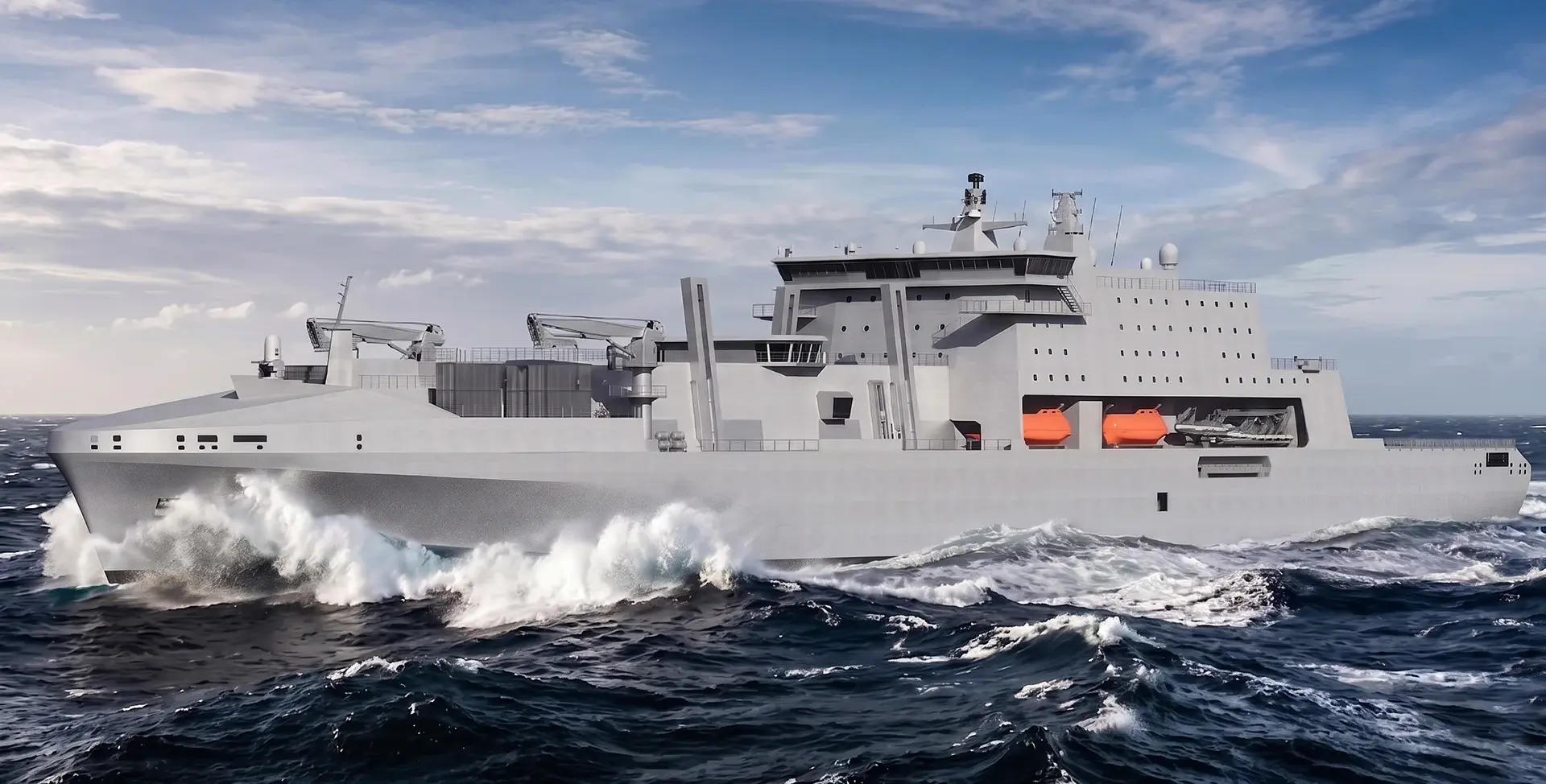
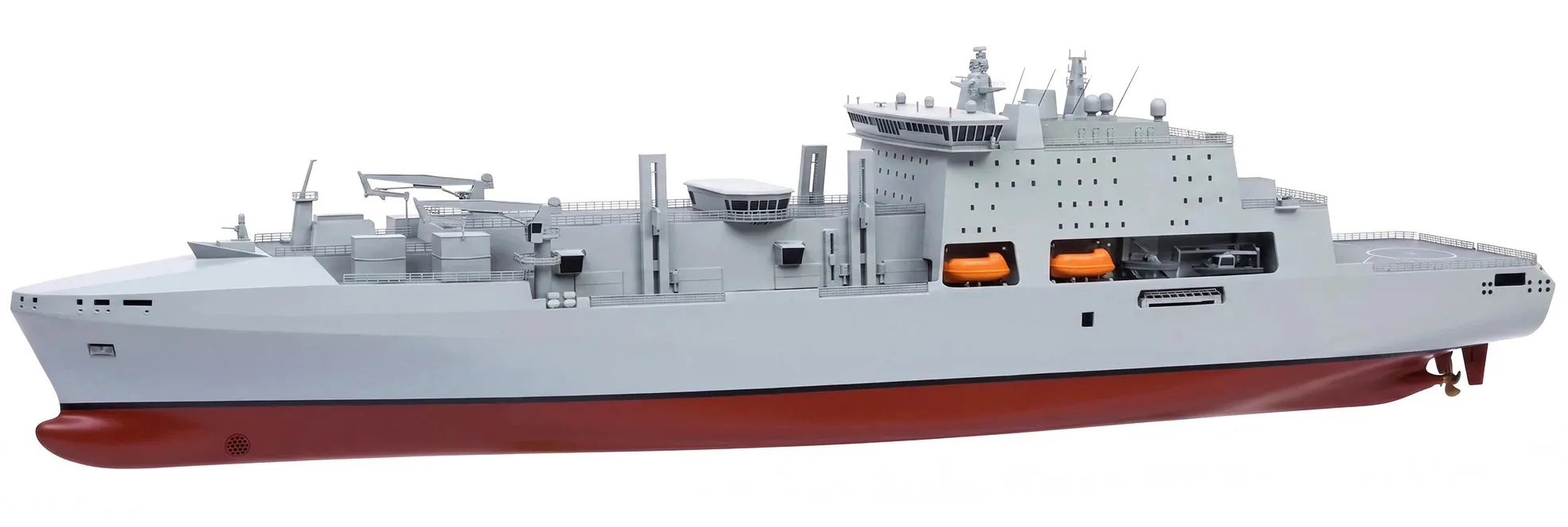
Fleet Solid Support ship construction is now advancing across three nations, with the first steel cut on RFA Resurgent in Cadiz, steelwork erection underway at Appledore and shipbuilding capacity being regenerated at Harland & Wolff, Belfast. At CNE 2026, we spoke to Navantia UK about the programme and the company’s ambitions beyond FSS.
Three yards, two countries
The first Fleet Solid Support ships are being built in three sections distributed across three yards. The forward section (2 modules) is being constructed in Appledore. The central section, comprising 3 modules, contains the main cargo holds, this will be built in Belfast. The third section aft, contains the machinery spaces and superstructure, these 2 modules will be built in Cadiz. All modules will be transported to Belfast for final integration. The NUK Seahorse barge, recently built at Methil, arrived in Appledore in early June. The forward blocks for all three FSS are being assembled on the barge in Appledore before delivery to Belfast, starting later this year. A large semi-submersible vessel will be used to transport the larger aft modules from Cadiz to Belfast.
Belfast is already building test blocks for Ship 2 while Ship 1’s sections are being progressed in Cadiz. The test blocks will have real build utility, but their primary purpose at this stage is to exercise the workforce, prove the fabrication processes, validate quality records, and identify problems early. Once the blocks arrive in Belfast, the integration work beyond the physical structure includes additional outfitting, painting and finishing, testing and commissioning of systems in preparation for trials.
When Harland & Wolff went into administration in 2019, the workforce numbered roughly 50 people engaged almost exclusively in ship repair, a yard that had not built a ship for around 20 years. Today, the Belfast yard employs around 450 people and is running an apprenticeship scheme taking on 50 to 60 recruits per year, with cohorts already into their second and third years of training. Across the Navantia UK group, which currently employs about 1,200 people at the 4 sites, the target is to have 500 apprentices by 2030.
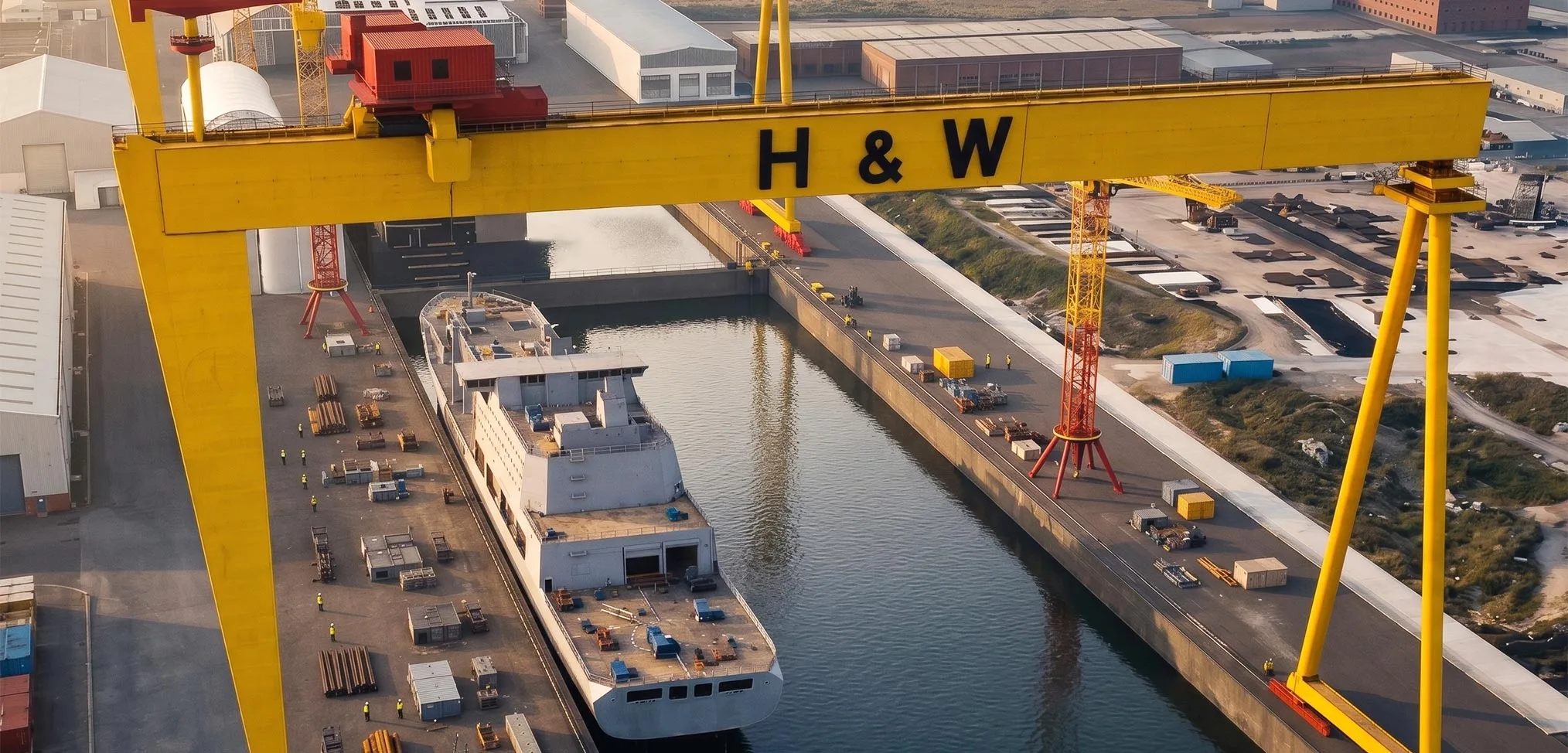 A major investment in the H&W yard in the late 1960s saw the construction of the vast dry dock intended to build super tankers. The dock is 556m long, 93m wide, with a depth over the sill at the average high tide of 8.4m. An intermediate gate can be placed across the dock to divide it into a flexible, part-wet, part-dry arrangement to work on multiple ships simultaneously. The dock is serviced by two 140m gantry cranes (Goliath and Sampson) certified to lift up to 900 tonnes (Navy Lookout mock up).
The investment to make this possible has been close to £100 million, directed at bringing the yard to a level of automation consistent with modern naval shipbuilding. The digital shipyard model being implemented at Belfast is a direct technology transfer from the established Spanish model. Belfast is the fifth yard Navantia has upgraded with new panel lines and the digital shipyard model already proven across four facilities in Spain. The processes, quality systems, and lessons learned are not being invented from scratch and the learning curve is reduced.
When assembled, RFA Resurgent will be 216m in length and the Belfast dock can accommodate two vessels simultaneously. Resurgent will be in final outfitting at one end while Ship 2’s blocks are being assembled at the other; Ship 1 will then be floated out for finishing and sea trials. At the peak of the delivery plan, there will be 3 FSS ships progressing through different build and commissioning stages concurrently.
To build, integrate and deliver three FSS vessels, there will be approximately 800 tradespeople and shipbuilders, alongside around 400 in other programme functions, including project management, quality assurance, procurement and engineering, employed at Belfast. The hiring plan is phased with the block construction schedule, allowing the headcount to build progressively rather than hiring at a large scale immediately. Navantia is confident that between its existing apprentice cohorts and continuing recruitment, it will reach the necessary numbers without a large-scale subcontractor dependency that characterises some other UK naval programmes.
Three ships under contract
All three FSS ships are under contract but there are credible rumours that the third ship could be cancelled as a cost-saving measure. The MoD theoretically retains the option to terminate ship 3, but the savings would be very modest. The contractor would be entitled to recover all costs incurred, reducing any savings to a fraction of the hull’s notional procurement cost at precisely the point in the programme when per-unit costs are falling as the build sequence matures.
The RN’s requirement for all three ships is clear. The deployment of the carrier strike group to the Indo-Pacific without a dedicated support vessel able to sustain carrier air operations is cited as an object lesson in what the programme is intended to solve. The FSS design was sized and designed specifically to resupply the carrier strike group and its air wing for a sustained period, potentially on a combat operation that would consume stores quickly. However, the ships have major utility beyond their core role, including within the RN’s wider ‘hybrid navy’ vision. Having large hangars, a flight deck, and containerised payload capacity, they could serve as a base for UAV or USV operations. They can also support humanitarian aid operations, provide medical facilities and could partially replace RFA Argus in the aviation training role.
 What comes next
The revival of Harland & Wolff means the country now has three yards actively building naval ships, with investment at Glasgow to expand Type 26 frigate production and the establishment of warship building at Rosyth for the Type 31 programme. This shipyard renaissance has restored industrial capacity that the UK needs to regenerate its fleet over the coming decades. However, sustaining this enterprise will require a regular drumbeat of funded RN orders, even if assisted by export successes.
Navantia UK now has to consider what may follow FSS at Belfast. The programme provides a foundation in the short-to-medium term that allows Harland & Wolff to attract and retain workers in what has historically been an uncertain environment. However, in order to preserve long-term continuity and avoid losing the capability that has been so deliberately rebuilt, design work on a new vessel will need to begin by the end of this year. A full design and build programme typically requires at least two and a half years of design work before fabrication begins, meaning the decision point to sustain the Belfast drumbeat arrives long before steel is cut. Waiting risks exactly the boom-and-bust cycle that has plagued UK naval shipbuilding for decades.
The obvious candidate for that follow-on work at Belfast would be the Multi-Role Support Ship (MRSS) project, the replacement for the RN’s amphibious shipping capability. However, the pre-DIP ‘mood music’ and the First Sea Lord declaring the RN “must move away from the need for ever bigger, ever more expensive platforms” suggest the project is in flux. Quite incredibly, during an official RN presentation at CNE 2026 on the future of UK Commando Forces and operations in the High North, MRSS did not merit a single mention. The more low-profile replacement of the ageing Point-class military logistics vessels is an alternative potential opportunity for Navantia UK, although those ships sit closer to the civilian end of the spectrum.
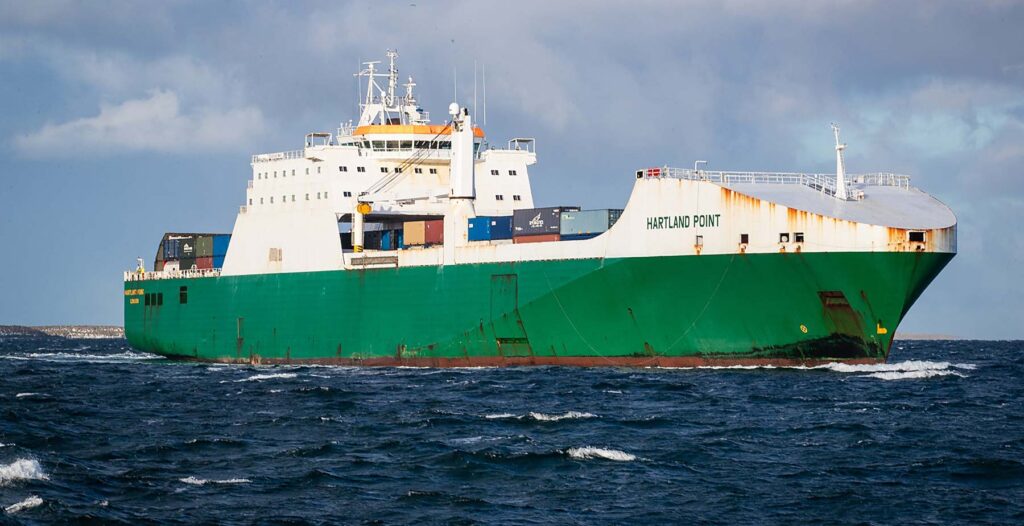 MV Hartland Point was the last ship built by Harland and Wolff, completed in 2002. The 4 Point-class vessels, which provide UK strategic sealift capability under a commercial charter agreement, need to be replaced soon.
Navantia UK believes its Methil yard would be ideally placed to deliver the two new floating dry docks to support nuclear-powered submarines at Faslane under project EUSTON. Funding is anticipated to fall in the 2029 to 2031 window, and the MoD has not yet released sufficient design information to allow bidders to fully scope the work, but the competition is expected to be structured as a design-and-build contract. Navantia previously designed, built, and operated a submarine floating dry dock at its Cartagena facility in Spain approximately 20 years ago, with staff who worked on the project still available.
Navantia’s focus is primarily naval shipbuilding, but it could consider commercial work that has sometimes sustained yards during lean periods. Belfast could potentially also benefit from export orders won by the wider Navantia group. The company’s position is that if the Spanish parent secures an overseas contract, global capacity across the whole enterprise would be taken into account. Spanish yards are presently busy on domestic and export programmes and face their own version of the boom-and-bust cycle familiar in the UK. The bigger picture is that Europe is committed to rearmament and sustained demand for naval shipbuilding appears likely.