
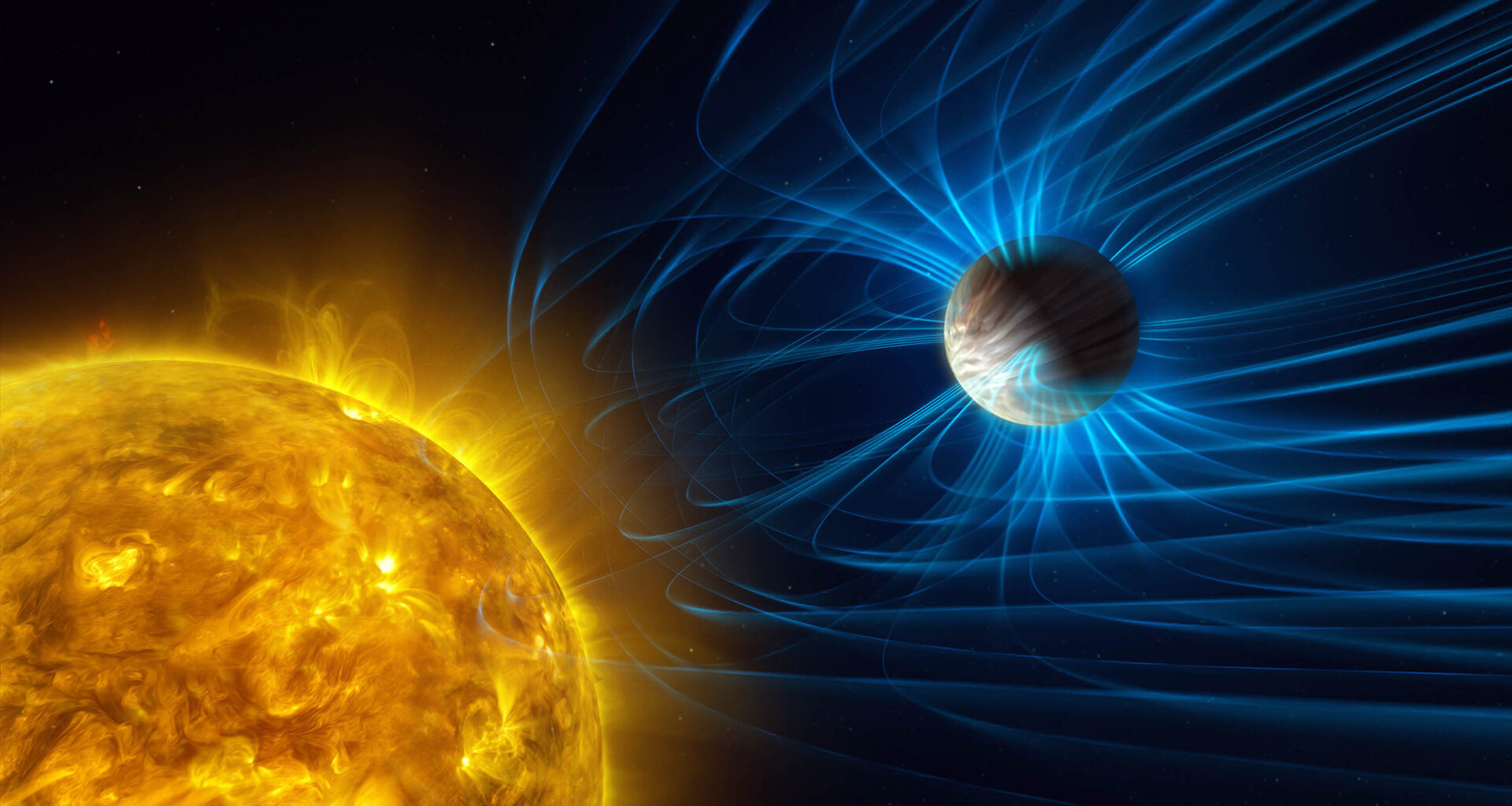
For years, astronomers have known that magnetic fields play a major role in shaping planets. On Earth, the magnetic field helps protect our atmosphere from harmful particles streaming from the Sun.
Magnetic fields also contribute to conditions that allow life to exist.

Yet one big question has remained unanswered: do planets beyond our Solar System have magnetic fields too?
Scientists may have finally found the clearest answer yet.
Magnetic fields on distant planets
A new study looked at several giant planets orbiting far-off stars and found strong proof that their weather is influenced by magnetic fields.
The work was led by Julia Seidel, an astronomer from the Laboratoire Lagrange at the Observatoire de la Côte d’Azur in France.
They used big telescopes to make these findings – the Very Large Telescope at the European Southern Observatory (ESO) in Chile and the Gemini North telescope in Hawaii.
Studying extreme atmospheric winds
The scientists were not originally looking for magnetic fields. Instead, they wanted to study winds on seven giant exoplanets.
These planets are similar in size to Jupiter but orbit extremely close to their host stars. Because they are tidally locked, one side permanently faces the star while the other remains in darkness.
That creates extreme conditions. One hemisphere is intensely hot, while the opposite side is much colder.
The temperature difference drives powerful atmospheric winds unlike anything seen on Earth.
The team measured wind speeds ranging from about 4,475 mph to more than 15,500 mph. For comparison, the fastest winds ever measured on Jupiter reach about 930 mph.
“In the beginning we set out to check if the atmospheric winds behaved the same way for all hot planets,” noted Seidel, who was previously an astronomer at ESO.
A surprising pattern emerges
When researchers compared wind speeds with planetary temperatures, they noticed something that did not make sense at first. The hottest planets had slower winds.
That was the opposite of what standard expectations suggested. More heat generally means more energy available to drive atmospheric motion.
“This is totally counter intuitive because, all things being equal, hot planets have more energy to accelerate the winds! Something must happen that slows down the wind speeds for hotter objects,” said study co-author Vivien Parmentier, a professor at the Laboratoire Lagrange.
The unusual trend pushed the team toward a different explanation.
Magnetic fields as planetary brakes
The most convincing answer involved magnetic fields. The atmospheres of these intensely hot planets contain charged particles.
Magnetic fields can interact with those particles and resist their movement, effectively slowing atmospheric winds.
Based on this relationship, researchers estimated the strength of the planets’ magnetic fields. The results suggested surprisingly powerful magnetic environments.
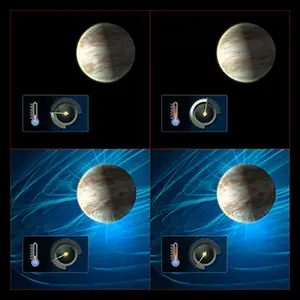 This diagram illustrates how astronomers can infer the strength of magnetic fields in exoplanets from their effect on the winds on these planets. Credit: ESO. Click image to enlarge.A new window on exoplanet research
The fields appear to be roughly four times stronger than Saturn’s magnetic field and about half as strong as Jupiter’s.
That matters because magnetic fields can influence everything from atmospheric stability to long-term planetary survival.
Scientists believe they may help planets retain their atmospheres and protect them from the damaging effects of stellar radiation.
“This breakthrough opens a completely new window on exoplanet research,” said Seidel.
“It’s the first time we can compare the magnetic environments of other worlds – a key step toward ultimately understanding which planets can stay alive, keep their water, and perhaps even, one day, host life as we know it.”
More than wind and weather
Strong magnetic fields can also produce spectacular light shows.
Study co-author Bibiana Prinoth is a former PhD student at Lund University in Sweden who is now an astronomer at ESO in Germany.
“Here on Earth, we know the beauty of the northern and southern lights, where particles from the Sun hit our magnetic field and are guided toward the poles, colliding with gases in the atmosphere to produce colourful displays of green, pink, and purple,” said Prinoth.
On these distant giant planets, auroras could be far larger and more energetic because of the intense conditions surrounding them.
The role of future observatories
Astronomers have spent decades finding exoplanets. Thousands are now known to exist, ranging from giant gas planets to rocky worlds that may resemble Earth.
Understanding their magnetic fields has been one of the toughest challenges in planetary science. The new technique could change that.
Future observatories may allow scientists to apply similar methods to smaller planets, including Earth-sized worlds.
ESO’s upcoming Extremely Large Telescope is expected to play a major role in that effort.
Researchers hope it will help detect atmospheric gases and other clues that reveal how distant planets function. For Prinoth, the possibility is exciting.
“I like to imagine that some of these worlds have a sky filled not only with stars, but with vast curtains of colourful light dancing across a planet that’s half in perpetual day and half in endless night,” said Prinoth.
The full study was published in the journal Nature Astronomy.
—–
Like what you read? Subscribe to our newsletter for engaging articles, exclusive content, and the latest updates.
Check us out on EarthSnap, a free app brought to you by Eric Ralls and Earth.com.
—–