
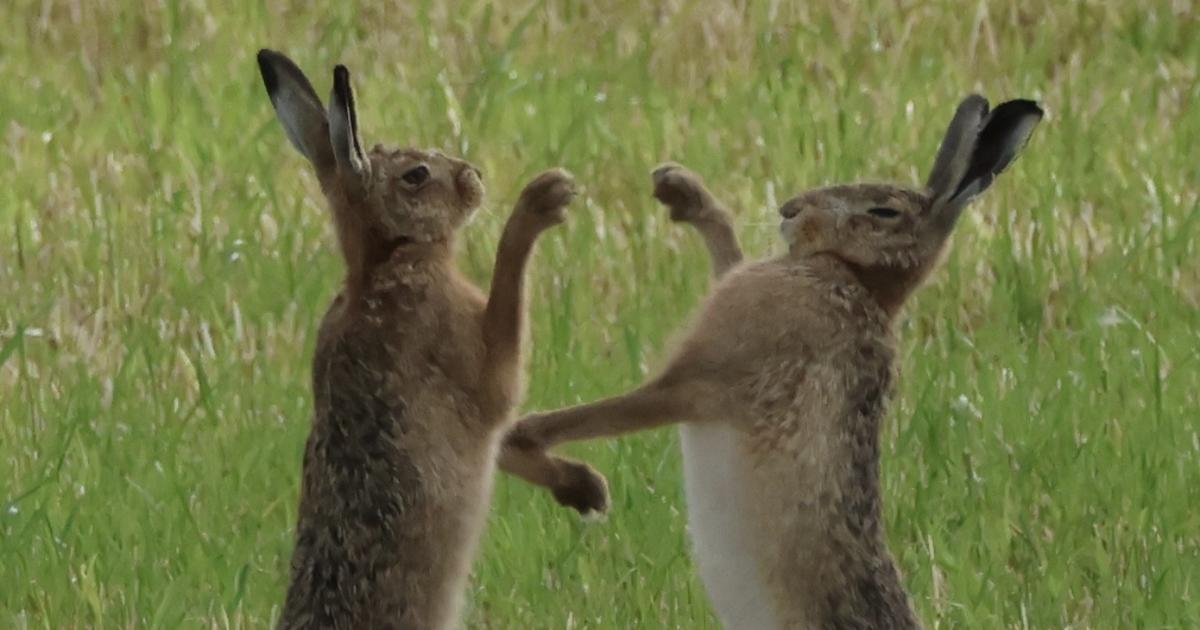
The dramatic performance sees adult animals standing upright in open fields embroiled in what looks to all intents and purposes like a ‘boxing’ match.
Take that! The photos were taken near Wool (Image: Kevin Evans)
For those lucky enough to witness it, the behaviour is typically observed during the hares’ breeding season, usually peaking in March – hence the expression, as “mad as a March hare”.
The breeding season however runs through from February to September.
Kevin, who said he had taken up wildlife photography just four months ago, came across the spectacle this month in a field outside Wool on an evening walk after work.
It was between 6.30pm and 7pm and he had been actually been out looking for deers, he said.
“I saw two hares. They were quite far apart so I thought I’d sit and watch,” said the 41-year-old, from Broadmayne, who works as a crane operator at Pulham Steels Ltd.
A common misconception is that it’s two males (Image: Kevin Evans)
“They were chasing each other and I thought it could happen and it did. I ended up with about 150 photos that I had to sift through when I got home but it’s over quite quick. It lasted about 30/40 seconds.”
Kevin, who was “crouched behind a fence”, said he had been “amazed” by the scene
“I was straight on the phone telling everyone – my friends, my other half,” he said.
A common misconception is that it is two males embroiled in the ‘battle’ but Kevin explained that was not the case.
“It’s not what people think. It’s not two males. It’s the female fending off the male because she has had enough.”
The behaviour can go on for weeks, according to research (Image: Kevin Evans)
Kevin said he was introduced to photographing wildlife by his 13-year old son, who has been pursuing the pastime with his granddad for five or six years.
“Now, I’m absolutely obsessed,” said Kevin, who said he started by buying a cheap camera and had now upgraded his equipment.
“It’s a really good hobby,” he said, adding that he had spent three months taking pictures of kingfishers.
For the boxing hare shots, he said he used a Canon R7 Mirrorless camera and a Sigma lens. He does not edit his pictures, he said.
Hare today – gone tomorrow? (Image: Kevin Evans)
Research has reportedly shown that the vast majority of these ‘boxing’ encounters are initiated by a female hare, or doe, who is ending off an overly persistent male, or buck. It can even go on for several weeks.
It is thought to be because the doe is not yet ready to mate or may be testing the male.
Kevin took up photography four months ago and came across the hares on an evening walk (Image: Kevin Evans)
More of Kevin’s pictures can be seen on his Facebook page Kevin Evans (Evans Photography).