
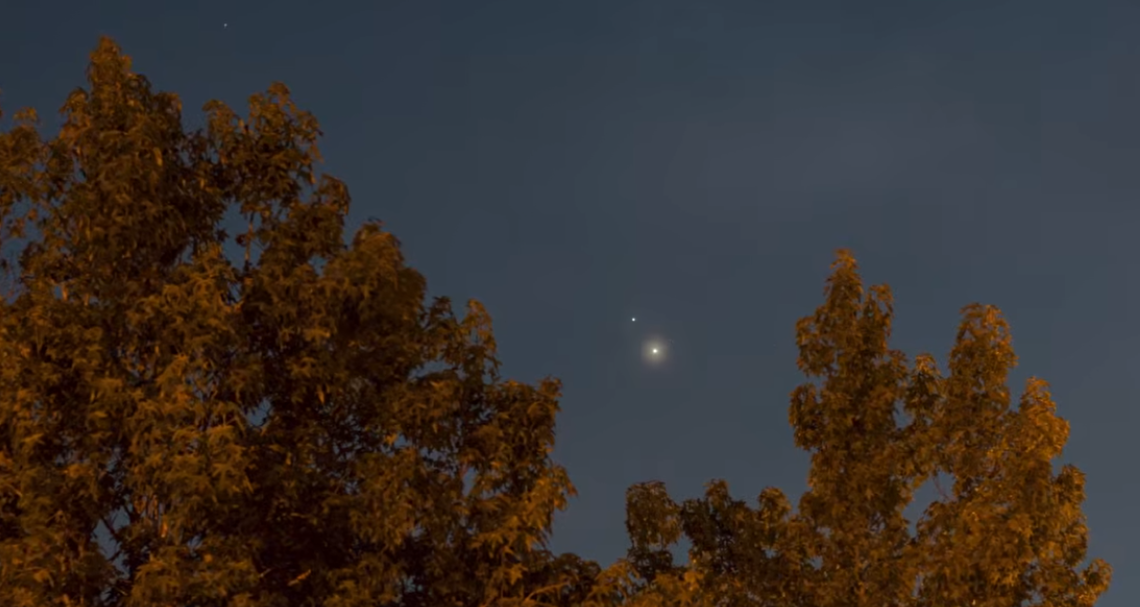
If you’re an avid skygazer, you may have noticed two bright objects, Venus and Jupiter, shining in the night sky this week. Now, a third planet is due to join the cosmic fun.
That’s right, Mercury is on its way to a sky near you, where it will turn a two-planet conjunction into a full-on planet parade.
These events aren’t exactly rare, but they do tend to generate plenty of excitement when they happen. That’s because, while at least one planet is typically visible to the naked eye from Earth, spotting multiple worlds in our solar system together is a notable occurrence.
You won’t want to miss the show.
NASA releases thousands more Artemis II photos. Here are the best.
1 of 15
NASA released thousands of new photos taken during the Artemis II mission around the moon. The astronauts selected for the mission thoroughly documented the 10-day voyage, which included an April 6 lunar flyby as they traveled more than a quarter-million miles from Earth.
(Provided by NASA)
Here’s everything to know about a planet parade, as well as when, how and where you can see the three planets for the next five nights.
3I/ATLAS: SETI finds no evidence of alien tech on 3I/ATLAS interstellar comet
When is the planet parade? Mercury to join Venus, Jupiter
Mercury, Venus and Jupiter are due to have a cosmic meetup colloquially known as a planet parade that should be visible between Thursday, June 11, and Monday, June 15, NASA said in a monthly skywatching guide.
Those who look up that night have not only a chance at seeing Venus – one of the brightest objects in the sky, after the sun – but the largest planet in our solar system: the gas giant Jupiter. While seeing Jupiter and Venus is not all that noteworthy, Mercury, which takes 88 days to orbit the sun, is an uncommon sight from Earth.
What is a planet parade?
While the term “planet parade” is not an official astronomy term, it is an unofficial way for astronomers and stargazers to refer to certain celestial events.
The planets in our solar system orbit the sun essentially along a line across the sky in a flat disc-shaped plane called the ecliptic.
Another term for a certain kind of planetary alignment, planet parades are what happens when planets line up along the ecliptic in a straight line and appear to us on Earth to be marching across the night sky, according to NASA. So, while planetary alignments themselves aren’t special, it is notable to have an opportunity to observe multiple planets at once.
Planetary alignment follows Venus, Jupiter conjunction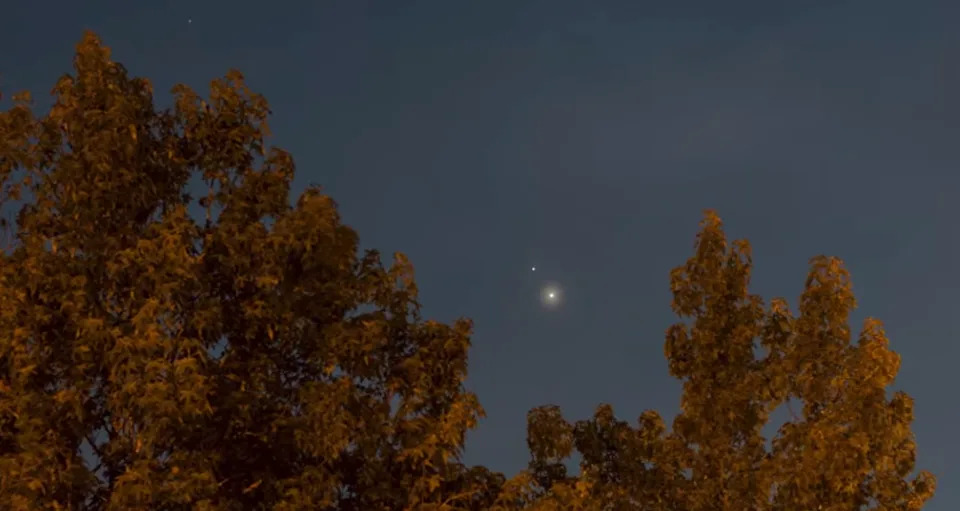
Venus and Jupiter are photographed together in the night sky during a previous conjunction involving the two planets.
Mercury is a little late to the party, as Venus and Jupiter have already been hanging out together since June 9 in a celestial event known as a conjunction.
A conjunction is an astronomical event in which at least two planets – and, often, also the moon – appear to our vantage from Earth to be close together in the sky even though they could still be millions or billions of miles apart.
How full will the moon be? What to know about lunar phase
During the second week of June, the moon will be entering a waning crescent phase before we have a new moon Sunday, June 14, according to the Old Farmer’s Almanac. That means Earth’s only natural satellite is getting less and less full each night as its crescent gets thinner and thinner, NASA explains.
In other words, the moon is not a threat to outshine any of the three planets.
In honor of Earth Day, see these photos of our planet from space
1 of 12
The crew of Artemis II captured a breathtaking image of a celestial event known as an “Earthset,” in which the Earth dropped below the lunar horizon. The image is reminiscent of the iconic “Earthrise” photo that NASA astronaut Bill Anders captured in 1968 during the Apollo 8 mission that showed our planet rising on the lunar horizon.
(Provided by NASA)Where, how can you see conjunction, planet parade?
For those in the Northern Hemisphere, which includes the United States, spotting the planet parade shouldn’t prove too difficult. Simply look west after sunset to see Mercury joining Venus and Jupiter in the night sky.
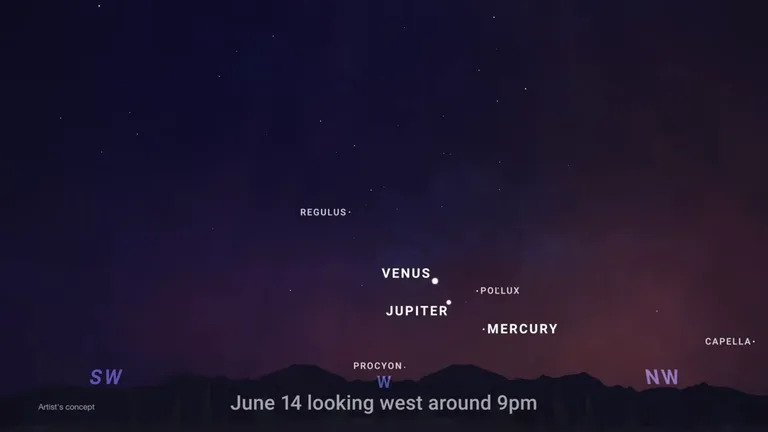
This graphic from NASA shows where in the sky to look for a planet parade involving Venus, Jupiter and Mercury in June.
Because Mercury will sit lower toward the horizon, “you will need a clear view to the west to catch it in the glow of twilight,” NASA said in a video.
To have the best chance of viewing the planetary alignment, find a spot free of light pollution and a view of the horizon without obstructions like trees or tall buildings.
Want to find a dark area near you? DarkSky International is a U.S nonprofit that maintains a list of designated dark sky communities around the world, including 176 in the United States.
Do you need a telescope to see planets form conjunction?
Mercury, Venus and Jupiter are among the five planets in our solar system visible without optical aid – along with Mars and Saturn.
Telescopes certainly will enhance the view but spectators don’t need any equipment to spot the three planets in the pre-dawn sky.
Eric Lagatta is the Space Connect reporter for the USA TODAY Network. Reach him at elagatta@usatodayco.com
This article originally appeared on USA TODAY: These 3 worlds will form a planet parade in June. When, where to watch