
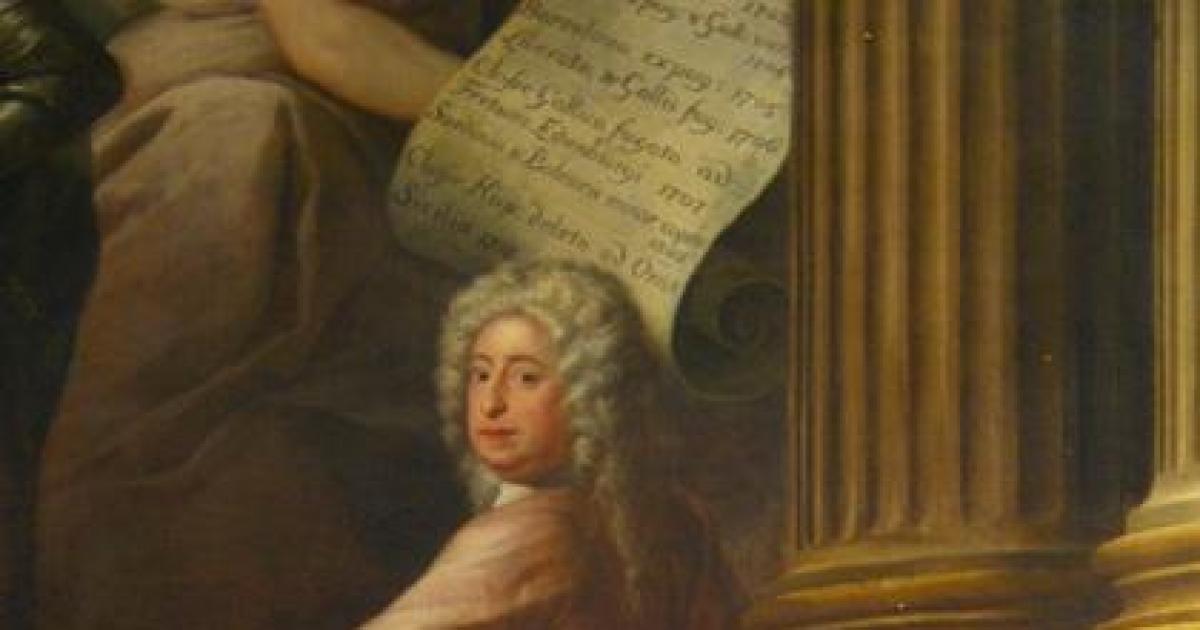
He left a legacy of wonderful paintings from the era of murals painted in the grand manner on walls and ceilings.
His most famous are the ones in the Painted Hall at Greenwich and the inside of the dome of St Paul’s Cathedral.
Stones from Portland began to be shipped to London for that cathedral in the year Thornhill was born in Lower Bond Street, 1675, and continued to be sent until 1710.
Apart from his obvious talents there was another reason that he got the job.
One of the trustees of the new building, Archbishop Tenison, had his own criterion for the choice of artist and insisted first that he “. . .be a Protestant; and secondly that he be an Englishman.”
Thornhill was chosen, but it did almost kill him once when, in a moment of careless abandon as he stepped back to look at something he had just painted, he came perilously close to the edge of the platform and nearly fell off.
He was saved only by the presence of mind of his assistant. It was a long way down from there.
The Last Supper painting by Sir James Thornhill in St Mary’s Church, Weymouth (Image: Wikimedia)
Thornhill was at the height of his success when he saw the need for art schools to be set up to keep the talented at home instead of being trained on, and lost to, the Continent.
The schools he set up, which had an emphasis on life drawing, formed the nucleus of the Royal Academy.
His most famous student ultimately became even more famous than he.
Hogarth, who married Thornhill’s daughter, Jane, continued to run the art school in the City of London after his father-in-law’s death and made his own large and unique contribution to English art.
Pepys and Evelyn, the great diarists of the day, described their era quite vividly. It was the time of Boyle, Newton and Halley, who founded the Royal Society.
They were followed a generation later by a society made up of artists, scientists and scholars, of which Thornhill was one, who created a stimulating period of history which probably laid the foundation of our way of life today.
Illustration of the Thornhill Obelisk near Sturminster Newton (Image: Supplied)
James, although based in London, still had roots in Dorset, and by this time he had bought back the old family seat, Thornhill House and Estate, near Stalbridge, which he redesigned and planted with many trees.
READ MORE: James Thornhill’s forgotten Last Supper in Weymouth church
In 1720 he was appointed Serjeant-Painter to George I and was knighted in the same year. The following year he was made a Freeman of his home town of Melcombe Regis, becoming its MP the year after that, a position he retained until his death at Stalbridge in 1734.
His house remained in the family for many years and William Hogarth continued his work of adding life and enthusiasm to the classical style of English painting which they both helped to create.
Thornhill did a lot of charitable work in Melcombe Regis and it is surprising that this worthy citizen is not commemorated more in the town of his birth.