
A damning first-of-its-kind report has exposed the grim reality facing sick Brits attending A&ERichard Ault, Joel Moore Senior Reporter and Carlos Novoa
15:17, 12 Jun 2026

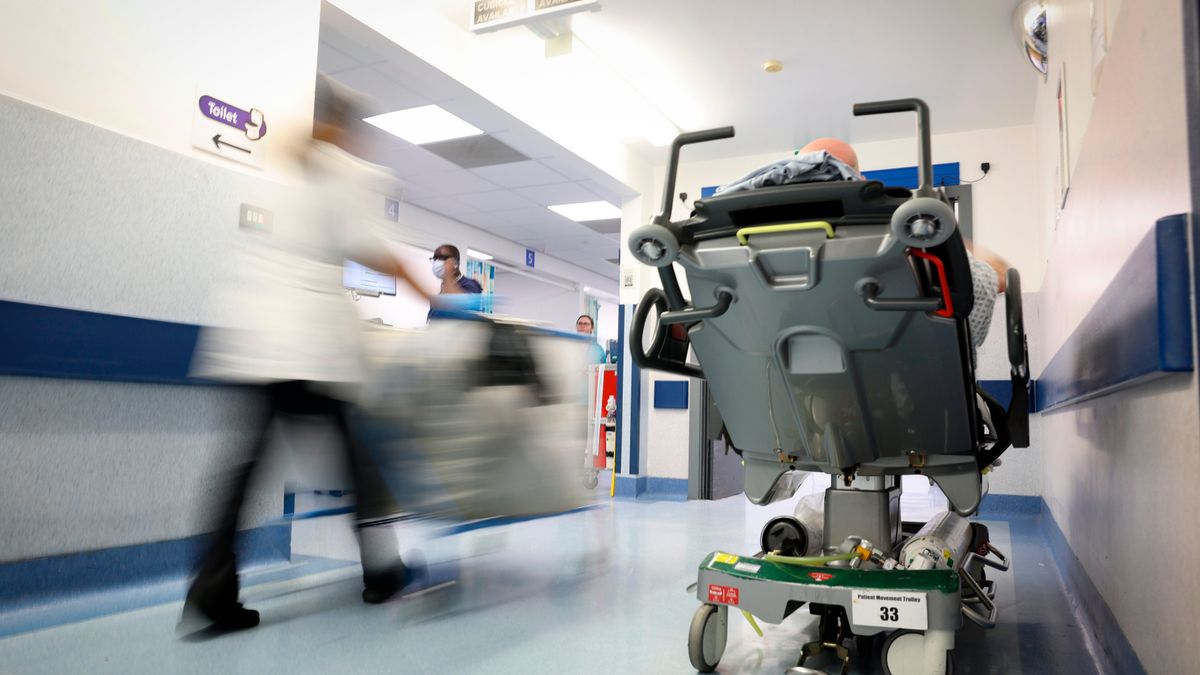
A staff member passes a patient on a bed in a corridor in the Emergency Department.(Image: Joseph Raynor/ Reach PLC)
More than 1,500 patients were treated in the corridors of a Nottingham hospital in just one month, newly released figures have revealed.
In a damning first-of-its-kind report, the NHS has published data exposing the grim reality facing sick Brits attending A&E and left languishing in makeshift “wards”.
According to the statistics, more than 90,000 people faced corridor care across hospitals in England in May.
At the Queen’s Medical Centre, which is run by Nottingham University Hospitals (NUH), 1,637 patients were treated in corridors, equating to 53 people per day.
A union representing thousands of workers across the trust said the care “compromises the privacy and dignity of people who are sick and vulnerable” and “undermines staff morale”.
Meanwhile, a campaign group said it was “a symptom of the perfect storm battering the NHS” and called on the government to develop a “sustainable funding model for the future”.
In January 2025, NUH deputy medical director Mark Simmonds told the Local Democracy Reporting Service that the trust aimed to end corridor care by the next winter.
However, these figures show that NUH ranks 16th worst for corridor care in the country.
Andrew Hall, chief operating officer at NUH, issued an apology to patients who had been forced to endure corridor care.
He said: “When our urgent and emergency care services are under pressure, we do utilise some corridors and other risk-assessed spaces to provide care for patients who are waiting to move into a formal bed space.
“While we work to ensure these areas are managed as well as they can be, they are not designed for patient care, and this leads to a poor experience for our patients and a substandard working environment for our staff.
“We would like to apologise to everyone who has had to spend part of a hospital stay with us in any of these spaces.
“We are taking action to reduce and eventually eradicate care in our corridors. We are now strengthening our clinical approach on wards to safely reduce length of stay and improve patient flow.”
Scott Weightman, regional organiser at Unison, said: “Corridor care compromises the privacy and dignity of people who are sick and vulnerable.
“It also undermines staff morale, as healthcare workers are working in challenging conditions that limit their ability to deliver the standard of care they strive to provide.
“Rising demand, combined with a crisis in social care, is placing immense pressure on NUH staff, making it increasingly difficult to deliver the quality of care patients need and staff want to give.
“The NHS cannot be expected to continue in this way. Meaningful investment and a long-term strategy are needed to address these challenges. In addition, the creation of a national care service is essential to relieve pressure on the NHS and resolve the persistent bottleneck in social care.”
Mike Scott, spokesman for Keep Our NHS Public Nottingham, said: “The 1,637 patients who received corridor care at the QMC last month are a symptom of the perfect storm battering the NHS.
“Nobody should be treated in a corridor, and everyone agrees that it’s completely unacceptable – but who should we blame?
“Pretty much every large trust in the country is in the same situation and all for the same reason: that funding has not kept up with changes in the population, particularly the growing number of older people and those with mental health problems.
“KONP believes the NHS should be a top government priority not an afterthought. It’s time to ditch the soundbites and come up with a sustainable funding model for the future.”
The data is the first to be released after NHS bosses ordered hospitals to compile and publish the data with a target of eradicating corridor care by 2029.
Daily figures show that in May, more than 69,000 corridor care incidents were reported at A&E units in England. That’s an average of 2,241 on any given day.
The figures also show that another 669 hospital patients on general and acute wards received care for more than 45 minutes on a ward “outside a bed space” each day, for a total of 20,611 incidents in May.
Figures for individual acute trusts show that 3,090 A&E patients and 575 general and acute ward patients received corridor care at London North West University Healthcare NHS in May, more than anywhere else in England.
There were also 3,238 corridor care patients at University Hospitals Sussex NHS Foundation Trust, which operates seven hospitals across Brighton and Sussex.
Mr Hall added: “We are working to ensure that consultant-led reviews are taking place on our wards to support faster clinical decision-making, alongside making practical changes to two wards to improve flow through our critical care pathways.
“Looking ahead, our expansion of our Same Day Emergency Care Unit (SDEC) will play a key role in transforming how patients access urgent and emergency services. By enabling more patients to be treated and discharged on the same day, we can reduce unnecessary admissions, improve flow across our hospitals, and support our ambition to eliminate corridor care altogether.”