
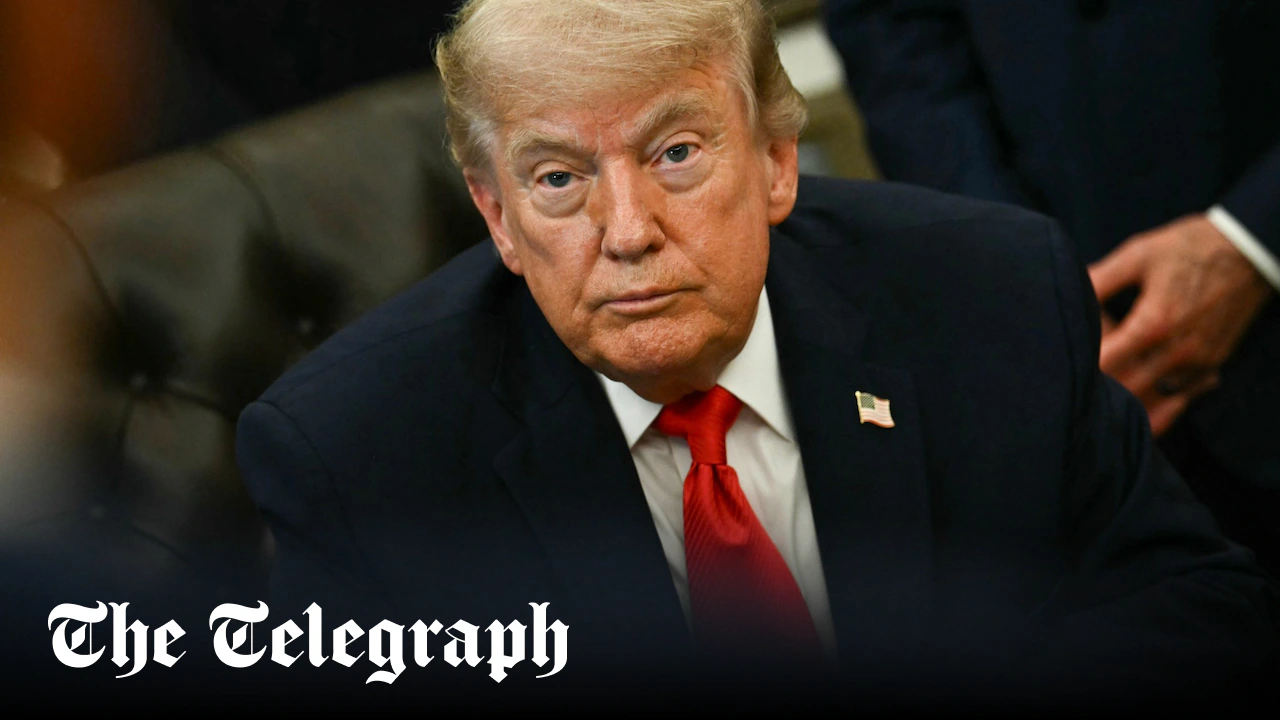
Donald Trump has shocked the world by banning the use of the most advanced AI by foreigners, including Britons, over national security fears.
The Trump administration has ordered that Anthropic’s latest systems, Fable 5 and Mythos 5, be cut off from non-Americans, including those based in the US. The AI systems are theoretically capable of conducting large-scale hacking attacks and developing bioweapons.
Anthropic said the only way to comply with the ban was to universally block access to its most advanced models, including for US citizens. Its popular Claude AI remains available.
Tom Tugendhat, the former Conservative security minister, warned that the ban exposed the UK’s lack of sovereign control over cutting-edge AI.
Writing on X, he said the ban was “the inevitable result of technology shaping warfare so that sovereignty is more about code than cannons”.
Mr Tugendhat told The Telegraph: “AI is the new competition for sovereignty.”
Andrew Griffith, the UK shadow business secretary, called the move “a disaster for Britain”.
Al Carns, who resigned last week as Armed Forces minister, wrote on X about Anthropic’s model: “British researchers were studying it. British companies were testing it. British hospitals were piloting it. Not any more.
“This isn’t an AI story. It’s the story of every industry we used to lead.”
The Trump administration issued an export control order on Friday night, Anthropic said. It came days after Dario Amodei, the company’s chief executive, himself wrote that the US government should have the power to block the rollout of new AI models if they were deemed “to present unacceptable risks”.
In a statement, Anthropic said the US government had been made aware of a method for bypassing safety controls, or “jailbreaking”, the models.
However, the company downplayed the problem, saying it was only a “specific technique being used to identify a small number of previously known, minor vulnerabilities”.
Anthropic said it disagreed with the export controls but was complying for now.
The company has taken the lead both in developing AI and in warning about its potential for harm.
It has clashed with the White House over the potential use of its technology by the US military. At the same time, Mr Amodei has argued that the US must work to maintain its lead in AI over China.
Mr Tugendhat said: “It’s hardly surprising that the States is looking to control AI models. AI usage is what enabled the extraordinarily successful targeting in Iran over the recent months.”
The restriction of the model in Britain is a blow to the Government, which has sought to position the UK as a global leader in the technology by inviting tech companies, including Anthropic, to test their models here.
Andrew Griffith, the shadow business secretary, told The Telegraph: “This is a disaster for Britain. Despite being our closest ally, no exemption for the UK has been procured.”
Mr Griffith added: “While the Labour Government is pursuing a 1970s fantasy of a state-owned steel industry and trains, there’s little to no action on sovereign capabilities in AI, in advanced manufacturing and in drones.”
The UK launched a sovereign tech fund in April of this year with the aim of turning the nation into what Sir Keir Starmer calls an “AI maker, not an AI taker”. However, the fund has only a £500m pot, a sum too small to make an influence on a technology that requires tens of billions to develop.
Responding to the Anthropic news on X, Kanishka Narayan, Labour’s tech minister, wrote: “The main lesson: as we debate the future of national security and technological sovereignty, access to AI capabilities is crucial. That’s why this Government is the first to set up dedicated funding for our AI industry.”