
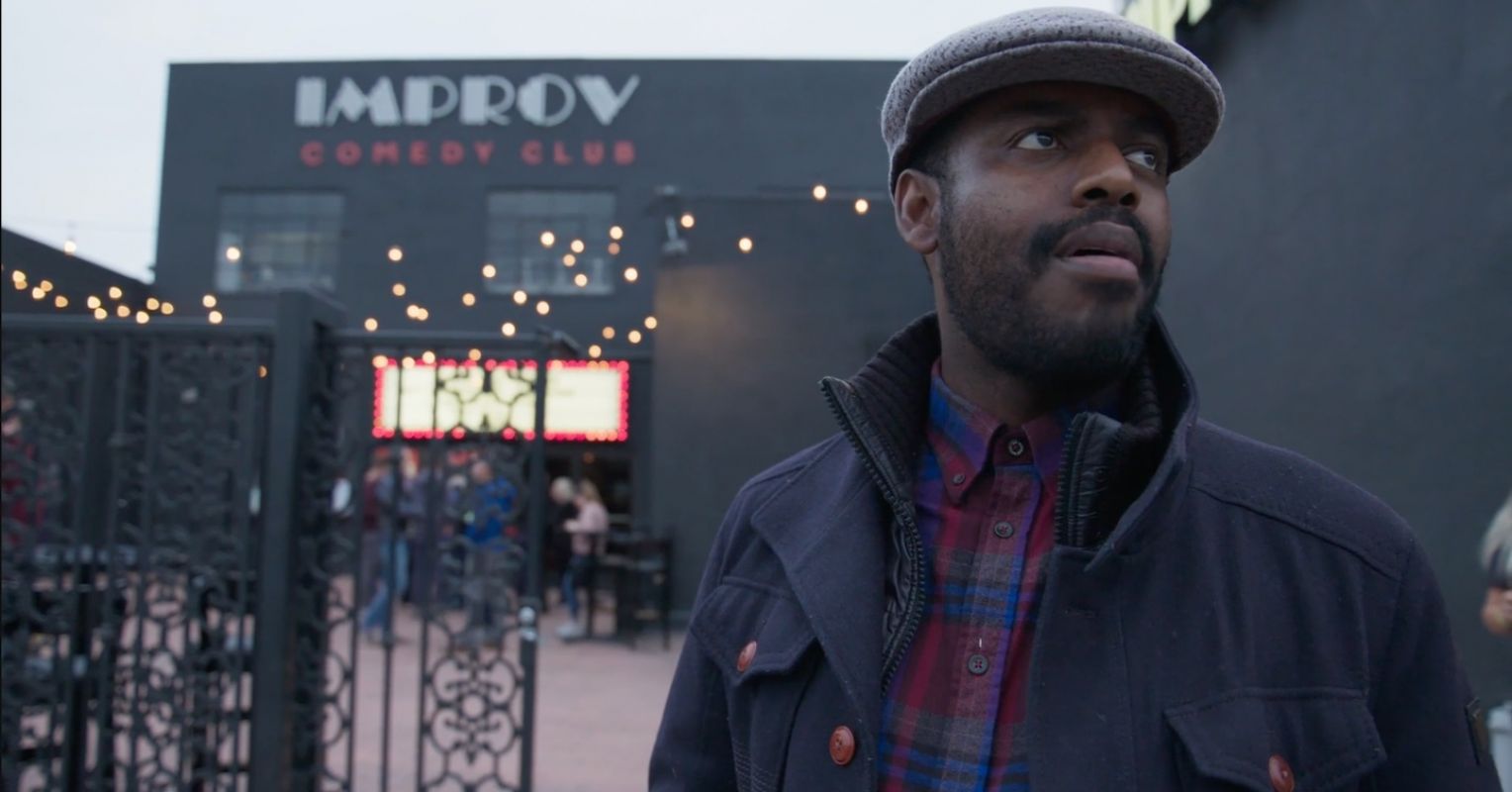
Anxiety Club, directed by Wendy Lobel, is an award-winning documentary that follows a group of comedians navigating the raw, uncomfortable, and unexpectedly funny experiences of living with anxiety. I have written multiple articles on the film because it feels so important to bring these conversations into different creative spaces, such as comedy, storytelling, and performance.
Among the featured comedians is Baron Vaughn, a comedian, actor, and writer recognized for his thoughtful and emotionally layered approach to comedy. His work, including Grace and Frankie and Mystery Science Theater 3000, explores identity, vulnerability, masculinity, and mental health through humor and storytelling. During a lovely conversation with Vaughn, we discussed comedy not just as entertainment, but as identity construction and emotional inquiry.
Humor and Coping With Life’s Challenges
Vaughn describes humor as a way of wrestling with the challenges of life. He pushes back on the idea of humor as a defense mechanism, noting that it is often misunderstood as deflection. Instead, he sees humor as a means of survival that helps us metabolize what is overwhelming into a narrative that can be shared and witnessed. At the same time, Vaughn points out that humor can sometimes lead us to minimize or dismiss our own pain or the pain of others.
“Any joke that you write is like a time capsule of who you were in the moment in which you wrote it,” Vaughn says. As a person evolves, the meaning of the joke evolves as well. When the realities of the person delivering the joke change, the joke itself may stop landing.
Many of his early acts were influenced by growing up without a father. “I had a lot of bits about that experience … leading up to meeting him later in life.” But after meeting his father, “I didn’t carry the same emotions. So the jokes stopped working.” He suggests that audiences are highly attuned to authenticity and can often sense when content no longer reflects the person performing it.
“When we try to solve thrillers or mysteries, the tip is always to follow the money,” Vaughn says. “But in comedy, you follow the feeling.” He explains that people do not necessarily engage with the experience itself as much as the emotion surrounding it. Everyone has been in a grocery store, but what audiences recognize is the feeling attached to the moment, whether it is overwhelm, shame, loneliness, or absurdity. Comedy distills those interactions into stories people can identify with.
“If you attach to things that you originally thought were funny,” Vaughn says, “it can become a trap. It gets in the way of progressing the joke.” It is crucial to allow bits to evolve organically, so that the jokes don’t become static.
Vaughn describes comedy as an unusual art form because the process and the delivery are inseparable. “A joke does not fully exist until it is performed,” he says. “Without the audience, there is no comedy.” Through repetition and feedback, the comedian learns what resonates with the crowd and what does not. This practice requires constant refinement of the set as well as the voice behind it.
Creating a comedy character also becomes part of the approach, which Vaughn describes as “… an amplified version of selected aspects of the self. The comedy character is parts of you.” Through constant self-reflection, certain traits, qualities, and personas are filtered, exaggerated, and expressed in ways that help audiences connect with the act more genuinely.
“I allow myself to go deeper into my inner landscapes,” Vaughn says. Comedy becomes a path to creative expression and self-investigation, where the performer is witnessed while trying to understand parts of themselves in front of a live audience.
Vaughn refers to comedy as the “bastard cousin of poetry,” stating that it is the act of “taking in, processing, and translating the human experience into verbal nuggets, so you can see what I see and see yourselves through my words.” The audience will either accept it or they will not, and comedians learn this through trial and error.
There are certain comedic observations audiences may reject if they betray the way a comedian has presented themselves. Vaughn notes that graphic sexual humor, for example, might not land if it falls outside the established emotional tone of the performer. Comedy, in this sense, depends not only on content, but on authenticity and consistency of character.
For Vaughn, growing up without a father has impacted the coping mechanisms he developed and his relationship to masculinity. In a culture where men are often limited to anger as the only acceptable emotion, vulnerability and the expression of pain are frequently framed as weakness. Vaughn suggests that the absence of a traditional male model may have allowed him to stay more connected to his emotions and access what lay beneath the anger.
Now, as a parent, Vaughn says he has a different perspective on his earlier experiences. “I see myself at the age my children are,” he reflects. It becomes a kind of shadow work, revisiting childhood through the lens of parenthood.
The Impact of “Anxiety Club”
When asked what surprised him most about Anxiety Club, Vaughn said he felt a real thrill when the film was screened at DOC NYC. The film helps people feel seen, less alone, and more willing to seek support. It is hilarious, disarming, and deeply relatable. Live events kicked off in New York at the Comedy Cellar and in Los Angeles at the Laugh Factory. The film is now available through its May 1 digital release across major platforms and continues to reach audiences through campus and community screenings. A portion of proceeds supports Comedy Gives Back and the Anxiety and Depression Association of America.
“The documentary is not like a lecture,” Vaughn says. “It is a depiction of a very human experience.” It is vulnerable, uncomfortable, honest, and very funny.