
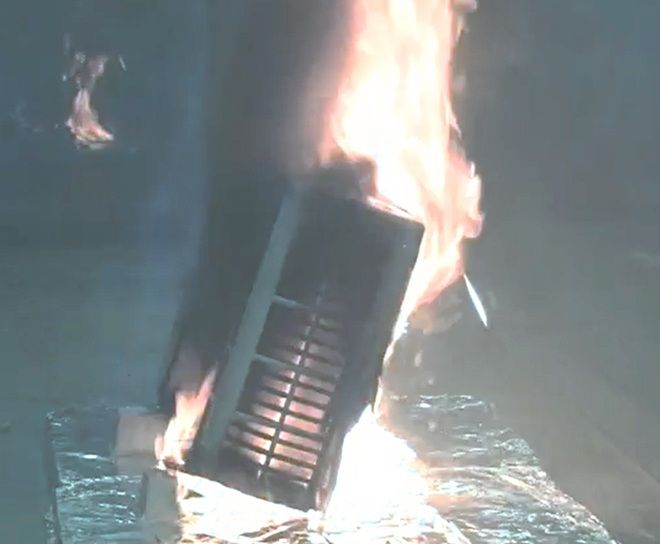
Add clear plastic water bottles to the list of items to keep clear of outdoor air conditioner units, lest they catch fire under the heat of the summer sun.
The warning and other precautions from the National Institute of Technology and Evaluation (NITE) are not directly linked to AC units themselves, but the season of peak usage.
MAGNIFYING EFFECT
Manufacturers and fire departments reported a total of 345 accidents involving air conditioners to the NITE over a five-year period between fiscal 2021 and fiscal 2025.
Their relative frequency during the summer was evident in monthly figures topping 50 for both July and August.
From there, the NITE analyzed 252 accidents with completed investigations from the overall 345. It found up to 60 percent of accidents were not related to technical issues with the indoor or outdoor units.
The largest batch, comprising 96 accidents, were attributed to or caused by fires that began elsewhere that spread to the units.
Plastic bottles were the culprit in one of these cases. A pair of clear bottles filled with water were placed on a sheet to keep it from blowing off the top of an outdoor unit.
The air conditioner was off the entire time. It is posited sunlight hitting the bottles acted like a magnifying lens and concentrated on a single point that caught fire, eventually engulfing the unit and surrounding area.
This is where proximity becomes an issue. Compressors used in outdoor units rely on refrigerant gas and lubricating oil; both burn violently if lit.
Along with plastic bottles, the NITE cautions against leaving anything flammable, such as cardboard boxes or ashtrays, near outdoor units.
The case against cardboard boxes is more roundabout. Mice and bugs may see them as potential shelter. If they move in, they could eventually venture into a unit and gnaw on cables or run into power supply boards.
This can lead to the appliance short circuiting or catching fire on occasion.
ACTIVE SAFETY CHECKS
Fire risks are not exclusive to the outdoors.
Modifying or extending power cords to contend with incompatible outlets or too-short cables can result in shoddy connectivity when plugged in; a cable could overheat and ignite, spelling disaster for an indoor unit and anything nearby.
The NITE recommends that consumers entrust air conditioner installation and repair work to contractors with specialized expertise and qualifications.
The institute similarly encourages the public to be proactive about checking that their units are safe to use to detect any issues as early as possible.
To do this, air conditioners should first be set to the lowest possible temperature and put in cooling mode for 10 minutes to determine whether they are properly expelling cold air.
They should then run for another 30 minutes and indoor units should be monitored for potential water leaks.
Both indoor and outdoor units should also not emit unusual noise or odors, such as a burning smell.
During this test, air conditioners must not display any error messages or unexpectedly shut off.
Any anomalies should be promptly shared with retailers and manufacturers.
ECO-FRIENDLY UPGRADES
The government is set to introduce much stricter energy efficiency standards for household air conditioners in April 2027 that manufacturers must comply with.
As a result, new models that meet the updated criteria are expected to have higher price tags than models made to the current standards.
However, consumers should take their time and not necessarily rush to replace their units, and upcoming models may help reduce electricity bills over time thanks to their improved energy efficiency.
Estimates by the Agency for Natural Resources and Energy show that an updated 2.2-kilowatt air conditioner designed for a room measuring six tatami mats will slash annual utility costs by 2,760 yen ($17) compared to conventional models.
The total yearly savings for a 4.0-kW air conditioner for a 14-tatami-floored room is projected to be 12,600 yen.
Some local governments also offer subsidies to residents upgrading to eco-friendly models or purchasing energy-efficient products, making it advisable to check for financial incentives before placing any orders.