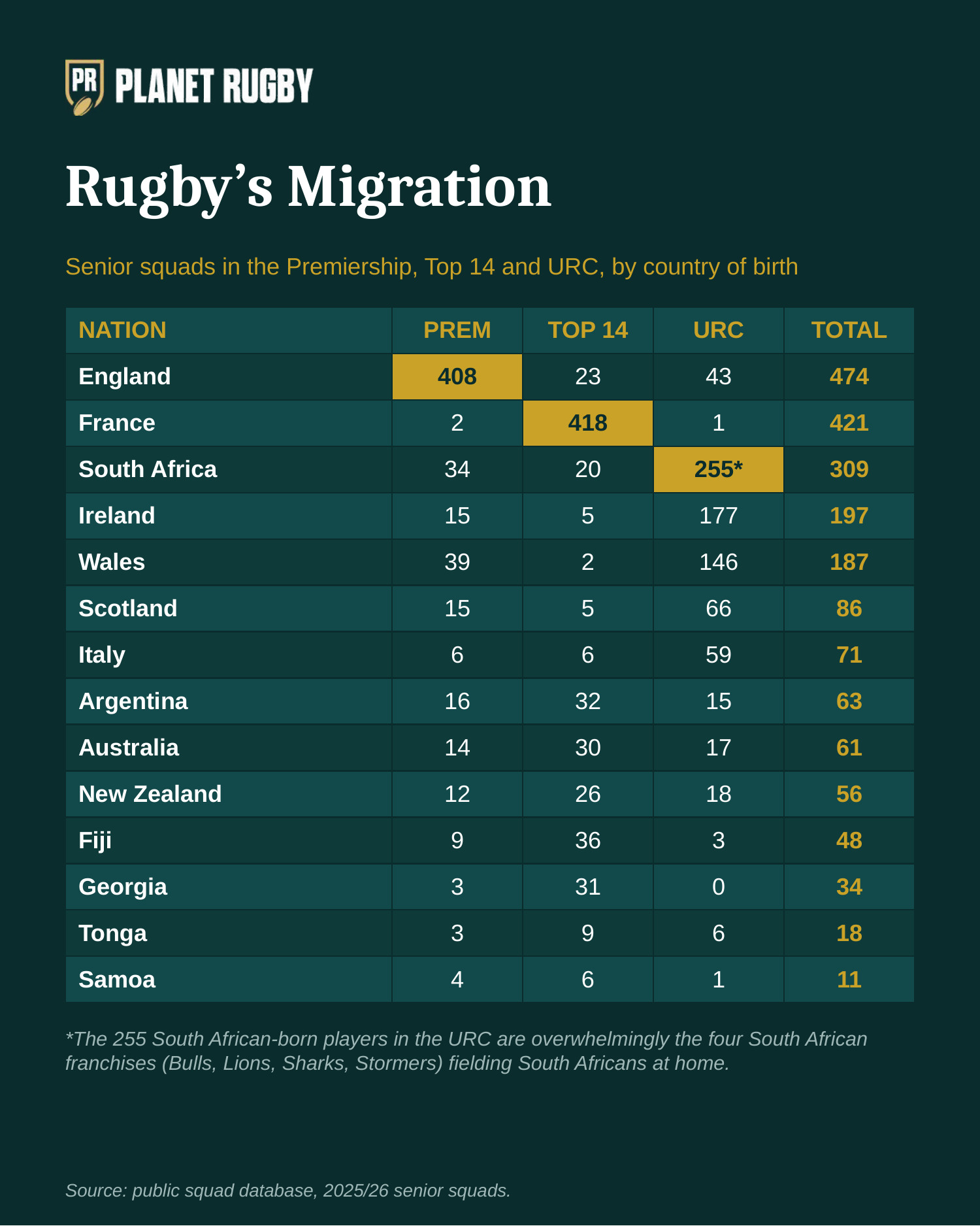

South Africa has spent years being blamed for an invasion of the northern game. Count these three leagues properly – the PREM, the URC and the Top 14 – and the accused turns out not to be the great exporter at all, while the raids that really drain rugby’s poorer systems go almost unremarked.
South Africa mostly plays at home
Ask a South African supporter what they have done to the northern game and they will know the charge sheet by heart. They have annexed the URC. The Springbok badge is on every team sheet from Bath to Bordeaux. It is a tidy story, and it collapses on the very first number.
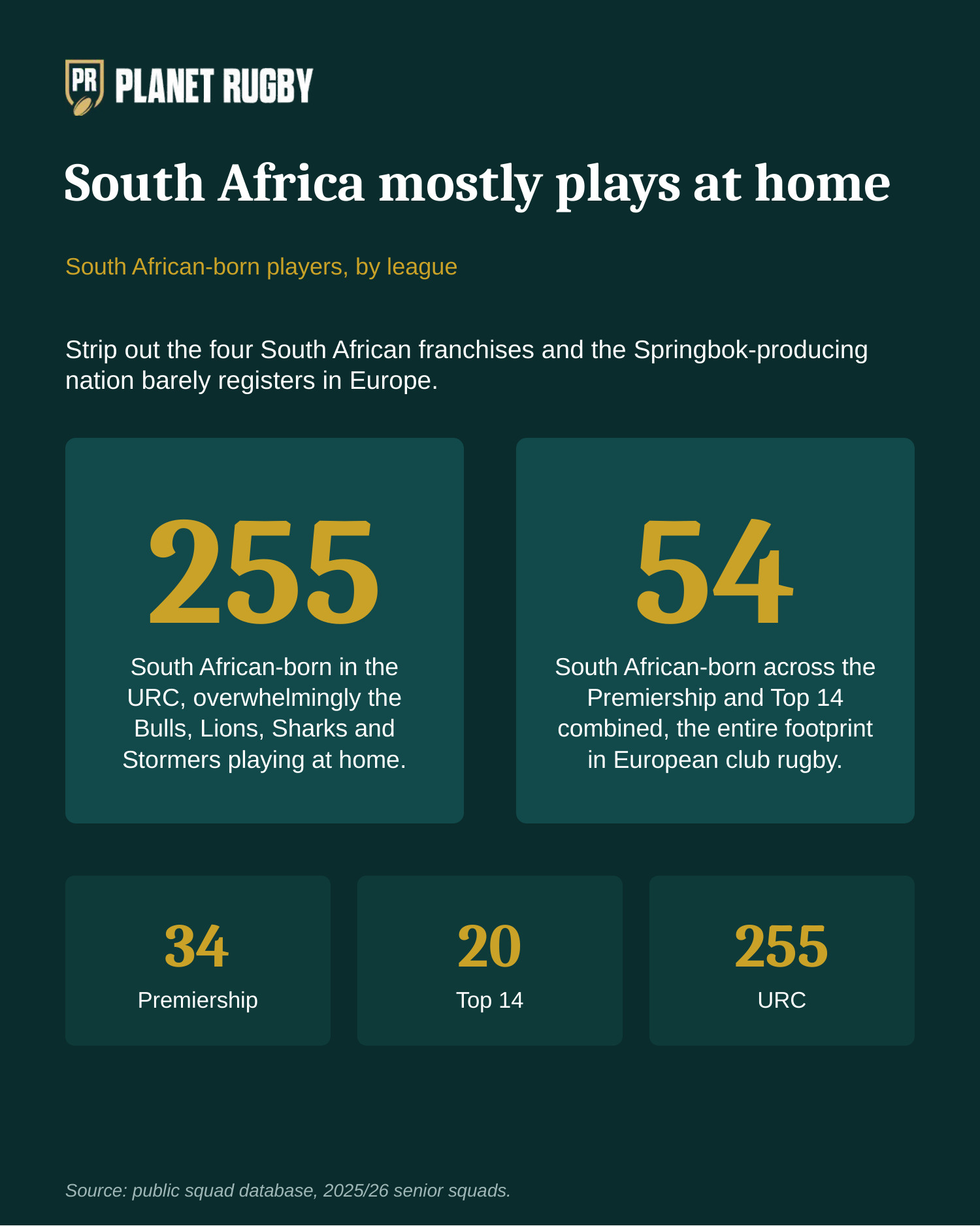
The 255 South Africans in the URC, the figure that launches the loudest threads, are overwhelmingly explained by the four South African franchises, the Bulls, the Lions, the Sharks and the Stormers, fielding South Africans in Pretoria, Johannesburg, Durban and Cape Town. Charging the league with it is like charging Leicester with a dangerous quantity of Englishmen.
Strip those four sides out and the actual South African-born footprint in European club rugby is slight: 34 across the Prem, 20 in the Top 14, 54 men spread across better than a thousand squad places in two leagues. On these lists the country cast as the great raider is one of the most home-based in the game.
The marquee movement even runs the other way. The biggest South African transfer of the year is not a Bok arriving in Europe but one going home, Thomas du Toit leaving Bath, the 2025 English champions, to pull a Sharks shirt back on in Durban. “Our lives, especially after rugby, are in South Africa,” he said. The country everyone casts as the great accumulator is still capable of pulling its best men home.
England is still English
The same lens that sees a Springbok takeover sees an English league drowning in foreigners, and it is wrong twice over. Of the 588 players named across the Prem this season, 408 were born in England, 69 per cent of the competition before anyone has mentioned residency or a project player.
A South African signing is spotted within the hour and filed under hired gun before he has unpacked. The group of imports almost nobody flags, meanwhile, is neither South African nor a horde of Kiwis. It is 39 Welshmen, quietly making a living across the bridge. The biggest outside supplier to English rugby is the nation next door, and it’s becoming an endemic talent drain.
Wales is the real leak
The leak that ought to keep someone in Cardiff awake is not coming in. It is going out, and it is Welsh: 39 Welshmen earn their living in the Prem, the largest overseas group in the whole English league, and more than one in five Welsh-born professionals across these competitions now play outside the four regions, almost all of them across the bridge. They go willingly, because the league next door can pay them and the system that raised them increasingly cannot.
The regions they leave behind are no longer reliably Welsh either, the home core thinned and padded out with imported labour while Welsh rugby talks openly about running out of money and cutting regions. A region has become somewhere Welsh players come from rather than somewhere they stay. The danger to Welsh rugby was never the men arriving. It is the men leaving.
France runs on poorer rugby economies
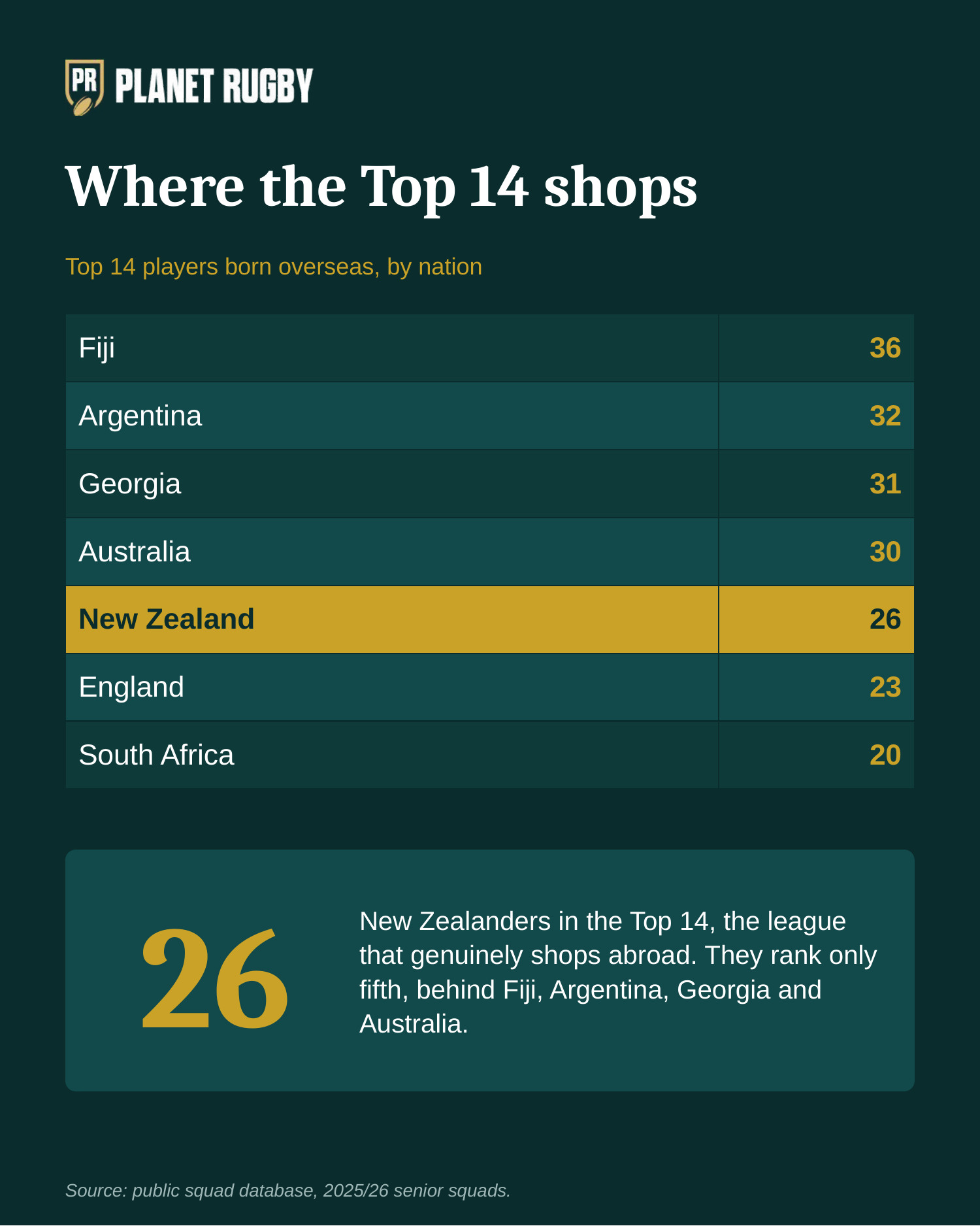
France has built itself on imported rugby labour all right, just not the source anyone complains about. The Top 14 carries 26 New Zealanders. It also carries 36 Fijians, 32 Argentines and 31 Georgians, with nine more from Tonga and six from Samoa stacked in behind them. Add Fiji, Tonga, Samoa, Georgia and Argentina together and a single league has taken 114 players from five unions on the wrong side of the game’s money, against 26 from the country everyone shouts about.
Most of these are nations that cannot get near French club salaries, and all of them are operating outside the game’s richest club economy. They hand over their best to a league that gives back no transfer windfall and no share of the broadcast money those players help to sell.
A Fijian wrecking ball in a French midfield is welcomed as a bargain. A Georgian tighthead holding up a French scrum is treated as furniture. The viral thread of indignation almost never comes, because the people on the wrong end of it are not fashionable enough to be worth defending.
New Zealand is the phantom menace
For all the folklore, the Kiwi invasion barely exists: 12 New Zealanders were named to Prem squads this season, 12 men. You could not crew a matchday 23 out of them, never mind annex a league. There are 18 in the URC and 26 in the Top 14, where they rank only fifth among overseas nations.
The bogeyman that earns a fresh thread every season turns out to be the smallest serious number in the data, and the anger has been aimed at the wrong 26 for years. Every season spent policing those 26 is a season the 114 in France go unremarked.
The money is the point
One honest qualifier, before this reads as a charge sheet of its own, is that nobody in it is a victim of kidnap. The Fijian in Toulon, the Georgian in Clermont, the Welshman in Bristol and the South African in Tokyo are all doing the sensible thing, taking the best wage the game offers them while the offer lasts.
A career is short and a body is fragile, and the money in France or Japan or England is money their own unions cannot match and would not pretend to. The players are not being stolen, they are being paid, which is a different thing, and most of them would tell you they are glad of it.
That is exactly why the silence around it should sit uncomfortably. Market forces are doing what market forces do, and the talent flows uphill to the richest rooms, from Suva and Tbilisi and Apia and, yes, from Llanelli and Pontypridd.
The Pacific needs that income and so does Wales, every bit as much, because the wage a young forward earns abroad is often the only return his system ever sees.
The trouble is never the individual deal. It is that the union which raised him, fed him through age-grade rugby and handed him to the world, gets no structural share of what he later earns, no levy, no development cut, no slice of the broadcast pot his shirt helps to sell. The richest leagues take the finished player and owe the factory nothing.
So this was never an argument for closing borders or capping foreigners, which would only make the poorer unions poorer still. It is an argument for noticing where the money goes, and where it does not. Fiji, Georgia and Samoa and the four Welsh regions are not being invaded. They are being quietly drained of the one asset they produce better than almost anyone, and handed nothing back but the wages of the men who leave.
Want more from Planet Rugby? Add us as a preferred source on Google to your favourites list for world-class coverage you can trust.
Put the five numbers together and the wrong invasion was never South African and never a Kiwi one. It was extraction, quiet and relentless, from the poor, the small and the financially broken, sitting in the squad lists in plain figures the whole time, waiting for somebody to add it up.
Every figure here counts listed squad players by where they were born, not by who they can play for. Figures are taken from listed squads across the Prem, Top 14 and URC, counted by country of birth rather than Test eligibility.