
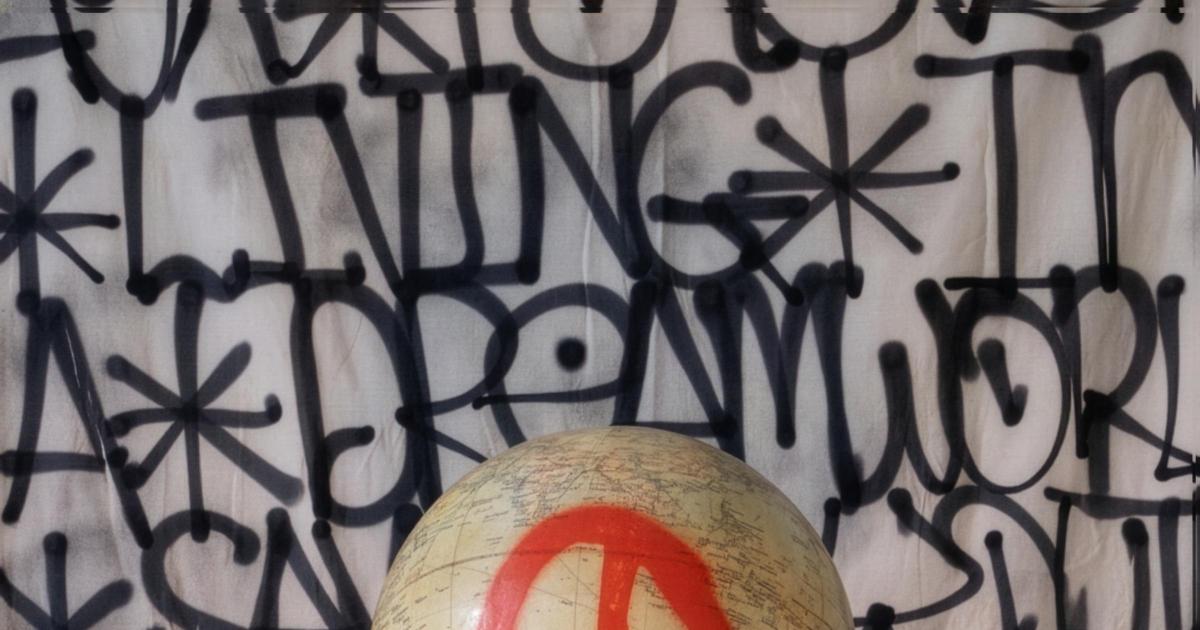
Long before street art became a commodity traded in auction houses and collected by hedge fund managers, a Bristol-based artist called Sickboy was painting his now-iconic Temple motif across the walls of Britain’s cities.
Temple Box (Image: Supplied)
For more than two decades, that symbol—a bold, graphic structure that speaks simultaneously of permanence and transience—has appeared on trains, underpasses, gallery walls, and, soon, on the landscape of north Norfolk itself.
Born Charlie, Sickboy is one of the figures who shaped a generation of British street art from the ground up—not as a follower of a scene but as one of its architects.
He was among the first to move beyond the tag and develop a distinctive visual motif: a shift that would come to define the transition from graffiti as vandalism to graffiti as art.
His peers from those early years include some of the most recognisable names in contemporary art, though Sickboy is clear that he walks his own path.
The humour is characteristic.
Sickboy has never been an artist who hides behind mystique.
Where others in the street art world have cultivated anonymity as a brand in itself, he has always put his name to his work and his face to his ideas.
Forever Cushion (Image: Supplied)
Sickboy came of age in Bristol at the precise moment the city’s streets became a proving ground for some of the most significant art of the late twentieth century.
Alongside Banksy, with whom he has a well-documented history, and others who would go on to define the street art canon, he developed his practice in an environment where risk was real and recognition came slowly, if at all.
His Temple motif became a recurring presence across the urban landscape in Bristol, London, and far beyond.
Unlike the political provocation that would become Banksy’s trademark, Sickboy’s iconography operates in a more philosophical register, circling the themes he has always returned to: love, peace, happiness, and death.
The Temple, with its architectural resonance and its suggestion of both sanctuary and ruin, carries all of these tensions at once.
He featured in Banksy’s landmark film and was part of the Santa’s Ghetto shows—the irreverent, sell-out pop-up exhibitions that brought street art into gallery spaces and forced the mainstream art world to pay attention.
He was also represented through Pictures on Walls, the print publisher that brought affordable editions of street art to a new generation of collectors and helped establish the market that now sustains the scene.
Sickboy’s own collection, accumulated over decades of travelling, buying, and trading, is itself a kind of artwork, a physical map of cultural enthusiasms that ranges from rare vinyl to antiques and beyond.
It both sustains his practice financially and feeds it intellectually.
His house, he says, is “like a show and tell”—a space where objects exist in conversation with each other and with the art he makes.
“Objects carry energy.
“They absorb the stories of the people who owned them and the moments they’ve lived through.”
The decision to step back was not taken lightly.
He had spent years putting his energy into other artists, other projects, other people’s careers.
“All my energy for my own art was being put on other people,” he reflects.
“And once you are in it, you can’t really get out of it.
“You’re just like, right, next project.
Sickboy (Image: Keown)
“You don’t want to let people down.”
His enthusiasm is contagious.
Now, Sickboy turns his attention to north Norfolk and to what promises to be one of the most distinctive exhibitions the region has seen.
Fair Warning opens at Bishop & Miller’s Glandford with a private view on 18 June (RSVP via www.sickboy.co.uk) from June 19 to July 5, inaugurating a new dedicated contemporary exhibition space at what was, until recently, a traditional auction house.
The transformation of Bishop & Miller, a specialist fine art and antiques firm with salerooms in Stowmarket and Glandford, into a contemporary art space is itself part of the story.
Sickboy arrived with energy, a vision, and a willingness to operate on his own terms, and the company’s response was to re-imagine what the space could be.
“They’ve basically gone, we’re going to close this auction house and turn it into a gallery,” he says, with evident satisfaction.
The conceptual framing is characteristically ambitious.
The show has grown out of what Sickboy describes as a focus on “positivity out of adversity”—a survey of moments in cultural history when art, music, and design emerged from darkness as acts of defiance and renewal.
“Art Deco came off the back of World War One,” he explains, “and people wanted to start doing all of that—the whole decadent theme, the expressiveness.
“People wanted to come out and be like that instead of just getting smashed by armour.”
The show spotlights twenty items and topics from the twenty-first century and earlier, each a case study in the human capacity to create beauty and community from catastrophe.
Bishop & Miller’s own statement captures the ambition: “This exhibition marks the beginning of a space where contemporary artists can respond directly to the extraordinary objects and histories that pass-through Bishop & Miller.
“Sickboy and his legacy of creating immersive environments is the perfect artist to open the conversation.”
But the exhibition does not begin inside the gallery.
In one of the most inventive public art gestures Norfolk has seen, Sickboy has broken apart his Temple symbol—the motif that has been the spine of his practice for over two decades—into seven pieces.
Each fragment has been placed inside a specially made wooden box and hidden at an undisclosed location across the county.
The public are invited to find them.
Clues will be released through Sickboy’s Instagram and social media channels, sending searchers out into the Norfolk landscape on a trail that is part treasure hunt, part conceptual artwork, part community event.
Those who find a fragment will be invited to bring it to the exhibition’s opening event, where all seven pieces will be reunited in a live act of collective assembly.
“I liked the idea of creating something that couldn’t exist until a group of strangers came together,” Sickboy says.
“Each fragment has its own journey, but the work is only complete when people choose to share what they’ve found.”
The completed work, titled Fair Warning Unity Temple, will then remain on display as part of the exhibition, carrying within it the stories of the people and the landscape that helped bring it into being.
It is a typically Sickboy gesture: conceptually rigorous, formally elegant, and fundamentally about connection.
“The whole show is about riffing off items,” he explains.
“Spotlighting positivity out of adversity, and letting people know that around the corner of something dark, there’s some light.
“That’s within human nature and spirit because otherwise these things would not happen.”
“I feel like health is unfinished,” he muses, when asked what remains incomplete.
“If I am healthier physically, purer—that, as a self-project, is the best thing I do.”
Fair Warning opens at Bishop & Miller, Glandford, north Norfolk, from 19 June to 5 July 2026.
The treasure hunt launches ahead of the opening—follow Sickboy on Instagram for clue releases.
The private view takes place on June 18.