
IceCube Collaboration Evidence for high-energy extraterrestrial neutrinos at the IceCube detector. Science 342, 1242856 (2013).
Aartsen, M. G. et al. Characteristics of the diffuse astrophysical electron and tau neutrino flux with six years of IceCube high energy cascade data. Phys. Rev. Lett. 125, 121104 (2020).
IceCube Collaboration et al. Evidence for neutrino emission from the nearby active galaxy NGC 1068. Science 378, 538–543 (2022).
Abbasi, R. et al. Probing the connection between IceCube neutrinos and MOJAVE AGN. Astrophys. J. 973, 97 (2024).
Li, R.-L., Zhu, B.-Y. & Liang, Y.-F. Investigating the correlations between IceCube high-energy neutrinos and Fermi-LAT γ-ray observations. Phys. Rev. D 106, 083024 (2022).
Stein, R. et al. A tidal disruption event coincident with a high-energy neutrino. Nat. Astron. 5, 510–518 (2021).
Winter, W. & Lunardini, C. A concordance scenario for the observed neutrino from a tidal disruption event. Nat. Astron. 5, 472–477 (2021).
Huang, K. et al. ALMA polarimetry of AT2018cow. Astrophys. J. Lett. 878, L25 (2019).
Abbasi, R. et al. Limits on neutrino emission from GRB 221009A from MeV to PeV using the IceCube neutrino observatory. Astrophys. J. Lett. 946, L26 (2023).
Thompson, T. A., Quataert, E. & Waxman, E. The starburst contribution to the extragalactic γ-ray background. Astrophys. J. 654, 219–225 (2007).
Lacki, B. C. & Thompson, T. A. The Physics of the far-infrared-radio correlation. II. Synchrotron emission as a star formation tracer in high-redshift galaxies. Astrophys. J. 717, 196–208 (2010).
Tamborra, I., Ando, S. & Murase, K. Star-forming galaxies as the origin of diffuse high-energy backgrounds: gamma-ray and neutrino connections, and implications for starburst history. J. Cosmol. Astropart. Phys. 2014, 043–043 (2014).
Murase, K., Guetta, D. & Ahlers, M. Hidden cosmic-ray accelerators as an origin of TeV–PeV cosmic neutrinos. Phys. Rev. Lett. 116, 071101 (2016).
Bechtol, K., Ahlers, M., Di Mauro, M., Ajello, M. & Vandenbroucke, J. Evidence against star-forming galaxies as the dominant source of Icecube neutrinos. Astrophys. J. 836, 47 (2017).
IceCube Collaboration IceCube-210922A—IceCube observation of a high-energy neutrino candidate track-like event. GRB Coord. Netw. 30862, 1 (2021).
Garrappa, S., Buson, S., de Menezes, R. & Fermi-LAT Collaboration Fermi-LAT gamma-ray observations of IceCube-210922A. GRB Coord. Netw. 30867, 1 (2021).
Malacaria, C. & Fermi-GBM Team IceCube-210922A: upper limits from Fermi-GBM observations. GRB Coord. Netw. 30871, 1 (2021).
Ayala, H. & HAWC Collaboration IceCube-210922A: no significant detection in HAWC. GRB Coord. Netw. 30876, 1 (2021).
Coleiro, A., Dornic, D. & ANTARES Collaboration IceCube-210922A: no neutrino counterpart candidates in ANTARES search. GRB Coord. Netw. 30875, 1 (2021).
Krauss, F. et al. IceCube-210922A: no candidate counterparts from Swift/XRT follow up observations. GRB Coord. Netw. 30877, 1 (2021).
Weimann, S. et al. IceCube-210922A: no candidate counterparts from the Zwicky transient facility. GRB Coord. Netw. 30870, 1 (2021).
Palmese, A. et al. IceCube-210922A: DESI observations. GRB Coord. Netw. 30923, 1 (2021).
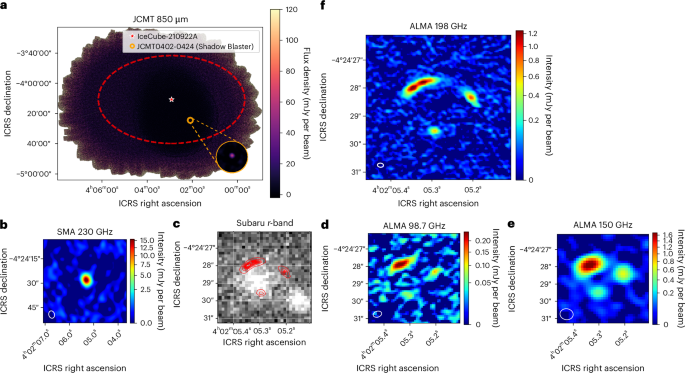
Urata, Y. & Huang, K. IceCube-210922A: JCMT/SCUBA2 observations. GRB Coord. Netw. 30882, 1 (2021).
Di Francesco, J., Johnstone, D., Kirk, H., MacKenzie, T. & Ledwosinska, E. The SCUBA legacy catalogues: submillimeter-continuum objects detected by SCUBA. Astrophys. J. Suppl. Ser. 175, 277–295 (2008).
Geach, J. E. et al. The SCUBA-2 Cosmology Legacy Survey: 850 μm maps, catalogues and number counts. Mon. Not. R. Astron. Soc. 465, 1789–1806 (2017).
Garratt, T. K. et al. The SCUBA-2 Large eXtragalactic Survey: 850 μm map, catalogue and the bright-end number counts of the XMM-LSS field. Mon. Not. R. Astron. Soc. 520, 3669–3687 (2023).
Urata, Y. & Petitpas, G. IceCube-210922A: SMA observation for the JCMT candidate. GRB Coord. Netw. 30891, 1 (2021).
Krauss, F. et al. IceCube-210922A: hard X-ray flux limit for JCMT/SCUBA2 source from NuSTAR observations. GRB Coord. Netw. 30937, 1 (2021).
Swinbank, A. M. et al. Intense star formation within resolved compact regions in a galaxy at z = 2.3. Nature 464, 733–736 (2010).
ALMA Partnership et al. The 2014 ALMA Long Baseline Campaign: observations of the strongly lensed submillimeter galaxy HATLAS J090311.6+003906 at z = 3.042. Astrophys. J. Lett. 808, L4 (2015).
Falgarone, E. et al. Large turbulent reservoirs of cold molecular gas around high-redshift starburst galaxies. Nature 548, 430–433 (2017).
Solomon, P. M., Downes, D., Radford, S. J. E. & Barrett, J. W. The molecular interstellar medium in ultraluminous infrared galaxies. Astrophys. J. 478, 144–161 (1997).
Solomon, P. M. & Vanden Bout, P. A. Molecular gas at high redshift. Annu. Rev. Astron. Astrophys. 43, 677–725 (2005).
Carilli, C. L. & Walter, F. Cool gas in high-redshift galaxies. Annu. Rev. Astron. Astrophys. 51, 105–161 (2013).
Papadopoulos, P. P., Thi, W. F. & Viti, S. CI lines as tracers of molecular gas, and their prospects at high redshifts. Mon. Not. R. Astron. Soc. 351, 147–160 (2004).
Bothwell, M. S. et al. A survey of molecular gas in luminous sub-millimetre galaxies. Mon. Not. R. Astron. Soc. 429, 3047–3067 (2013).
Sturm, E. et al. Massive molecular outflows and negative feedback in ULIRGs observed by Herschel-PACS. Astrophys. J. Lett. 733, L16 (2011).
Cicone, C. et al. Massive molecular outflows and evidence for AGN feedback from CO observations. Astron. Astrophys. 562, A21 (2014).
Downes, D. & Solomon, P. M. Rotating nuclear rings and extreme starbursts in ultraluminous galaxies. Astrophys. J. 507, 615–654 (1998).
Weiß, A., Henkel, C., Downes, D. & Walter, F. Gas and dust in the Cloverleaf quasar at redshift 2.5. Astron. Astrophys. 409, L41–L45 (2003).
Oikonomou, F., Murase, K., Padovani, P., Resconi, E. & Mészáros, P. High-energy neutrino flux from individual blazar flares. Mon. Not. R. Astron. Soc. 489, 4347–4366 (2019).
Murase, K., Kimura, S. S., Zhang, B. T., Oikonomou, F. & Petropoulou, M. High-energy neutrino and gamma-ray emission from tidal disruption events. Astrophys. J. 902, 108 (2020).
Abbasi, R. et al. Evidence for a spectral break or curvature in the spectrum of astrophysical neutrinos from 5 TeV to 10 PeV. Phys. Rev. Lett. 136, 121002 (2026).
Simpson, J. M. et al. The SCUBA-2 Cosmology Legacy Survey: ALMA resolves the rest-frame far-infrared emission of sub-millimeter galaxies. Astrophys. J. 799, 81 (2015).
Hodge, J. A. et al. Kiloparsec-scale dust disks in high-redshift luminous submillimeter galaxies. Astrophys. J. 833, 103 (2016).
Fujimoto, S., Ouchi, M., Shibuya, T. & Nagai, H. Demonstrating a new census of infrared galaxies with ALMA (DANCING-ALMA). I. FIR size and luminosity relation at z = 0–6 revealed with 1034 ALMA sources. Astrophys. J. 850, 83 (2017).
Toba, Y. et al. Hyper-luminous dust-obscured galaxies discovered by the Hyper Suprime-Cam on Subaru and WISE. Publ. Astron. Soc. Jpn 67, 86 (2015).
Fukuchi, H. et al. J1406+0102: a dust-obscured galaxy hiding a super-Eddington accretion system with bright radio emission. Astrophys. J. 987, 66 (2025).
Casey, C. M. et al. The brightest galaxies in the dark ages: galaxies’ dust continuum emission during the Reionization Era. Astrophys. J. 862, 77 (2018).
Zavala, J. A. et al. The evolution of the IR luminosity function and dust-obscured star formation over the past 13 billion years. Astrophys. J. 909, 165 (2021).
Chapin, E. L. et al. SCUBA-2: iterative map-making with the Sub-Millimetre User Reduction Facility. Mon. Not. R. Astron. Soc. 430, 2545–2573 (2013).
Holland, W. S. et al. SCUBA-2: the 10 000 pixel bolometer camera on the James Clerk Maxwell Telescope. Mon. Not. R. Astron. Soc. 430, 2513–2533 (2013).
Sault, R. J., Teuben, P. J. & Wright, M. C. H. A retrospective view of Miriad. In Astronomical Data Analysis Software and Systems IV (Shaw, R. A. et al.) Vol. 77, 433 (Astronomical Society of the Pacific, 1995).
CASA Team et al. CASA, the Common Astronomy Software Applications for Radio Astronomy. Publ. Astron. Soc. Pac. 134, 114501 (2022).
Hunter, T. R. et al. The ALMA interferometric pipeline heuristics. Publ. Astron. Soc. Pac. 135, 074501 (2023).
Bosch, J. et al. The Hyper Suprime-Cam software pipeline. Publ. Astron. Soc. Jpn 70, S5 (2018).
Labrie, K. et al. DRAGONS—a quick overview. Res. Notes Am. Astron. Soc. 7, 214 (2023).
Schlafly, E. F. & Finkbeiner, D. P. Measuring reddening with Sloan Digital Sky Survey stellar spectra and recalibrating SFD. Astrophys. J. 737, 103 (2011).
Birrer, S. & Amara, A. lenstronomy: multi-purpose gravitational lens modelling software package. Phys. Dark Universe 22, 189–201 (2018).
Kennicutt Jr, R. C. Star formation in galaxies along the Hubble sequence. Annu. Rev. Astron. Astrophys. 36, 189–232 (1998).
Spilker, J. S. et al. ALMA imaging and gravitational lens models of South Pole Telescope—selected dusty, star-forming galaxies at high redshifts. Astrophys. J. 826, 112 (2016).
Danielson, A. L. R. et al. The properties of the interstellar medium within a star-forming galaxy at z = 2.3. Mon. Not. R. Astron. Soc. 410, 1687–1702 (2011).
Greve, T. R., Papadopoulos, P. P., Gao, Y. & Radford, S. J. E. Molecular gas in extreme star-forming environments: the Starbursts Arp 220 and NGC 6240 as case studies. Astrophys. J. 692, 1432–1446 (2009).
Spinoglio, L. et al. Submillimeter line spectrum of the Seyfert Galaxy NGC 1068 from the Herschel-SPIRE Fourier Transform Spectrometer. Astrophys. J. 758, 108 (2012).
Harrington, K. C. et al. Hot diggity dog: simultaneous CO and dust modelling of the most luminous WISE hot dust-obscured galaxy unveils extreme molecular gas excitation. Astron. Astrophys. 703, A216 (2025).
Ruszkowski, M. & Pfrommer, C. Cosmic ray feedback in galaxies and galaxy clusters. Astron. Astrophys. 31, 4 (2023).
Tabatabaei, F. et al. The radio spectral energy distribution and star formation calibration in MIGHTEE-COSMOS highly star-forming galaxies at 1.5 < z < 3.5. Astrophys. J. 989, 44 (2025).
Caprioli, D. Cosmic-ray acceleration in supernova remnants: non-linear theory revised. J. Cosmol. Astropart. Phys. 2012, 038 (2012).
Ajello, M., Di Mauro, M., Paliya, V. S. & Garrappa, S. The γ-ray emission of star-forming galaxies. Astrophys. J. 894, 88 (2020).
Kornecki, P. et al. γ-Ray/infrared luminosity correlation of star-forming galaxies. Astron. Astrophys. 641, A147 (2020).
Werhahn, M., Pfrommer, C., Girichidis, P. & Winner, G. Cosmic rays and non-thermal emission in simulated galaxies – II. γ-Ray maps, spectra, and the far-infrared-γ-ray relation. Mon. Not. R. Astron. Soc. 505, 3295–3313 (2021).
Aartsen, M. G. et al. All-sky search for time-integrated neutrino emission from astrophysical sources with 7 yr of IceCube data. Astrophys. J. 835, 151 (2017).
IceCube Collaboration IceCube-210922A: upper limits from a search for additional neutrino events in IceCube. GRB Coord. Netw. 30872, 1 (2021).
Toba, Y. et al. Far-infrared properties of infrared-bright dust-obscured galaxies selected with IRAS and AKARI far-infrared all-sky survey. Astrophys. J. 840, 21 (2017).
Schechter, P. An analytic expression for the luminosity function for galaxies. Astrophys. J. 203, 297–306 (1976).
Gillman, S. et al. The structure of massive star-forming galaxies from JWST and ALMA: dusty, high-redshift disc galaxies. Astron. Astrophys. 691, A299 (2024).
Ellison, S. et al. Galaxy evolution in the post-merger regime. III–The triggering of active galactic nuclei peaks immediately after coalescence. Open J. Astrophys. 8, 12 (2025).
Massaro, E., Perri, M., Giommi, P. & Nesci, R. Log-parabolic spectra and particle acceleration in the BL Lac object Mkn 421: spectral analysis of the complete BeppoSAX wide band X-ray data set. Astron. Astrophys. 413, 489–503 (2004).
Abdo, A. A. et al. Bright active galactic nuclei source list from the first three months of the Fermi Large Area Telescope All-sky Survey. Astrophys. J. 700, 597–622 (2009).
Aartsen, M. G. et al. Evidence for astrophysical muon neutrinos from the northern sky with IceCube. Phys. Rev. Lett. 115, 081102 (2015).
Kelner, S. R., Aharonian, F. A. & Bugayov, V. V. Energy spectra of gamma rays, electrons, and neutrinos produced at proton–proton interactions in the very high energy regime. Phys. Rev. D 74, 034018 (2006).
Ackermann, M. et al. Resolving the extragalactic γ-ray background above 50 GeV with the Fermi Large Area Telescope. Phys. Rev. Lett. 116, 151105 (2016).
Ackermann, M. et al. The spectrum of isotropic diffuse gamma-ray emission between 100 MeV and 820 GeV. Astrophys. J. 799, 86 (2015).
Murase, K., Kimura, S. S. & Mészáros, P. Hidden cores of active galactic nuclei as the origin of medium-energy neutrinos: critical tests with the MeV gamma-ray connection. Phys. Rev. Lett. 125, 011101 (2020).
Brammer, G. B., van Dokkum, P. G. & Coppi, P. EAZY: a fast, public photometric redshift code. Astrophys. J. 686, 1503–1513 (2008).
Krimm, H. A. et al. The Swift/BAT hard X-ray transient monitor. Astrophys. J. Suppl. Ser. 209, 14 (2013).