
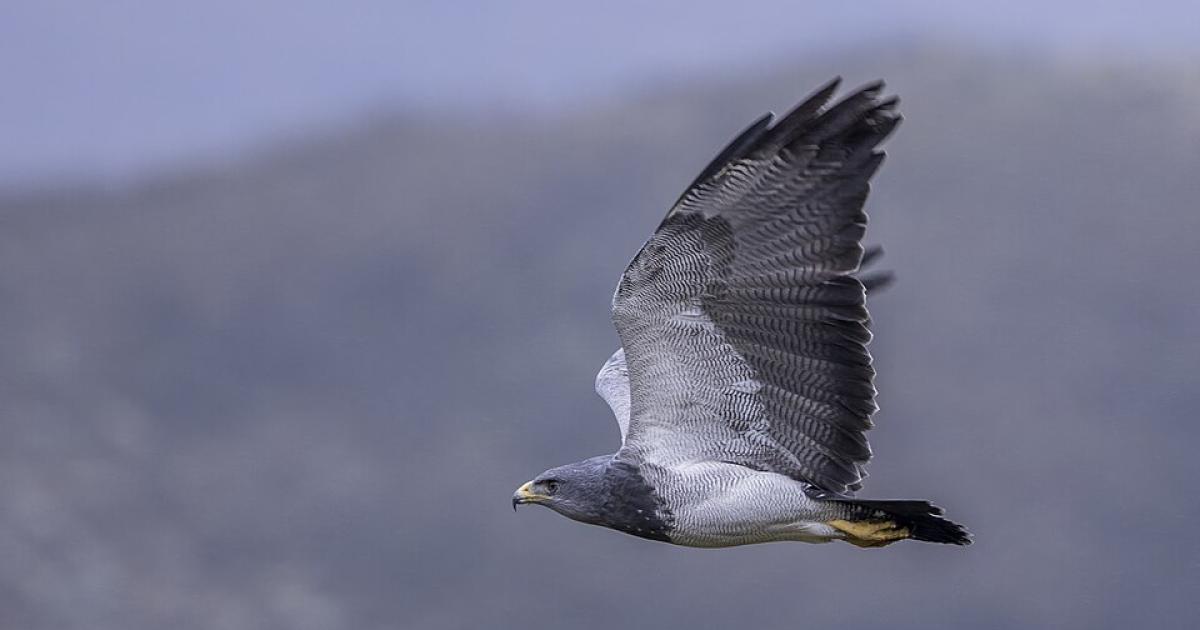
The Chilean blue eagle, better known as a black-chested buzzard eagle, escaped during a flying exhibition at the Cowpie Country Show in Surrey on June 14.
The bird, which habitually lives at Huxley’s Birds of Prey Centre in Horsham, has a wingspan of around five feet.
In a social media post, Huxley’s volunteer Liz Hughson said the eagle had “decided to fly off on a little adventure of his own.”
There was a confirmed sighting in the Lingfield area of Surrey on June 15, but the eagle flew off just two minutes before Huxley’s staff and volunteers arrived.
Although he is equipped with a tracker (track number 434.000 Marshall GPS), the device has only been working intermittently.
And, despite the tireless searching of staff and volunteers, he is still missing.
Chilean blue eagles are native to South America, where they are known to eat rodents, rabbits, and even foxes, according to animal information sites Oiseaux-Birds and Critter Science.
When asked on social media whether their captive eagle would be able to feed himself in the wilds of Surrey and Sussex, a Huxley’s volunteer said he would target rabbits and pheasants.
The eagle poses no danger to humans and, as he is used to being fed by humans, the volunteer said it was “doubtful” he would even be able to hunt for himself.
Ms Hughson’s post led several people in the area to comment reporting possible sightings.
One person said: “I’ve seen a huge bird over near my horse field and the golf course in Limpsfield Chart a couple of times recently, it caught my eye as it looked different and bigger then the normal red kites we see in the area.”
Another claimed to have seen an “extremely large bird” in the Tandridge area, while a third asked if his silhouette would look like a giant seagull.
Black-chested buzzard-eagle (Geranoaetus melanoleucus) in flight in Chingaza National Park, Colombia. (Image: Charles J Sharp/Wikimedia Commons)
Ms Hughson described the eagle, with its five-foot wingspan, as “difficult to miss.”
However, there are large wild buzzards in the area that he could be confused with from a distance.
The Argus understands that the eagle is still believed to be in the Lingfield area, so sightings in Sussex are less likely, despite its proximity to the Sussex border.
A volunteer said that, in order to avoid the centre’s telephone line being overwhelmed, reports of possible sightings with photographs are preferred.
Ms Hughson said: “If you see him, please do not try to catch him, but take a photo and call Huxley’s on 01403 273458 and we will send someone straight out.”