
When most people think of plague, they picture medieval Europe, crowded streets, and rats carrying infected fleas. New research suggests the disease was already killing people thousands of years before any of those conditions existed.
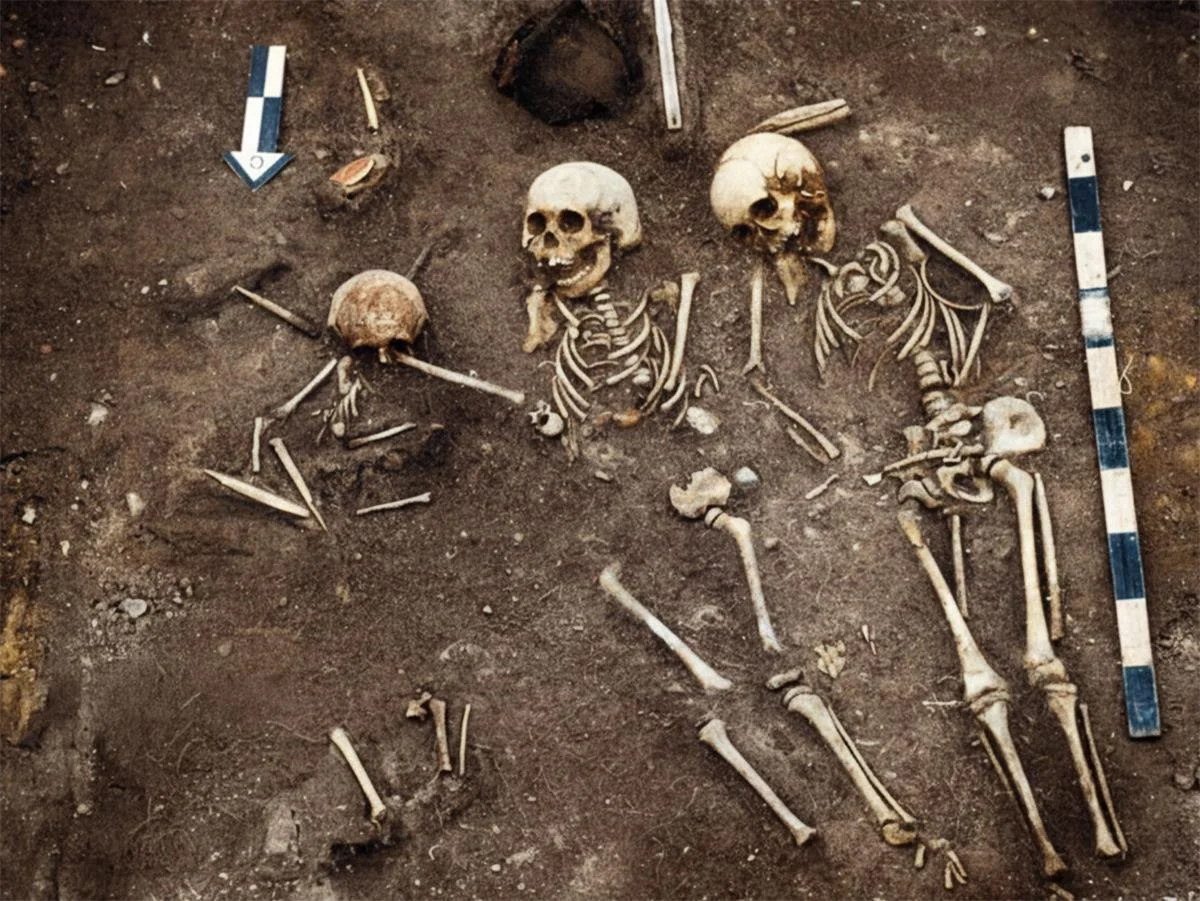 Features of the Isakovo mortuary grouping at Ust’-Ida I. Photograph from the excavation of Grave 25 at Ust’-Ida. Credit: Macleod et al., Nature (2026)
A study published in Nature reports evidence of deadly plague outbreaks among hunter-gatherers living around Lake Baikal in eastern Siberia about 5,500 years ago. The findings push the history of plague much further back in time and challenge long-held ideas about when large disease outbreaks first appeared.
An international team of researchers analyzed DNA preserved in the teeth of 46 individuals buried at four prehistoric cemeteries along the Angara River. The river flows out of Lake Baikal, the world’s deepest freshwater lake. By sequencing ancient DNA, the team identified two previously unknown strains of Yersinia pestis, the bacterium responsible for plague.
Eighteen of the 46 people carried plague DNA. That figure surprised the researchers. Nearly 40 percent of those examined showed signs of infection, a rate higher than what has been reported from some medieval plague burial sites.
The results helped solve a mystery archaeologists had been facing for decades.
Excavations at the cemeteries revealed an unusually high number of children and young teenagers buried within a short period. There were no signs of violence, warfare, or traumatic injuries. Researchers struggled to explain why so many young people died.
Radiocarbon dating later showed that many of the burials occurred close together in time. DNA analysis revealed family connections among several victims. In some cases, siblings were buried together. Other graves contained parents and children or other close relatives. One burial held three related young girls. Another contained an aunt and her nephew.
 Overview of the spatiotemporal distribution of ancient humans and plague infections in this study. a, Locations of affected cemeteries on the Angara River northwest of Lake Baikal, and IBD sharing between the sampled occupants of cemeteries (pairwise sharing lines between sites; greyscale ramp indicates total IBD sharing in segments larger than 3 centimorgans (cM) totalling more than 10 cM in pairwise relationships between sites; Supplementary Note 2). Inset represent the sampled individuals at each site (31 Ust’-Ida I, 8 Bratskii Kamen, 2 Serovo and 5 Shumilkha), with plague detections indicated, and shared graves indicated by shaded areas around individuals. Maps created using Natural Earth Data. b, Kernel density estimates plotted within Bayesian models of the date ranges for the early (red) and late (dark yellow) phases of plague outbreaks at Baikal. Lighter shaded areas correspond to the summed probability distributions prior to modelling; dates used are from individuals identified with plague only. Inset, 95.4% confidence intervals for modelled date ranges at Baikal are shown compared with those from other pre-LNBA plague cases: RV2039 from Latvia15, Warberg 1 and Warberg 2 from Germany61 and FRA102 from Sweden11. c, Kernel density estimate modelled radiocarbon date distributions for the four cemetery sites, for all radiocarbon-dated post-weaning age humans (or associated deer tooth pendants), irrespective of DNA sampling. Radiocarbon date modelling undertaken with OxCal v.4.4.4. Credit: Macleod et al., Nature (2026)
Taken together, the evidence points to outbreaks that spread through families and local communities.
Scientists have debated for years whether early forms of plague were capable of causing large numbers of deaths. Ancient strains lacked some of the genetic features found in later versions of the bacterium, especially traits linked to flea-borne transmission. Because of this, many researchers suspected those early strains caused less severe disease.
The new study paints a different picture.
The Siberian strains carried a unique genetic feature known as a superantigen. Superantigens trigger an extreme immune response, causing severe inflammation throughout the body. Researchers think this genetic factor played a major role in the deadliness of these infections and may explain why children appear so frequently among the victims.
The team identified evidence for two separate outbreaks. One occurred between about 5,596 and 5,341 years ago. The second took place between roughly 5,126 and 4,926 years ago.
Researchers believe wild marmots were the likely source of the disease. Archaeological evidence shows that hunter-gatherers in the Lake Baikal region interacted closely with these large rodents, which still carry plague today. The bacterium likely passed from infected marmots into humans before spreading through local groups.
The disease was likely pneumonic plague, a form of infection that affects the lungs and spreads through respiratory droplets. Unlike bubonic plague, pneumonic plague does not rely on fleas for transmission. That fits with the genetic evidence from these ancient strains.
The findings suggest deadly epidemics did not begin with farming villages or growing cities. Small hunter-gatherer communities were facing lethal plague outbreaks thousands of years earlier. For the families buried along the shores of Lake Baikal, plague was already a deadly threat long before the first cities appeared anywhere in Eurasia.
Publication: Macleod, R., Seersholm, F. V., De Sanctis, B., Lieverse, A., Timpson, A., Schulting, R., … Willerslev, E. (2026). Lethal plague outbreaks in Lake Baikal hunter-gatherers 5,500 years ago. Nature, 654(8119), 697–705. doi:10.1038/s41586-026-10540-5