
His returns are generally when he brings fish or sticks and material to add to the nest.
Night-time on the nest does allow for some sleep time for FS2, but she does wake periodically and leaves the nest for a few minutes before making a quick return to sit back over the eggs.
FS2 and Eli (Image: Tweed Valley Osprey Project)
Just before first light, the dawn chorus can be heard starting with the loudest nearby songs coming from a robin and a wren, and as light slowly creeps across the forest, FS2 stirs and starts her day, often preening her feathers, stretching and staying watchful, waiting for her partner to come in with fish.
During one of FS2’s night-time stretches on the nest, we can see one of her new tail feathers distinct from the old ones, growing into the tail, half broken out down the shaft of the feather.
New tail feather growing (Image: Tweed Valley Osprey Project)
She is undergoing a moult of some of her feathers during the breeding season and each feather lost is replaced.
This requires energy to complete and is a necessary part of the osprey life cycle along with breeding and migration.
Females will moult during breeding but will retain their essential ability to fly by shedding feathers sequentially.
Males cannot complete moulting during breeding because they are relied on for fishing throughout the summer and will delay moult outside of this time.
Keeping the feathers in condition is achieved by preening and FS2 has been seen preening more lately which is a good thing because she was sometimes looking sodden in the heavy rain.
FS2 moves a stick above her (Image: Tweed Valley Osprey Project)
By preening, she will spread an oily substance from her preen gland through the feathering to maintain condition and make them waterproof.
There are a couple of weeks still to go before we can expect hatching at this nest, and it is a long time for the parents to wait, so it is not that surprising that Eli continues to find occupying his time with the nest structure a good distraction between the occasions when he gets to take a turn sitting on the eggs, or away on fishing trips and the responsibility to keep his partner well-fed.
Eli delivered a fish to FS2 (Image: Tweed Valley Osprey Project)
FS2 and Eli (Image: Tweed Valley Osprey Project)
He is certainly looking after her by bringing cosy soft lining for the nest and building up the sides as a protective wall.
Not sure she appreciates that when the sticks are dropped across her back though.
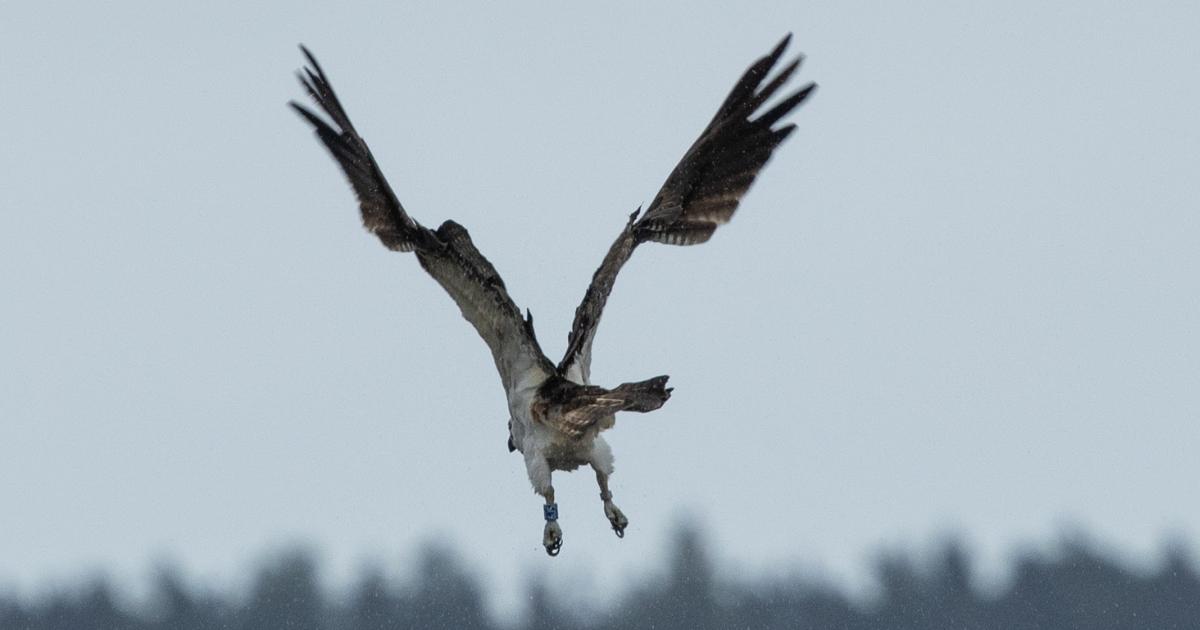
Her daughter Teddy (6J8) continues to thrive down at a nest platform in Dorset where she has not one, but three suitors, all local boys from the area, but she seems to favour the one, 5R0, as he brings her fish.
Sunday, (June 14), she was at the platform with Poole Harbour male 5H3 but she left to go fishing and was successful and flew off into the heat haze with it.
(No heatwave for her mum in the Scottish Borders).
Teddy going to fish (Image: Kate Plater)
Teddy (Image: Kate Plater)
The male osprey 6J5, spotted at Kielder on May 24, has turned up again.
This time he has moved over to Derwent Reservoir in Durham where Bob Telford spotted him and took a photograph on June 15.
It seems this two-year-old is favouring the northeast of England to explore while on the lookout for territory and a partner.