
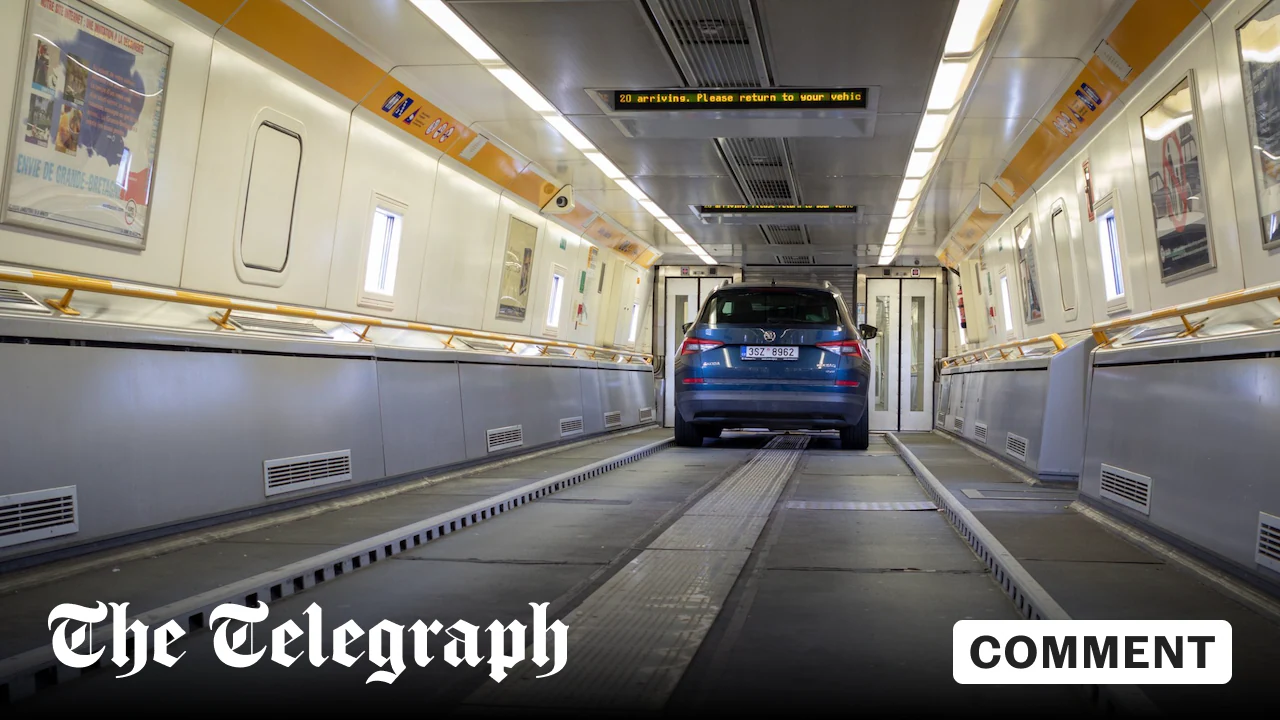
If you were hoping for some newer rolling stock, better facilities or even lower ticket prices for taking your car to the Continent this summer then you can probably forget about it.
Eurotunnel, which operates the link from Dover to Calais, last week condemned Britain as “uninvestable” as it prepared to take the Government to court over the increase in its rates bill.
Likewise, Mondelez, which owns Cadbury, warned it may have to wind down investment here over the endless obesity targets and levies.
A worrying pattern is starting to emerge. Britain is turning into a shake-down state – and investors will have no choice but to get out as fast as they can.
Business rates were originally meant to be a way of raising money for local services, and were based on a modest assessment of what a company’s premises were worth.
But like so many taxes under this Government they have morphed into a way of squeezing as much cash out of companies as possible.
Eurotunnel is a good example. Getlink, the Paris-based owner of the route, has seen its bill pushed up from £40m to £118m.
It is taking the Government to court and in the meantime says it can’t invest in this country anymore.
The rise, Eurotunnel said when it was first mooted last year, was “unjustified and confiscatory”, while it argued it was being “unduly penalised compared to its competitors whose activities are more carbon-intensive, less-taxed, and some of which are deviating from the social models applicable in France and Great Britain”.
Ouch. It is far from alone.
Gatwick Airport last year complained of an £11m annual increase in its rates bill (one reason why it has pushed up the rightly disliked “drop-off” fee to £10 a car) while Heathrow faces a £35m a year increase in the amount it has to pay.
You can’t pick up a tunnel or a runway and move it somewhere else. The companies have little choice but to stump up the cash. But that doesn’t mean it doesn’t have any impact. It just gets passed on in the form of higher prices for customers, and less investment in keeping the facilities up to date.
Likewise, obesity levies were originally designed as a way of persuading us to eat more healthy foods, but they are starting to turn into a revenue machine as well. The result? Mondelez says endless taxes and targets would eventually force it to invest elsewhere.
“It makes you doubt a little bit … on how much we should invest in the UK,” according to Dirk Van de Put, its chief executive.
We might think of Cadbury as an emblematic British product, and in some ways it still is. But no one should be surprised if their Dairy Milk is imported from Poland or Hungary very soon.
In reality, the same pattern is being repeated.
Business rates are imposed seemingly on the basis of where cash is squeezed out of companies, which have no choice but to stay where they are, even if there is no real basis for them.
Windfall taxes are imposed more or less arbitrarily, depending on how much money the Treasury thinks it can squeeze out of a sector and not because an industry is genuinely making exceptional or unjustified profits.
There is an endless series of green levies imposed on top of what is already the most expensive industrial energy in the world. Packaging levies are imposed on anyone the Government thinks may be able to pay them, while businesses are somehow meant to hit a social target the Government has set for itself, but no longer has any money left to pay for. The list goes on.