
SASKATOON — Agriculture is at a dangerous crossroads, says the chief executive officer of U.S. Farmers and Ranchers in Action.
“There are some people who think where we are now is very similar to what happened in the 1980s when 300,000 U.S. farmers defaulted on their loans,” Kevin Burkum said during a webinar introducing a new study authored by S&P Global Energy.
“(That) created a rural recession that lasted a generation.”
Kevin Lindemer, a vice-president with S&P, said the key take-home point of the Fueling Agriculture: Biofuels as the Catalyst report is that the world is transitioning into a demand-limited market.
Population growth is slowing. The annual global growth rate is expected to decline to 0.4 per cent by 2050, down from about 1.4 per cent at the start of this century.
Fertility rates in most high-income economies are already below replacement levels.
China’s population has peaked, and the country is expected to lose about 10 million people per year through 2050, said Lindemer.
Read Also

Global demand growth for crops is expected to lag supply growth through 2050.
Slowing global population growth has profound implications for agriculture.
Per capita meat consumption is expected to grow at a rate of 0.1 per cent per year by 2050, down from 2.4 per cent in the late 1990s, indicating near-saturation in many markets.
Meat demand drives growth in feedgrain and oilseed consumption.
That is problematic because corn yields have been increasing at a rate of 1.5 per cent per year for decades.
And there are further increases on the way. The next wave of agricultural productivity will be driven by stacked technologies — the convergence of biotechnology, artificial intelligence and advanced data analytics.
That is expected to lift U.S. corn yields by 1.6 per cent annually through 2050, resulting in 50 per cent more production without expanding acreage.
Lindemer remembers as a kid growing up on a farm in Minnesota when a 125 bushel per acre corn crop was considered good. Today’s yield contest winners are harvesting nearly 600 bu. per acre.
U.S. farmers will need to find a market for an extra eight billion bu. of corn by 2025 if they intend to keep planting about 98 million acres of the crop.
So where will that demand come from in an environment of slowing global population growth and meat consumption? The hope is that biofuel will provide the answer.
However, biofuel demand is facing similar pressures due to vehicle fuel efficiency gains, changing driving patterns and increased reliance on electric vehicles.
At the current 10 per cent blend rates, U.S. ethanol demand for on-road transportation fuels could fall nearly 50 per cent to 6.6 billion gallons by 2050.
However, with higher blend rates and market penetration in marine fuel and sustainable aviation fuel, the picture could be far different.
Global ethanol output from major feedstocks such as corn and sugarcane could increase 300 per cent by 2050, while biodiesel/renewable diesel derived from soybeans and canola could grow about 170 per cent, according to the study.
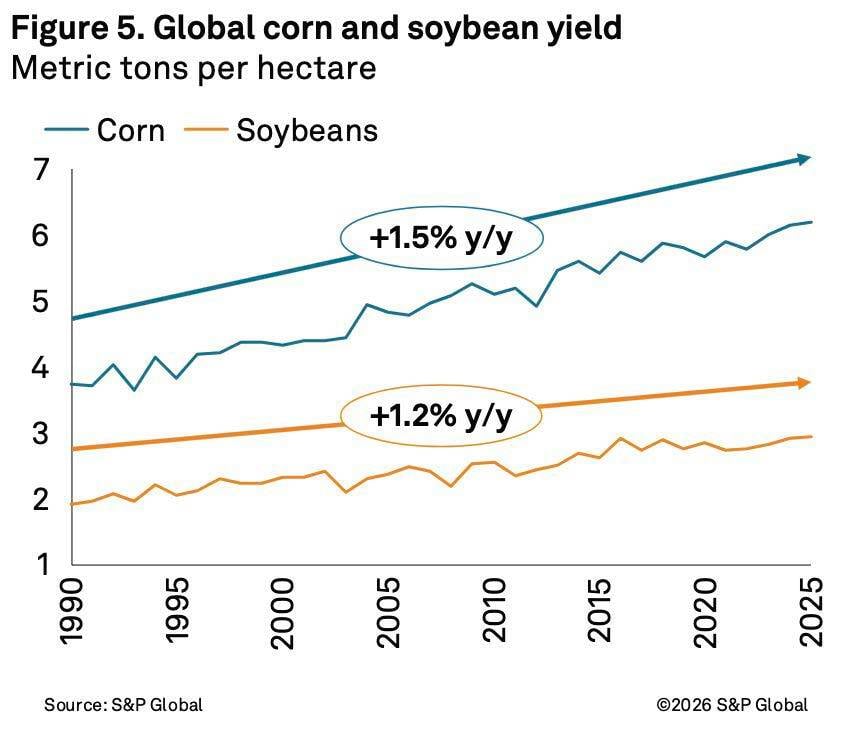
Global corn yields have risen by 1.5 per cent per year since 1990, while soybean yields have increased by 1.2 per cent. Demand has not been keeping pace and the situation will only get worse moving forward, according to a new report by S&P Global.
Photo:
SP Global
“This report points out a path forward and shows how biofuels can help restore profitability to struggling farms, turbocharge innovation, and expand capacity to feed and fuel the world using fewer resources,” said Burkum.
Biofuels restored profitability to agriculture before and can do it again, he said.
The authors of the study were asked what would happen if there is no increase in biofuel demand.
Juan Sacoto, global head of agribusiness consulting with S&P, said one of the big takeaways from the study is there’s not enough food demand to support agriculture.
He noted that 10 or 15 years ago, everyone was fretting about whether there would be enough food to feed the world.
Sacoto said that is no longer an issue. The challenge has shifted to, how are you going to keep farmers farming?
If there is no increase in biofuel demand, the United States is going to lose about 30 million acres of corn by 2050.
“That’s the do-nothing environment,” he said.