
My column this week is rather different from usual.
I focus today on some words that have recently been spoken: by me, and by someone else from Norfolk who you’ll be aware of.
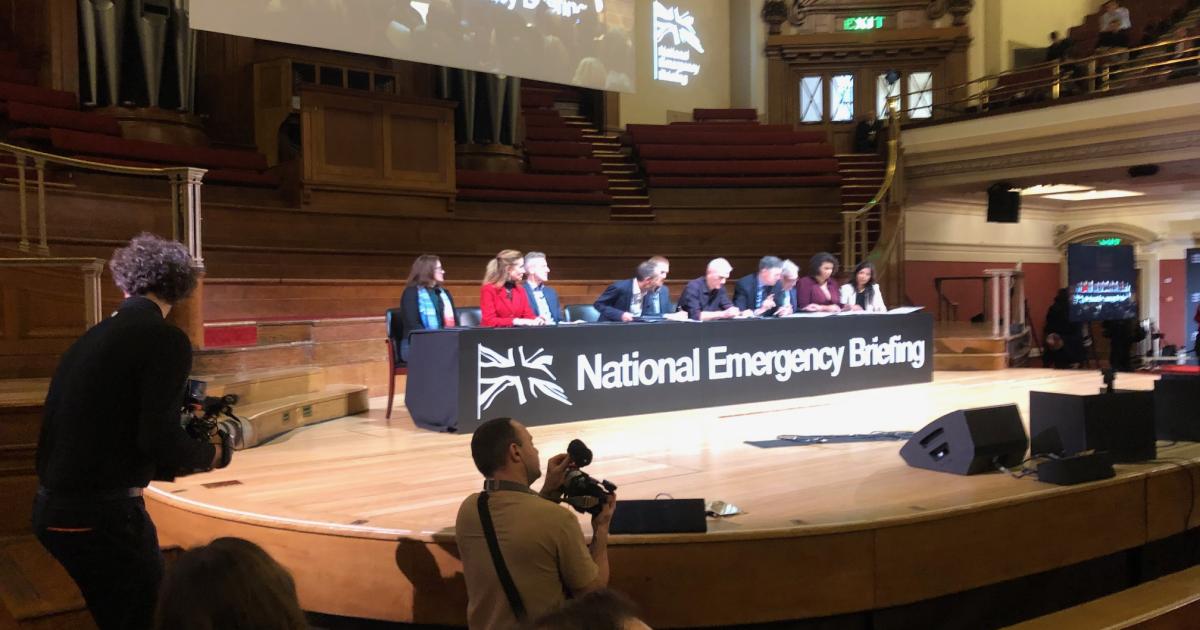
They are words occasioned by an important film which is doing the rounds in East Anglia and across the country: it’s called the ‘People’s Emergency Briefing’.
It’s about the tight corner that – increasingly – we are in, and what together we might do about that.
Here then is the speech I gave after a recent showing of that film, in Poringland.
Where 90 people turned out to fill a room, to see it:
“Friends, the shocking thing about this film is that even since it was made just months ago, things have got if anything even worse…
“A third of the world’s fertilizer goes through the Strait of Hormuz, …or rather it did until the war started; and now virtually none has been going through.
“And also we’re now moving into what’s called a ‘super El Nino’, a really extreme version of the world’s climate/weather, which will grow and continue through the next year; and this is a phenomenon which is made more likely and worse by man-made dangerous climate change.
“We’re going to be tested pretty soon.
The people in the People’s Emergency Briefing film who said this is not even really about future generations anymore…They’re absolutely right.
“It’s about us now.
“And I must tell you that my professional judgment is that if anything the film is actually too optimistic and makes what we do next seem a bit too easy.
Things are if anything more difficult than this difficult film suggests!
“So, there’s tough stuff in this film, and even tougher stuff beyond it.
We need to be aware of this stuff, but we also crucially need to process it.
Awareness is no good without processing, without acceptance.
“I was very struck by the fact that, over and over again in the film, folks were getting just to the brink of tears.
That’s real and that’s rational and that’s to be expected, and we should work with that rather than try to push it back down.
“What’s also absolutely crucial is taking action and in that connection we shouldn’t think something like this: ‘Well, I won’t take any significant action until I’m more fully informed.’
We actually need to get going with action, together, all the time, and take the awareness in as we go, as we do stuff.
“Finally, there’s one more thing which is crucial as well as the awareness and the acceptance and the action and that’s awareness again, but awareness this time not of the facts, but awareness that you’re not alone in facing them.
Collective awareness.
Awareness that we are many.
That’s one of the key reasons why I think events like this are really good.
Because when we look around we can see that there’s lots of other people who are very concerned, as well as us.
“My final point: back to the action.
What actions could and should we take?
Well, we are lucky to live in a semi-rural part of the country.
Most of us have significant gardens or allotments, or can be part of collective food schemes, or community gardens.
It’s actually not that difficult for us to do something on our own – and together – about the food component of the coming crisis.
“As I say, in relation to what’s happening with the Straits of Hormuz, and with the super El Nino that’s brewing, all on the back of the trouble we’re already in due to global climate breakdown, I think it would be really, really smart for us to think and act together to make our food system right here where we live more resilient.
That’s why I’m proud to be part of the local five-mile network, our local resilience network here.
That’s the kind of thing that may be really needed, soon.
“To get us through.
“…Thank you!”
The Emergency Briefing features something incredibly authoritative that I’ve written about in my EDP column before: the suppressed National Security Assessment on ‘Biodiversity Loss and Ecosystem Collapse’, written by this country’s intelligence chiefs, which warns that by 2030 the UK food system could be at strategic risk of catastrophic failure.
Let me end this column then with some wonderful words by someone who belongs to a different political party from me but who is getting quite serious about these matters, Norwich South’s MP Clive Lewis.
Clive recently said that “…we need to rethink what security means.
“Defence can no longer mean only tanks, submarines and the threat from Russia, real though those threats are.
The front line now also runs through our reservoirs, our farms, our energy system, our data centres, our labour market, and the social contract itself.
A society fractured by inequality, dependent on collapsing ecosystems and brittle private monopolies, is not a secure society.
“Security has to be understood whole.
“Water, food, energy, computing, skills and care are not just sectors of the economy.
They are the strategic infrastructure of national survival.”
Reader, please let those words sink in.