
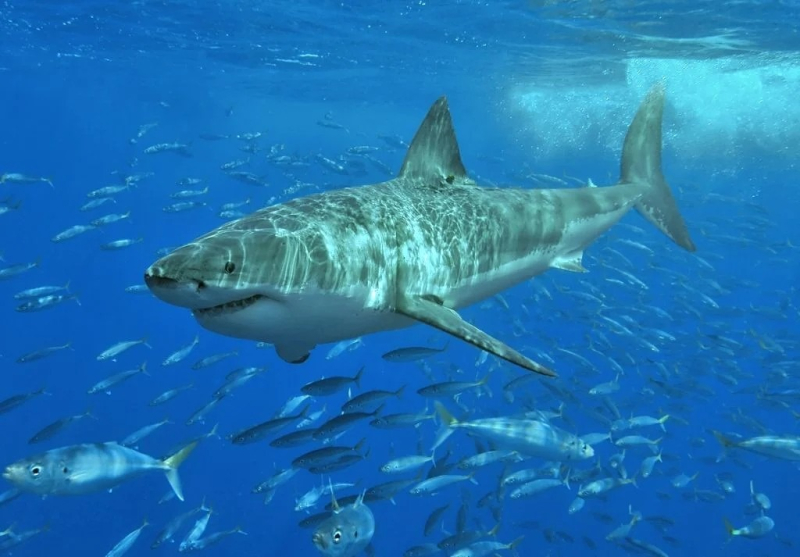
A website dedicated to the legendary 1975 movie Jaws and shark research has suggested the waters off the Outer Hebrides could be prime habitat for great white sharks.
The apex predator that propelled itself into public consciousness thanks to Steven Spielberg’s blockbuster could now, claims The Daily Jaws, be lurking in the depths near the Isles.
Discussing the possibility of great white sharks being present in UK waters, the website says that while there is no confirmation of a permanent population, but there is strong evidence that this shark species does occasionally visit.
“Great white sharks are highly adaptable predators that can survive in a wide range of water temperatures. Thanks to a special system that helps them keep their bodies warmer than the surrounding water, they can live comfortably in conditions similar to those found around the UK,” explains The Daily Jaws.
What is likely to attract the sharks is the abundant prey, “including seals and the increasingly common Atlantic bluefin tuna, both of which are important food sources for great whites.”
Over the years, there have been hundreds of unconfirmed or mistaken sightings in UK and Irish waters.
“However, some accounts from experienced marine biologists suggest that great white sharks may occasionally pass through British and Irish waters,” The Daily Jaws points out.
“One notable report involved scientists in the Outer Hebrides who observed a large shark with characteristics matching a great white.”
With the greater number of drones in use, The Daily Jaws believes the chances of documenting a great white shark are higher than ever.
They contend: “Many experts believe that a confirmed sighting in British or Irish waters is only a matter of time. If such a sighting occurs, it should be viewed with excitement rather than fear. Great white sharks are remarkable animals, and their presence would be a sign of the richness and health of the marine environment rather than a threat to people.”
Though the idea of great white sharks going unnoticed may at first appear to be far-fetched, there is some evidence that could hint at their presence.
A Bluefin Tuna fishery in the waters off the islands is rapidly becoming commercially viable. And at the same time, there is solid scientific evidence that seal numbers in the Western Isles have declined sharply.
Recent monitoring by the University of St Andrews’ Sea Mammal Research Unit (SMRU) found that harbour seal populations fell by about 20% between 2018 and 2023.
Harbour seal populations were once considered stable in the Western Isles, but the sharp decline in their numbers is seen as particularly concerning.
Traditionally, the Outer and Inner Hebrides had long been seen as a refuge for harbour seals, bucking declines seen in Orkney, Shetland, and the east coast. The west coast of Scotland has been strategically important for harbour seals, accounting for over 65% of the UK’s harbour seal population.
There is also evidence of falling numbers of dolphins, another great white prey species, off the East Coast of Lewis. Earlier this month, Highlands and Islands Enterprise awarded Lewis marine conservation charity Mara a £13,974 grant to help them investigate declining numbers of dolphins.
Mara, based in Portvoller, is planning an 11-month monitoring project in the North-East Lewis Marine Protected Area that stretches from the Butt of Lewis to Lochs.
Meanwhile, the recent downturn in seal numbers is a “wake-up call” according to SMRU scientists, showing that pressures are now widespread.
At the same time, the return of bluefin tuna fisheries in Hebridean waters adds another ecological factor — large predators may be attracted to the area.
Researchers now believe that, as well as predation by large sharks, there are other multiple pressures that may be driving the declining numbers. These include diseases such as distemper, climate change, and reduced availability of food stocks.
For now, the question of whether great white sharks are having an impact on seal numbers in the Isles remains open.
Evidence is thin, anecdotal and based on unverified sightings by fishermen and scientists who reported observing a large shark with “characteristics matching a great white.”
Ocearch, a US-based marine research group, has organised expeditions to search for great whites. Despite having so far been unsuccessful, they have acknowledged that the seas around the UK and Ireland have “near-perfect habitat suitability” for great white sharks.
This aligns with unconfirmed reports of large sharks resembling great whites, especially in areas where seal populations have declined, and bluefin tuna have returned.
Image content – creative commons