
‘Who’s in the mono?’ O’Brien rejects framing of multiculturalism debate
Ted O’Brien says he rejects the framing of the multiculturalism debate when asked whether he supports multiculturalism, particularly as the shadow foreign affairs minister.
He lobs the question right back and asks what the definition of multiculturalism and monoculturalism actually are.
He claims if everyone in the audience was to write a definition down, they’d probably be different.
double quotation markWho’s in the mono? I don’t know. Who decides who’s in the mono? I mean, I assume it’s government, right? And I’m a Liberal, I believe in some more government, not big government. I mean, what do we have, a minister for cultural purity?
I’ve been to some countries where the state dictates people’s customs and how things should be done. I don’t know how many of you have been to North Korea, I have been to North Korea and I can tell you, it’s not the sort of place you want to live.
So for me, I think this debate’s a silly one.
He’s asked whether he would have a problem walking through parts of Australia and hearing people speaking French or Arabic or Mandarin.
“No,” he says, and adds that he learned Mandarin so he could communicate when he at one point lived in China. But he says everyone in Australia should be able to speak English.
double quotation markI don’t have any problem with that. I mean, I previously had conversations in Mandarin and [in] Australia, and that’s what you do.
The thought that, Johnny, who’s at work, speaking English, can’t go home and speak Italian to his nana? That’s nuts. That’s not the sort of Australia I want to live in.
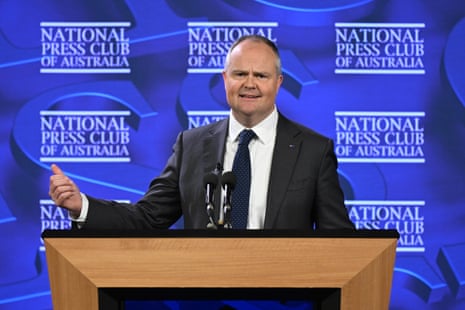 Shadow foreign affairs minister, Ted O’Brien, addresses the National Press Club in Canberra. Photograph: Lukas Coch/AAPShare
Updated at 23.58 EDT
Key events
What is cultural confidence?
Thank you all for your contributions to the debate on what cultural confidence is – there’s some mixed reactions.
Tim Wilson earlier said that Australia should be a “culturally confident country”.
One person in the comments section wrote “It’s phrase you can mould any way you like and if you get a bad reaction, you turn it into some other thing altogether. It’s meaningless.”
Wilson – a dedicated reader of the blog – has pointed out to me that there’s a meaning in the Journal of Hospitality and Tourism Management which says cultural confidence:
double quotation markRefers to individuals’ perception of cultural identity, belonging, and pride based on understanding, accepting, and living up to their own culture.
Hanson blames far left for taking her comments ‘into the realm of utter fantasy’
One Nation leader, Pauline Hanson, says her words on monoculturism have been twisted, and in fact the Socceroos represent her vision of a monocultural Australia.
Last week, Hanson told the national press club that multicultural policy had “failed” and that Australia should be “a multiracial society, but we must be monocultural”.
In the Senate a short time ago, Hanson said monocultural wasn’t a “dirty word”.
double quotation markIn the past week, the far left have naturally taken my comments into the realm of utter fantasy. I was going to ban foreign food, and the Socceroos wouldn’t have beaten Turkey under my policy. What rubbish, predictable and pathetic.
The Socceroos, in fact, represent my vision of a monocultural Australia. People from different backgrounds and cultures and nations, all wearing green and gold, and representing one nation under one flag, and succeeding under the same set of rules.
Australian monoculture is not exclusive. It is welcoming. It’s an umbrella which covers all manner of difference. It’s not a dirty word.
Updated at 23.50 EDT
‘Who’s in the mono?’ O’Brien rejects framing of multiculturalism debate
Ted O’Brien says he rejects the framing of the multiculturalism debate when asked whether he supports multiculturalism, particularly as the shadow foreign affairs minister.
He lobs the question right back and asks what the definition of multiculturalism and monoculturalism actually are.
He claims if everyone in the audience was to write a definition down, they’d probably be different.
double quotation markWho’s in the mono? I don’t know. Who decides who’s in the mono? I mean, I assume it’s government, right? And I’m a Liberal, I believe in some more government, not big government. I mean, what do we have, a minister for cultural purity?
I’ve been to some countries where the state dictates people’s customs and how things should be done. I don’t know how many of you have been to North Korea, I have been to North Korea and I can tell you, it’s not the sort of place you want to live.
So for me, I think this debate’s a silly one.
He’s asked whether he would have a problem walking through parts of Australia and hearing people speaking French or Arabic or Mandarin.
“No,” he says, and adds that he learned Mandarin so he could communicate when he at one point lived in China. But he says everyone in Australia should be able to speak English.
double quotation markI don’t have any problem with that. I mean, I previously had conversations in Mandarin and [in] Australia, and that’s what you do.
The thought that, Johnny, who’s at work, speaking English, can’t go home and speak Italian to his nana? That’s nuts. That’s not the sort of Australia I want to live in.
Shadow foreign affairs minister, Ted O’Brien, addresses the National Press Club in Canberra. Photograph: Lukas Coch/AAPShare
Updated at 23.58 EDT
Labor’s economic model to ‘spend, tax and stoke’ inflation, says shadow treasurer
Tim Wilson’s whipped out his favourite line, describing Jim Chalmers as an arsonist “pouring debt petrol on the inflation fire” after the release of today’s inflation numbers.
He’s blaming government spending, and says “homegrown inflation” is at 4.7%.
double quotation markThe Albanese government’s economic model is to stoke inflation, tax inflation, and spend inflation, perpetuating a cycle that ensures Australians pay higher prices at supermarkets.
Jim Chalmers is like the cosplay arsonist pouring debt petrol on the inflation fire, burning away at the future economic prosperity of Australia.
Wilson says the inflation started going up long before conflict in the Middle East, adding “Australians don’t buy his [Chalmers’] excuses”.
Updated at 23.10 EDT
O’Brien pushes back against Hanson’s call to abandon United Nations
Ted O’Brien has subtly pushed back against One Nation’s call for Australia to abandon international bodies like the United Nations and World Health Organization.
The party’s platform says it would withdraw from the bodies and the Paris climate agreement which it claims would save up to $1bn a year.
O’Brien, the shadow foreign affairs minister, is addressing the National Press Club, and says the world’s major institutions are “sick” but they should be reformed, not abandoned.
double quotation markI believe the world’s major institutions, which were created to support an international order based on liberal values, are sick and suffering a crisis of legitimacy. But I reject calls for Australia to abandon these institutions.
If liberal democracies like ours vacate the field, the vacuum will be filled by others, whose worldview and values do not necessarily align with our own. This would be against our national interests.
Australia should still fight the good fight. By working with like-minded countries to help preserve that which works and change that which can be practically fixed or improved.
Shadow foreign affairs minister, Ted O’Brien, addresses the National Press Club in Canberra. Photograph: Lukas Coch/AAPShare
Updated at 22.56 EDT
Tim Wilson accuses Labor of dividing Australians over multicultural debate
Tim Wilson says Australia should be a “culturally confident country” when asked for his perspective on multiculturalism in Australia.
At a press conference in Parliament House, the shadow treasurer said the Coalition wants people to come and commit to Australia and adopt our “central values”.
He then accused Labor of “seeking to divide Australians”.
double quotation markI believe we should be a culturally confident country … People will come from all over the world, and that’s what enriches our country so long as they commit to those underlying values, which was the original intention of multiculturalism, not what we now have, which is identity politics pushed by Labor, because they want to divide the Australian community.
What we have is a Labor government that’s seeking to divide Australians. We have other political parties on the far right seeking to divide Australians.
Have a go in the comments at what you think “culturally confident country” means.
Shadow treasurer Tim Wilson. Photograph: Mick Tsikas/AAPShare
Updated at 22.47 EDT
‘We don’t support an exemption for our content creators’ for AI training, says Chalmers
A little earlier we brought you David Pocock’s concerns that the government could consider allowing tech companies exemptions to mine data from Australian artists, journalists and authors to train AI models.
Chalmers denies the government is considering an exemption.
He also says he doesn’t believe that not providing an exemption will slow investment in Australia. The sector in Australia is currently booming.
Chalmers says:
double quotation markWe don’t support an exemption for our content creators when it comes to training by AI, my colleagues … are working through all of these sorts of challenges, but we made it really clear that we support the rights of copyright holders, content creators, to make sure that as we work through a series of really quite tricky issues when it comes to AI, that we are maximising the benefits and minimising the risks, and that includes the people who create content.
Share Patrick Commins
Petrol prices plunge in May, but RBA ‘vigilant’ on underlying price pressures
A nearly 12% drop in fuel prices in May helps explain why annual inflation unexpectedly eased to 4%, from 4.2%.
Petrol prices are below where they were in late February and immediately before the start of the Middle East conflict, which triggered a global oil supply shock.
The welcome fall in headline inflation masked some less welcome news in the Australian Bureau of Statistics figures.
Food and non-alcoholic drink prices climbed by 3.3% in the year to May, up from 2.8% in April. The food component was driven by higher prices for meals out and takeaway, which lifted by 4%.
Government subsidies have clouded the view on inflationary pressures, most obviously in the 21% jump in electricity costs versus a year earlier when federal and state government power bill rebates were in place.
Economists and the Reserve Bank will also be focusing on the underlying measures of inflation.
On that score, the story was also less encouraging, with the trimmed mean inflation rate (which removes more volatile price moves) lifting to 3.6% from 3.4%.
That was expected, but Stephen Smith, a partner at Deloitte Access Economics, said the central bank had to “remain vigilant” as inflation by any measure remained well above the 2.5% target.
double quotation markThe government’s temporary fuel excise cut has masked the extent to which inflation pressures remain a problem for the Australian economy and is delaying some of the price growth pass-through to other sectors.
Updated at 22.27 EDT
O’Neil was using a ‘general description’ on housing market claim, says Chalmers
Chalmers says he agrees there’s been a “softening” on house prices, but that the housing minister Clare O’Neil’s claim of a housing market “correction” was more of a general description rather than a technical definition.
Chalmers repeats the Treasury modelling which expects house prices to continue to grow but 2% slower (compared with a scenario without the tax changes).
He attributes the slowdown not just to the tax changes – which haven’t yet been legislated – but also rising interest rates and war in the Middle East.
double quotation markI agree that there’s been a softening in house prices, that’s self-evident from the numbers, and the same is true of auction clearance rates, and they are for reasons which go beyond the changes in the budget … I know that there is a technical definition of a correction, it hasn’t seen the sort of percentages which are consistent with that technical definition, but I know that what Clare was describing was a general situation where house prices have softened a bit, auction clearance rates have softened a bit for reasons that go beyond the budget.
Updated at 22.25 EDT
Fuel excise cut ‘part of the story’ on lower inflation rate
Jim Chalmers says the fuel excise cut, which was extended by another month at a lower rate, is part of the reason headline inflation went down, but not the only factor.
The treasurer also says the impact of war in the Middle East will continue to be felt in the economy for some time.
He adds that while the impacts were initially felt in rising petrol prices, the impacts are now “broadening in our economy”.
double quotation markThe government’s efforts to cut the fuel excise are part of the story, but not the whole story, even when it comes to this very welcome moderation in fuel costs reflected in the inflation figures today.
Updated at 22.14 EDT
Inflation numbers ‘better than expected’, says Chalmers
Jim Chalmers says the second consecutive monthly drop in inflation is better than forecast, but the numbers still show the pressure on the economy from the conflict in the Middle East.
Speaking to reporters in Parliament House, Chalmers points to inflation ticking up in other parts of the world including Europe, the US and Canada.
He says the economy is “well placed” to deal with global turmoil (something he has been saying for a while).
Inflation has dropped to 4% in the year to May, from 4.2%, but after removing the most volatile price moves in the month, the central bank’s preferred measure of annual inflation climbed to 3.6% from 3.4%.
Chalmers says:
double quotation markThis is a very welcome set of numbers, which shows that inflation fell once again for the second month in a row. We’re not complacent about that. We know that there are still inflationary pressures in our economy, that’s reflected in the underlying measure, but these numbers today are much better than the market expected, much better than forecast, and that’s obviously a very good thing.
Treasurer Jim Chalmers. Photograph: Lukas Coch/AAPShare
Updated at 22.10 EDT