
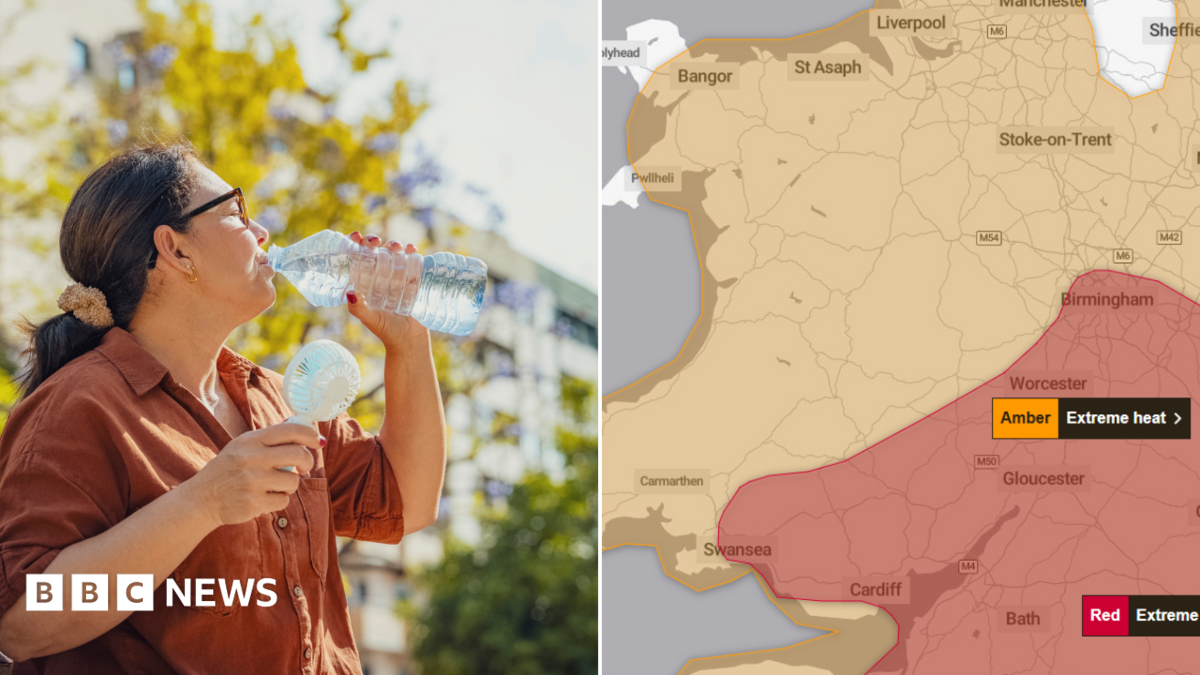
A “heat emergency” has closed more than 500 schools in Wales as the country faces a two-day red weather warning.
Schools have closed or partly closed across mid and south Wales, including all in Blaenau Gwent, and most in Caerphilly and Bridgend.
Nerys Evans, the Welsh government’s deputy minister for public and preventative health, called it a “heat emergency”.
Mary Gagen, climate scientist at Swansea University, called the heatwave “frightening” and said Wales is not prepared.
A red warning for extreme heat has been issued for Wednesday and Thursday, and temperatures could hit 37C.
School closures are confirmed in Cardiff, Blaenau Gwent, Bridgend, Caerphilly, Carmarthenshire, Merthyr Tydfil, Monmouthshire, Neath Port Talbot, Newport, Powys, Rhondda Cynon Taf, Swansea, Torfaen and Vale of the Glamorgan.
Speaking on Radio Wales Breakfast, Chief Medical Officer for Wales Isabel Oliver said in these periods of heatwave, there can be “significant pressure on the NHS”.
“But the health effects of heat are largely predictable and preventable so it is really important that we are all aware of what we need to do to keep safe and in good health,” she said.
On people going to concerts and events, Oliver said mass gatherings can be risky.
The Cure will play Blackweir Fields in Cardiff on Wednesday, and McFly are due to play in Cardiff Castle on Thursday.
“If people are feeling the effects of heat exhaustion which is tiredness, dizziness, headaches feeling sick it is really important that they move to a cool place, remove unnecessary clothing such as jackets or socks.
“If you see people suffering give them plenty of water to drink and cool down their skin with a cool cloth.
“It is also important to take care with alcohol and also sugary drinks can contribute to dehydration.
“The main thing is to be aware of what alcohol can cause on our bodies and make dehydration that we experience worse and some of the symptoms of heat exhaustion and heat stroke worse,” she added.
Gagen said while we’ve always had heatwaves, it is nothing like the intensity and frequency we are seeing.
“We had one a month ago in May. That’s really unusual to have two in a row. Actually, for me on a personal level, as I’m walking around, it feels like the first time in my life that I can physically feel climate change.
“And it’s quite frightening, actually. It’s an uncomfortable experience.”
She called for building design and urban planning in Wales to adapt.
“Our infrastructure is absolutely not prepared for this.
“We have a huge advantage here in Wales. We have fantastic green and blue infrastructure, basically vegetation and water. And we can use that to our advantage, particularly to help keep our cities cool,” she said.