
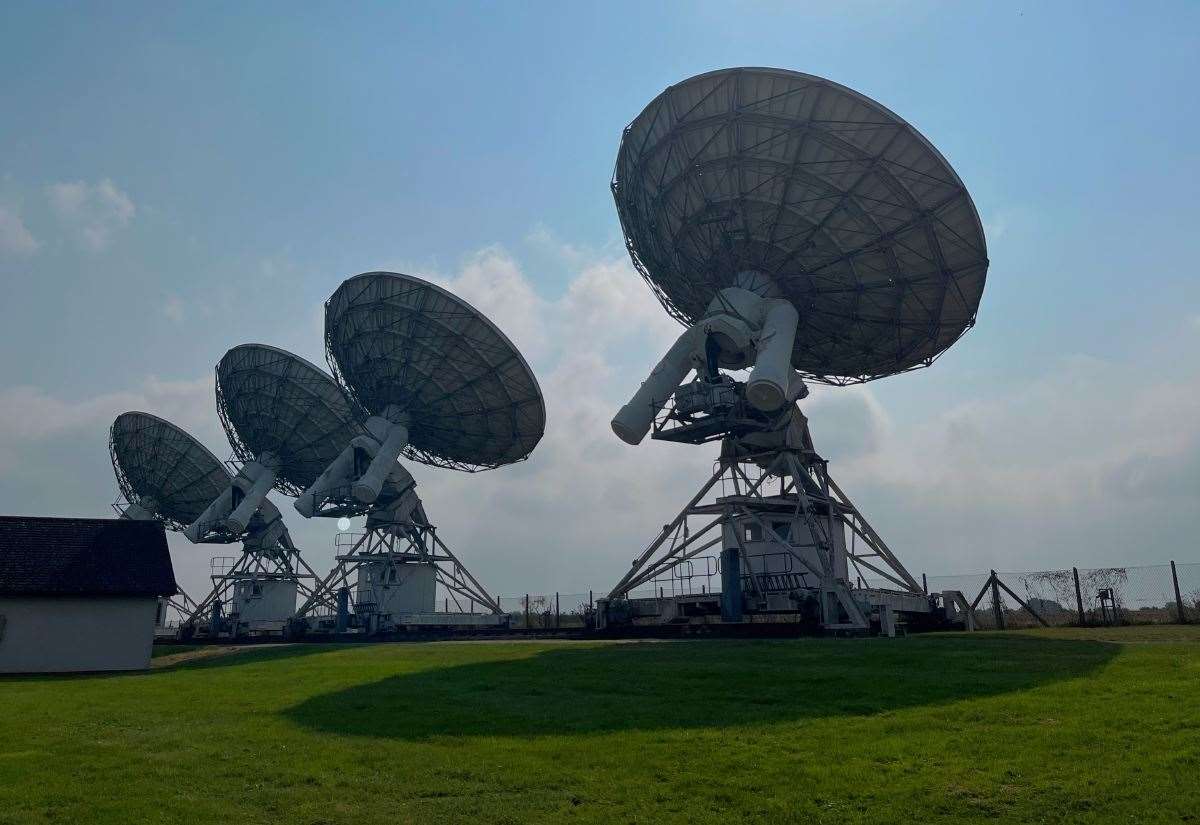
The University of Cambridge has warned that only changing the path of East West Rail can protect its internationally important astronomy site in what could be the biggest challenge yet to the proposed route.
The alignment put forward by East West Rail Company (EWR Co) would travel within 150m of the highly sensitive Mullard Radio Astronomy Observatory (MRAO), which the university says would devastate UK radio astronomy research.
 The Mullard Radio Astronomy Observatory during Open Cambridge 2024. Picture: Zoe Smith/Open Cambridge
In its response to the latest EWR consultation, it says only major changes will prevent the proposed railway from irreversibly damaging one of the UK’s vital scientific assets.
The university says the train line would introduce electromagnetic interference and ground-borne vibration that would threaten the observatory’s precision instruments.
This could jeopardise millions of pounds of existing and future UK investment in radio astronomy, the university warns.
And it argues that EWR Co has not given the observatory at Lord’s Bridge, near Harlton, meaningful consideration in its route selection or environmental assessment despite its warnings and the site’s protected status.
“Instead, EWR Co have continued to hand the problem back to the university, asking whether it could agree to compromise research that is at the forefront of international science,” the university explains.
It says it is supportive of EWR in principle to unlock regional innovation, enable major research partnerships and aid national ambitions in emerging technologies.
But it objects to the entire Comberton to Cambridge stretch – and will hold that objection throughout the Development Consent Order (DCO) process and examination until the impact on the observatory is resolved.
EWR Co says it welcomes the university’s feedback and is working on potential mitigation measures.
The MRAO is one of only two major centres in the UK, along with Jodrell Bank at the University of Manchester, that design, build and operate internationally competitive radio and other telescopes along with their associated receivers and instruments.
“The university is very concerned that EWR Co has assumed a mitigation strategy that depends solely on measures that would fundamentally compromise existing and future research at the MRAO site,” it explains. “The university is equally concerned that the impacts of the proposed project on the MRAO have not been given sufficient consideration.
“The university continues to object to the approach to environmental assessment and mitigation being proposed and requests that EWR Co urgently consider ways to avoid or mitigate adverse impacts on the university’s nationally and internationally important radio astronomy research at the MRAO.”
At its closest point, the railway would come within 150m of the MRAO boundary and within 800m of multiple installed facilities, many of which include some of the most sensitive astronomical equipment.
Because the impact cannot be mitigated at the observatory itself and would also restrict essential unscheduled observing time, it argues that the project risks rendering some current and future scientific work unviable.
The university explains: “The potential impacts of the proposed project would be serious enough to prejudice the current activities and future capabilities of the site.
“The MRAO cannot be relocated: the combination of radio-quietness, statutory protection, infrastructure and expertise would significantly undermine the robustness of the research undertaken both on site and through its connections.
“Damage to that future is already accruing through the uncertainty the proposed project has introduced into multi-year planning.”
The university warns that EWR’s failure to avoid or properly mitigate the problems, contrary to government guidance, could cause significant, avoidable harm.
The proposed route also runs through the Lord’s Bridge Restricted Area, where local planning policy permits development only where there is no risk of interference to MRAO.
“Discussions regarding potential mitigation options have been ongoing for a number of years, and despite the university identifying several options to investigate quantitatively, there is little evidence that EWR Co have fully considered these and certainly there is no reference to this within the consultation documentation made available,” it explains.
It says it has been engaging with EWR Co since 2019, sharing detailed data from 2021 and held meetings between 2022 and 2024, but only received full EMI and vibration assessments in late 2025, with further surveys now planned for summer 2026. The university argues they should have been carried out much earlier.
It states: “In relation to the impacts on the MRAO, these are so severe, realignment of the route for the proposed Comberton and Cambridge route is the only fully effective remedy to enable the MRAO to continue operating unaffected; full mitigation at source to fully protect the whole of the MRAO site is next-best.
“Otherwise, the proposed project would have a devastating effect on UK radio astronomy.”
The university also warns that increased noise, vibration and electromagnetic interference from additional EWR traffic could compromise highly sensitive biomedical research at the Anne McLaren Building (AMB) on Cambridge Biomedical Campus, which relies on strict environmental limits that the facility was purpose-built to maintain.
It also warns that cumulative impacts on both the building and adjacent future research sites, such as Plot 9, require firm assurances and effective mitigation, as any exceedance of operational thresholds would damage research quality, credibility and long-term development potential.
The university notes that several of its landholdings – including sites at the Anne McLaren Building, Cambridge University Press and Assessment, and the Granta Backbone Network – may face temporary or permanent impacts from East West Rail, with unclear implications for access, operations and future development.
It stresses that disruptions could severely affect university business and it requires detailed clarification, consultation and mitigation from
EWR Co.
The university concludes: “The university will continue to engage constructively and collaboratively with EWR Co to agree a resolution to the above issues of concern prior to EWR Co’s submission of the application for a DCO for the proposed project.
“However, given that the proposed project has the potential to have significant adverse impacts on the MRAO and the AMB in particular, the university reserves its right to make representations in respect of the proposed DCO, and to participate fully in the examination process, should that be necessary.”
The university and EWR Co are discussing mitigation options. Engineering measures could include putting the railway underground by tunnelling or using cut-and-cover near the observatory, EMI-suppressed traction systems, low-vibration track form and appropriate signalling/communications choices.
EWR Co says a Development Consent Order (DCO) application to build the railway is expected to be submitted in 2027.
Natalie Wheble, external affairs director at EWR Co, said: “We appreciate the University of Cambridge’s continued engagement with East West Rail and their feedback on our latest consultation, which reflects the constructive and positive working relationship we have maintained since 2019.
“The university acknowledges in its response that East West Rail will provide the connectivity and opportunities to expand academic collaboration, and that it could reduce journey times to its key sites by as much as 75 per cent.
“We also note the importance of the issues they have raised and are now carefully analysing all feedback received during the consultation. This is part of a wider process to review all responses to ensure that stakeholder input is fully considered.
“We will continue to work collaboratively with the University of Cambridge and other stakeholders throughout this process. This includes exploring appropriate mitigation measures in partnership with the university as we continue to refine our proposals.”