

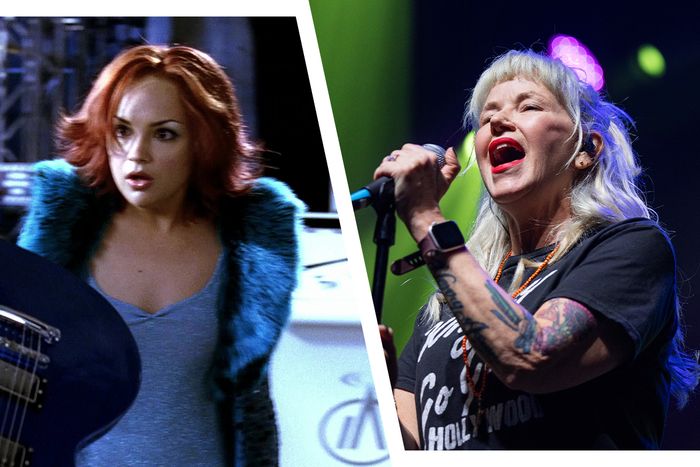
“I’ve received less than $1,500 for Josie and the Pussycats. My last payment for it was in 2009.”
Photo-Illustration: Vulture; Photos: Universal, Daniel DeSlover/ZUMA Press Wire/Shutterstock
Cinephiles, fans of alternative rock, or Ben Wyatt could tell you that Kay Hanley, the front woman of the popular ’90s band Letters to Cleo, provided the vocals of Josie McCoy in Josie and the Pussycats. The pop satire, released in 2001 to middling reception, has since enjoyed an afterlife as a Technicolor cult classic, with lead actresses Rachael Leigh Cook, Rosario Dawson, and Tara Reid still embracing the film all these years later. Hanley, though, is currently in a residual battle to be fairly compensated for her work.
The singer-songwriter admits that it took 25 years to understand the scale of the errors that occurred during production to screw her over in the long term, and she’s prepared for the upward battle she faces to prove her contributions — she has been paid for only one day of labor when her work amassed to nearly a full month. Hanley will also be losing her SAG-AFTRA health insurance on July 1 because she didn’t make enough earnings for the calendar year; her insurance rate of $725 a quarter will go up to about $2,100 a month, and she’ll have to kick her son off her plan. (It’s a scenario that many indie musicians find themselves in.) “It’s really hard,” she tells me. “The union is really good about this stuff, but in this case, it’s going to be difficult for me to resolve this, hopefully without legal action.” Here, she tells her story.
Babyface was the producer of the songs in the film. He had chosen a singer to play Josie who was an incredible vocalist from Atlanta. She was a Black rock singer who had a big, insane voice. But when they tested her voice coming out of Rachael Leigh Cook’s mouth, it was like, Oh, that doesn’t make any sense. I had flown in from Boston to do the voices of the Pussycats — I was working on the background arrangements and already there when they identified the need for a new singer. I wasn’t able to just swoop in to get the job, though. There was some drama that culminated in me getting the job eventually.
I had never been hired for “my vocals” before. I was the singer in Letters to Cleo and wrote all of our lyrics and melodies. I wasn’t a voice-over person or actor. When I got the Josie job, I was approaching it as being the lead singer of a band. I would go into the studio every day and we would try out different things. There was no film footage yet, because it hadn’t started shooting. Rachael was going to sing along to me rather than me mimicking anything she was doing. I had no idea that what I was doing was a job called “voice-over artist,” because I didn’t know it was a job. My only experience was with my band or films using my music as needle drops. I didn’t know there was any difference. My manager and attorney weren’t thinking about it, either.
Listen, this was very novel. We just weren’t thinking about SAG contracts. I was supposed to be getting day sheets that were reported to the union, and I was supposed to be compensated with a daily union scale. None of that was a conversation. I don’t think Babyface knew he was supposed to be doing that, either. But I had an absolute blast. It was life-changing on about a dozen different levels. I didn’t feel like I had a whole lot of agency in a rock band and what my financial future was going to be or what my career trajectory could be like. After that experience, inspired by Babyface, I went behind the scenes in the industry and was someone who wrote songs for animation and directed other voice-overs.
Now, here’s a helpful comparison to another one of my bigger projects. 10 Things I Hate About You, right out of the gate, was being shown on cable television after its theatrical run. The residuals started coming for me immediately. Josie and the Pussycats didn’t have that. It was never on television or anything like that. It was a slow, cult film. They didn’t even make a Blu-ray for it. It wasn’t easy to find for a long time. 10 Things was hugely popular at Blockbuster. It was always a smash on the secondary run, and the streaming era brought a whole new revenue stream to it. Over that film’s lifespan — which, I should note, I’m also briefly onscreen for — I’ve made about $50,000 in residuals. I’ve received less than $1,500 for Josie and the Pussycats. My last payment for it was in 2009.
I’ve never run into a situation like this, where Universal Pictures seems to have overpaid residuals to the principal actors in the first few years of release. I’ve never heard of such a thing before. According to SAG, there’s no way of saying when Universal and the production company will recoup that overpayment. But I wasn’t a part of that overpayment. I wasn’t overpaid. I was reported as being on set for one day, which is the same as any other extra actor. That characterization doesn’t fit my role in the film. Now that it’s been discovered, I expect I’ll be able to remedy the situation. I’ve always been able to resolve stuff like this on my own.
But what SAG wants from me now is pay stubs and documentation of time in the studio, which I don’t have. So I’m talking to our attorney to see if they have any correspondence or documentation left over for Josie. But none of that is going to help my case, anyway, because it doesn’t support that I was on set or recording at Babyface’s studios. I probably had paper airline tickets. There’s no way I can document that any of this happened, except: Watch the fucking movie, duh. That’s my voice coming out of Rachael Leigh Cook’s mouth. I don’t know what better proof I could offer than that.
Ultimately, you have to know if your voice is going to be on film. What are your rights there? If your voice is being broadcast anywhere, your fee pays for that first use. Any recurring use after, the production gets paid, and you get paid for that. But my simple advice for anyone in this industry is to make sure you’re filling out your SAG paperwork. The voice-over studio should be presenting you with your paperwork every day if you’re doing voice-over. I know how all of this works, and I still wasn’t making the connection between what I was doing over decades of work and what I did on Josie and the Pussycats. It took me 25 years to realize me not getting paid residuals was messed up. And it’s because I really didn’t understand the job I did back then. If I can miss these things, I can’t imagine how widespread it is.
I’m familiar with my rights. And yet I’m fighting every day to make sure all of my songs are registered correctly and I’m getting paid for them. Learn from me.
Related