
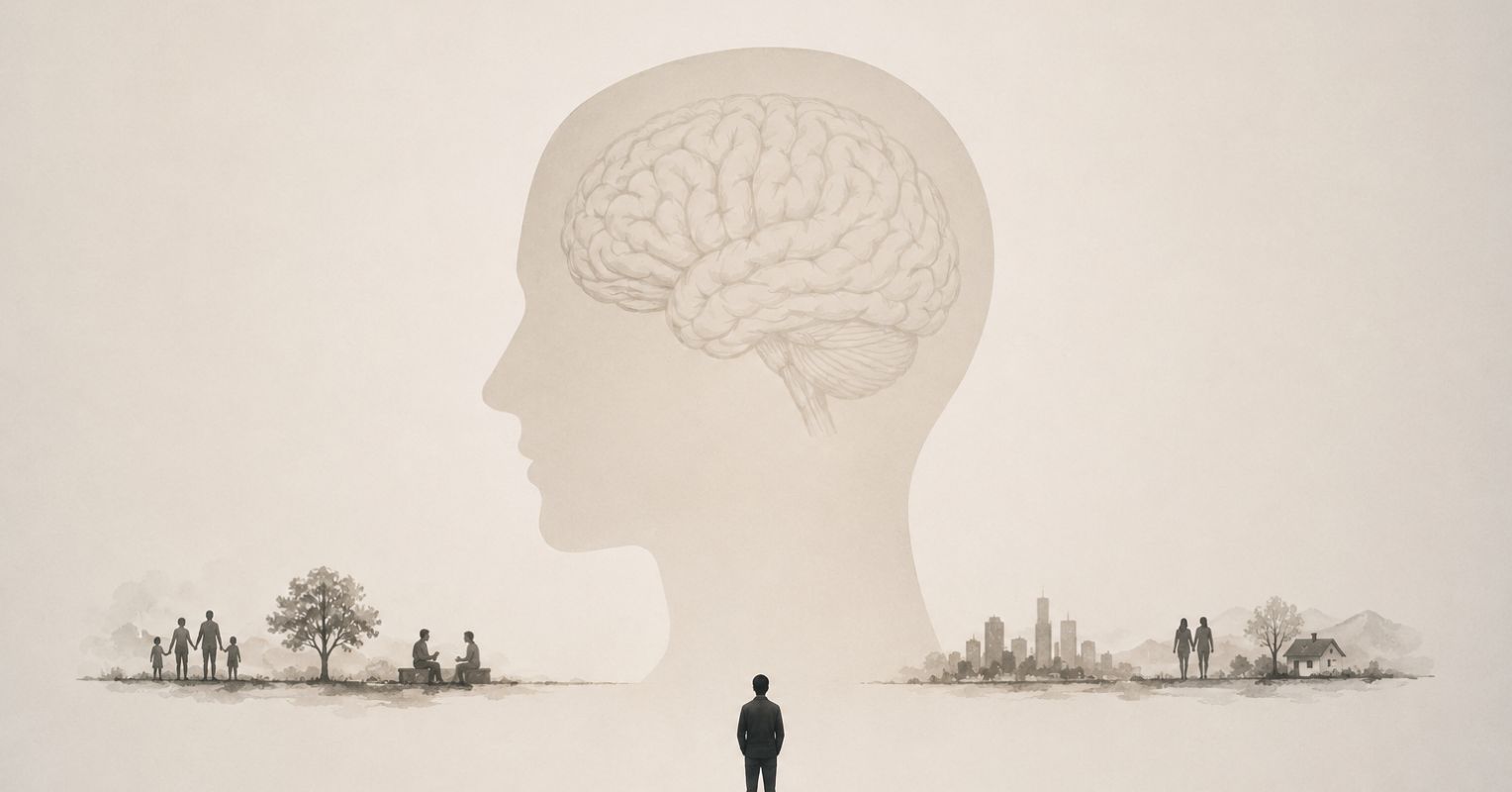
Over the past decade, the neurodiversity movement has transformed the mental health discourse. Originally developed as a challenge to pathologizing narratives around such psychiatric diagnoses as autism and ADHD, its “umbrella” has come to cover an increasingly large and diverse portion of the population. While the neurodiversity paradigm contains a range of different perspectives, its mainstream form is characterized by the claim that the experiences and patterns of behavior falling under its umbrella are best understood as expressions of neurological difference, a natural part of human variation, as opposed to representing some sort of dysfunction, disorder, or disease process as psychiatry has long held.
In certain respects, this shift has been valuable: it has challenged stigma associated with the experiences and behaviors that come under such diagnostic labels; it has also promoted an expansion and acceptance of human difference more generally; and, finally, it has called into question the central psychiatric premise that psychological distress and impairment are properly thought of as “medical disorders.” Perhaps most impactfully, the language of neurodiversity has provided a sense of dignity and community for some, as well as a common language that provides a way of interpreting and articulating their struggles and having those struggles recognized by others.
Despite these contributions, however, there are important reasons to question the neurodiversity paradigm. At a time, now, where it dominates mental health discourse and has a significant say in how many people understand their own minds, it has gone far beyond a non-pathologizing recategorization of a very small sub-group of people.
Chief among these reasons is that while it presents itself as a critique of—and departure from—the medical model, it nevertheless retains its cardinal assumption: the belief that psychological distress and impairment are best explained in terms of individual, internal factors, and in the case of such diagnoses as ADHD and autism, that such processes are reducible to neurology. This is in direct contrast to accounts that emphasize social and relational explanations of psychological distress.
From Disorder to Neurotype
Where psychiatry, directly or indirectly, locates the source of distress or impairment in a disordered brain (i.e., neurodevelopmental disorder), neurodiversity theory tends to locate it in a differently wired brain, in terms of different “neurotypes.” This is often portrayed as a radical shift. But how radical is it?
It is radical in one sense, but highly conservative in another, as it uncritically accepts psychiatric categorization itself and, in the case of autism and ADHD, the assumption that the experiences and behaviors gathered under these categories are best explained in neurological terms. In other words, it replaces one form of essentialism with another. Although the moral evaluation changes—from deficit to difference—the underlying explanatory framework remains intact. This is important because, while neurological explanations are often presented as settled science, there remains considerable debate about whether the categories in question correspond to discrete neurological entities at all.
The Problem of Reification
Psychologists have long warned against reification: the tendency to treat abstract concepts as though they were concrete things. Diagnostic categories are particularly vulnerable to this error. For more than a century, psychiatry has sought to overcome the problem by grounding its diagnostic categories in biology. The hope was that advances in neuroscience and genetics would eventually reveal the underlying disease processes responsible for psychiatric diagnoses.
However, despite enormous investment and decades of research, this project has failed to identify specific biological markers that reliably correspond to the vast majority of psychiatric categories, including ADHD and autism. This failure has prompted a noticeable shift in tone within sections of the psychiatric establishment. In a recent article for the New York Times, the influential psychiatrist Awais Aftab put it this way:
“When psychiatrists say that you ‘have A.D.H.D.,’ what they really mean is something like this: After spending time listening to you, talking with people who know you and observing how you think and behave, I’ve made a judgment call that your experience fits a behavioural pattern we currently call A.D.H.D… Patterns like these are handy for picking treatments that might be helpful, but they don’t settle the deeper questions about how your brain works or what kind of person you are.”
Neurodiversity Essential Reads
This statement is as honest as it is revealing. Psychiatric categories, in other words, have been—and continue to be—wrongly reified. To say that someone has ADHD or has autism is to offer a particular way of describing a complex constellation of behaviors, feelings, relationships, and life experiences, as interpreted through a psychiatric lens. It is not to identify a thing that people “have”—a disordered or differently wired brain—something that, despite what many have been led to believe, has not been empirically established.
As Aftab goes on to acknowledge, psychiatry has often “given the false impression that each mental disorder is a relatively distinct problem with clear boundaries and an essence that makes it what it is,” when in fact such categories are “practical tools that provide a shared language.” Aftab deserves credit for saying the quiet part out loud. Yet in doing so, he also exposes psychiatry to a range of difficult questions concerning the ontological status of its categories and the authority granted to them.
Here, however, we are concerned specifically with the neurodiversity movement and its use of psychiatric categories. In my view, and in the view of many critical colleagues, the neurodiversity movement rightly challenges the pathologizing assumptions attached to the experiences that tend to be diagnosed as ADHD and autism—particularly under the considerably broadened definitions of the DSM-5. Yet by affirming rather than questioning these categories, neurodiversity theory has perpetuated and, in some respects, amplified their reification beyond psychiatry itself.
The result is that what Aftab describes as “practical tools” have increasingly become treated as defining features of personhood—a leap from description to cause, and from interpretation to identity. In doing so—and this is the central concern—the relational, developmental, and socio-cultural dimensions of human life risk being eclipsed by an individualistic and neuro-centric conception of what it means to be a person in such cases.
What Happens to Social and Relational Explanations?
Interpretation is inherently subjective, and subjectivity is strongly shaped by socio-cultural influences, pressures, and trends. Psychiatric diagnoses, by their nature, therefore encompass heterogeneous groups of people whose difficulties may arise through a wide range of developmental, relational, social, and/or biological pathways, which may, in important respects, constitute very different sets of experiences. This is an inevitable consequence of using categories that lack objective validation.
Which diagnosis a person receives—or adopts for themselves—is significantly influenced by the prevailing discourse surrounding psychological distress at a given historical moment. This helps explain the dramatic rise and fall of particular diagnoses over time (e.g., multiple personality disorder, borderline personality disorder, and bipolar disorder). The psychiatric categories that fall under the neurodiversity umbrella—principally autism and ADHD—are no different in this respect. Indeed, as the broadened definitions of the DSM-5 have taken hold, and as public interest in neurodiversity has grown—with services, identities, and communities increasingly organized around these categories—more and more of the heterogeneity of human distress and impairment has come to be located within them.
Given the widespread belief that autism and ADHD identify fixed neurological differences, a deep concern is that experiences that might previously have been understood through the lenses of social adversity, attachment difficulties, developmental trauma, or complex PTSD are increasingly being interpreted through neurological frameworks. What appears, from a psychiatric or neurodiversity perspective, as evidence of an underlying neurological disorder or difference may, from another standpoint, be understood as an adaptive response to chronic relational adversity or adverse social conditions.
As such, like the biomedical model it originally sought to challenge, neurodiversity theory can divert attention away from the interpersonal and societal conditions that shape human experience. When difficulties are understood primarily as expressions of an underlying neurotype—just as when they are understood in terms of a disordered brain—there is a risk that relational trauma, attachment disruptions, family dynamics, poverty, exclusion, discrimination, and other forms of social injustice recede into the background, exonerating relationships, institutions, and society from critical scrutiny. This deep problem of the medical model, in other words, persists in the model of neurodiversity.
Conclusion
If psychiatric diagnoses are interpretative constructs rather than natural kinds, then replacing the language of disorder with that of neurotype does not, by itself, move us beyond the medical model or some of the central problems associated with it. This is not to deny the reality of human difference or the value that many people find in neurodiversity as a source of identity, meaning, and community.
Rather, it is to question whether categories that remain scientifically contested and interpretatively constructed should occupy the privileged explanatory position they increasingly do, often at the expense of relational, developmental, and social understandings of human suffering. The central question is not whether people differ; it is whether our differences and difficulties are best understood in terms of the kinds of brains we are presumed to possess or in terms of the relationships, histories, and social worlds through which our lives are constituted.