
Archaeologists have recovered thousands of fossils from South Africa’s Rising Star cave system over the past decade, revealing one of the most unusual human relatives ever found. Now a new study has added another surprise. After analyzing ancient proteins preserved in the teeth of Homo naledi, researchers found evidence suggesting that every known individual from the species may have been female.
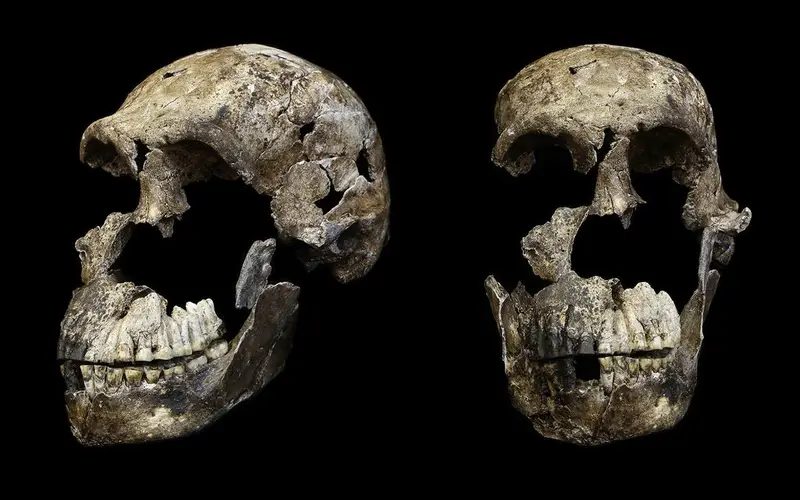 The largest skull of Homo naledi found in the Rising Star cave system in South Africa. Credit: Hawks et al., eLife (2017)
The findings, published in the journal Cell, come from the first genetic-style analysis of Homo naledi, a species that lived roughly 335,000 to 236,000 years ago. The work focused on proteins trapped inside tooth enamel, which often survive far longer than DNA.
Homo naledi has puzzled scientists since its discovery in 2013. The species combined a small brain and primitive upper body with more human-like hands, legs, and facial features. Fossils recovered from the cave system represent at least 20 individuals, ranging from children to older adults. Researchers have also argued that the species may have used fire and deliberately placed its dead in the cave, ideas that remain debated.
The new study examined proteins extracted from 23 teeth belonging to at least 20 individuals. Scientists used a minimally destructive method that removes tiny amounts of enamel through acid etching. They then searched for proteins linked to biological sex.
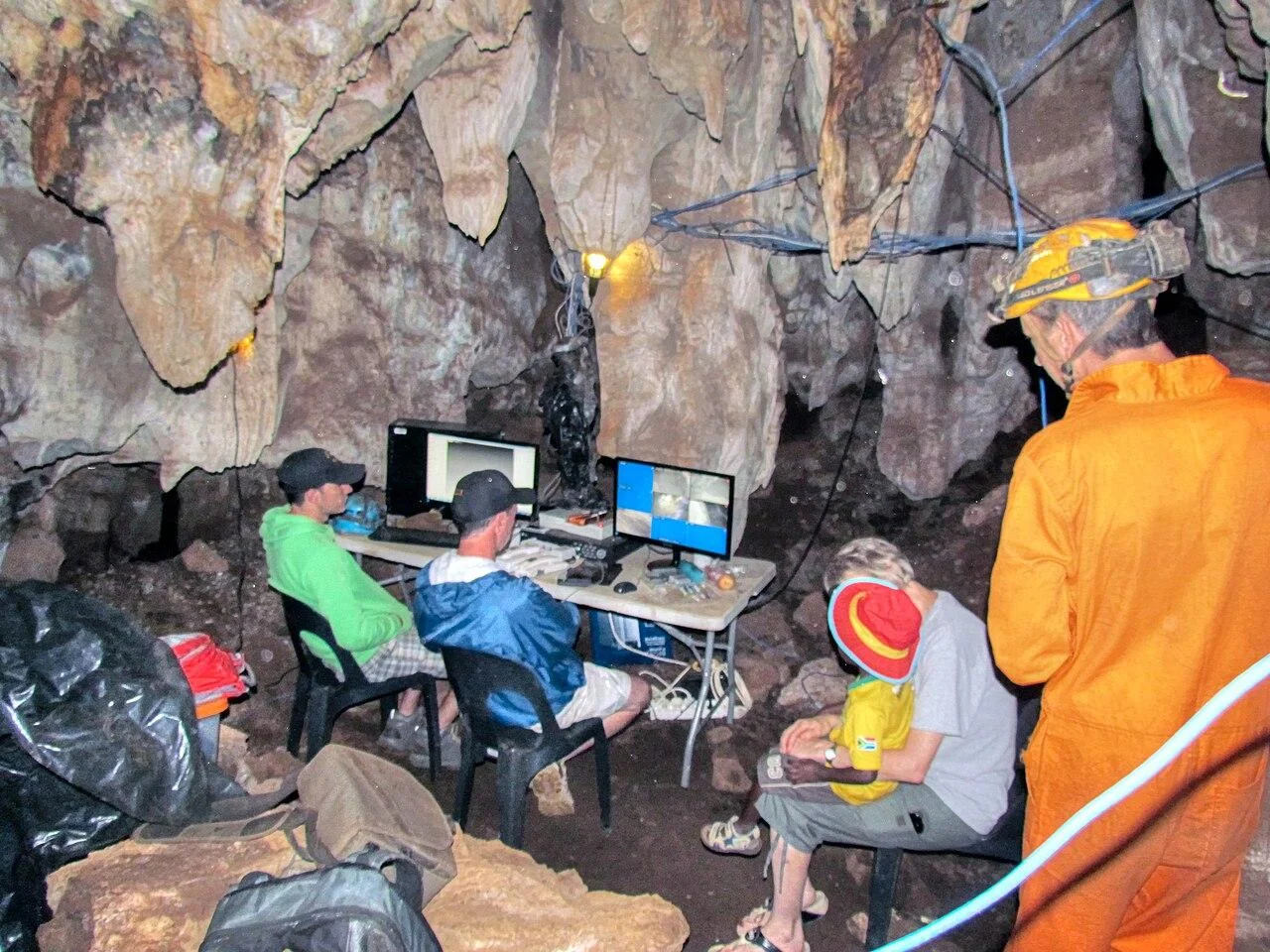 A view of command central set up at the entrance of the Rising Star Expedition cave in South Africa that was found to contain more than 1,500 ancient human bones. Credit: Rising star cave exploration, Simon Fraser University
One protein marker comes from the AMELX gene, which occurs in both males and females. Another, AMELY, is normally found only in males. The researchers detected AMELX proteins throughout the sample but found no convincing evidence of AMELY in any individual.
After ruling out technical problems, the team concluded that the known Homo naledi fossils either come entirely from females or belong to a population in which males lacked the usual AMELY marker. Statistical analysis identified 19 individuals as females with high confidence, while the remaining specimen also matched a female profile.
The result helps explain a long-standing mystery surrounding Homo naledi. Previous studies had noted an unusual lack of variation in the skeletons and teeth. In many human species, males and females differ noticeably in size. Homo naledi fossils showed far less variation than expected.
The findings also challenge earlier assumptions. One nearly complete skeleton known as “Neo” and another important specimen called DH1 had previously been interpreted as likely males because of their size and skull features. The protein evidence now suggests otherwise.
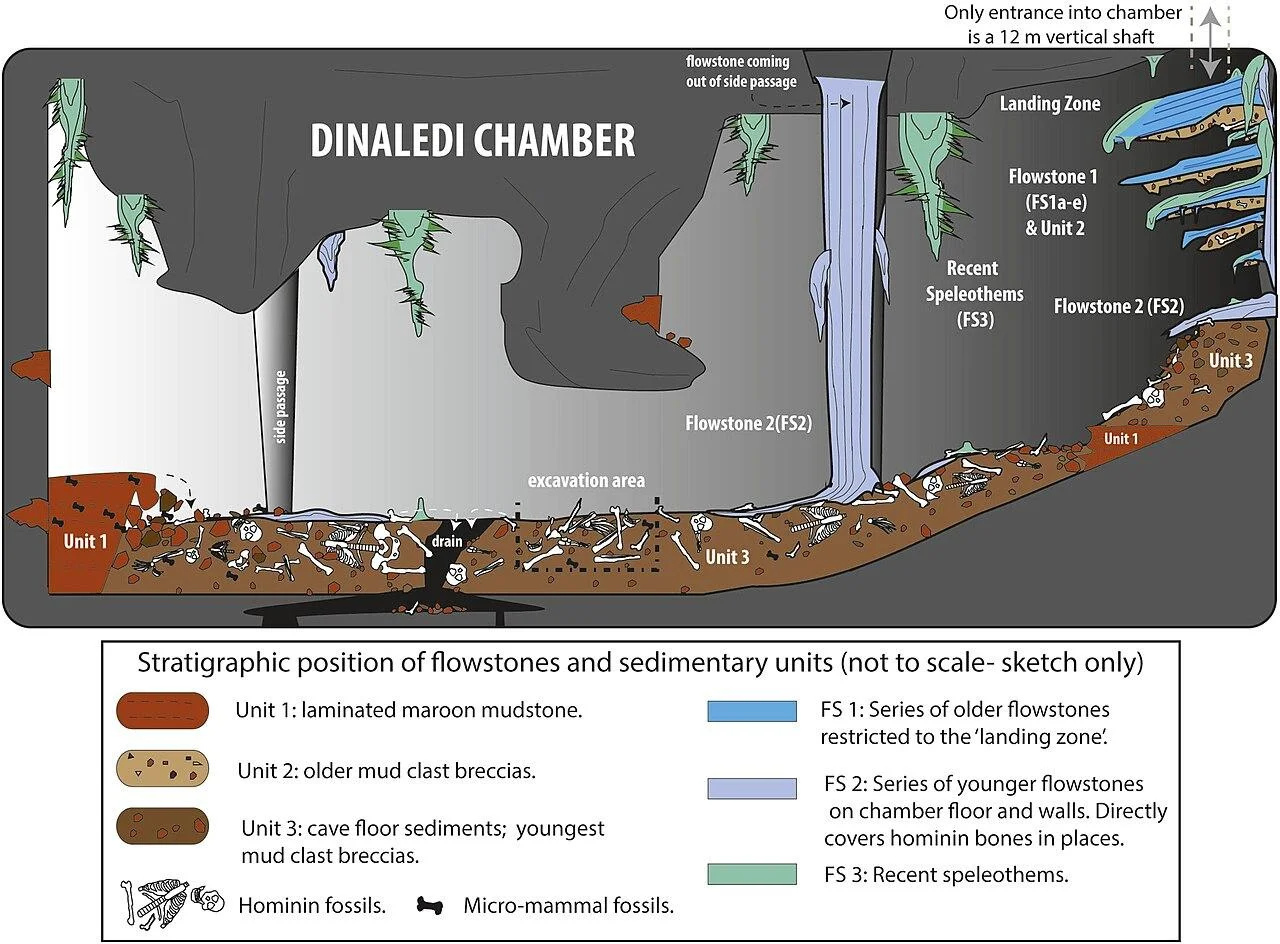 Illustration of the Dinaledi Chamber, site where Homo naledi remains were recovered. Researchers suggest the bones may have been placed after bodies were dropped through a shaft into the underground space, forming the scattered remains on the chamber floor. Credit: Dirks et al., eLife (2015); CC BY 4.0
Researchers considered another possibility: a deletion of the AMELY gene. Such deletions are known in modern humans and have been documented in at least one Neanderthal. If all Homo naledi males carried this genetic change, their protein profiles would appear identical to those of females. The study notes that this scenario is possible but unlikely.
If the cave truly contains only female individuals, scientists face a new question: why? The odds of randomly finding 20 females and no males are extremely small. Some researchers suggest the pattern could reflect social or burial practices. Similar sex-biased burial groups are known in later human societies, though none approach the extreme female dominance seen at Rising Star.
The study also uncovered clues about Homo naledi’s place in human evolution. Researchers identified a genetic variant linked to collagen production that is shared with Paranthropus robustus, another ancient human relative that lived in South Africa between one and two million years ago. The same variant has not been found in modern humans, Neanderthals, or Denisovans.
Scientists do not yet know what this shared trait means. More protein data from other ancient African hominins, including Homo erectus and Australopithecus africanus, will be needed before the evolutionary relationships become clearer.
Beyond the biological findings, the study highlights the growing power of paleoproteomics, the study of ancient proteins. Because the method causes very little damage to fossils, researchers believe it offers a new way to investigate extinct human relatives while preserving rare specimens.
For Homo naledi, the latest results add another layer to an already unusual story. More than a decade after the first fossils emerged from the Rising Star cave system, the species continues to raise new questions about human evolution and the diversity of our ancient relatives.
Publication: Madupe, P. P., Taurozzi, A. J., Koenig, C., Patramanis, I., Munir, F., Dickinson, M. R., … Cappellini, E. (2026). Proteomic analysis of dental enamel from 20 Homo naledi individuals shows no male markers. Cell. doi:10.1016/j.cell.2026.05.044