
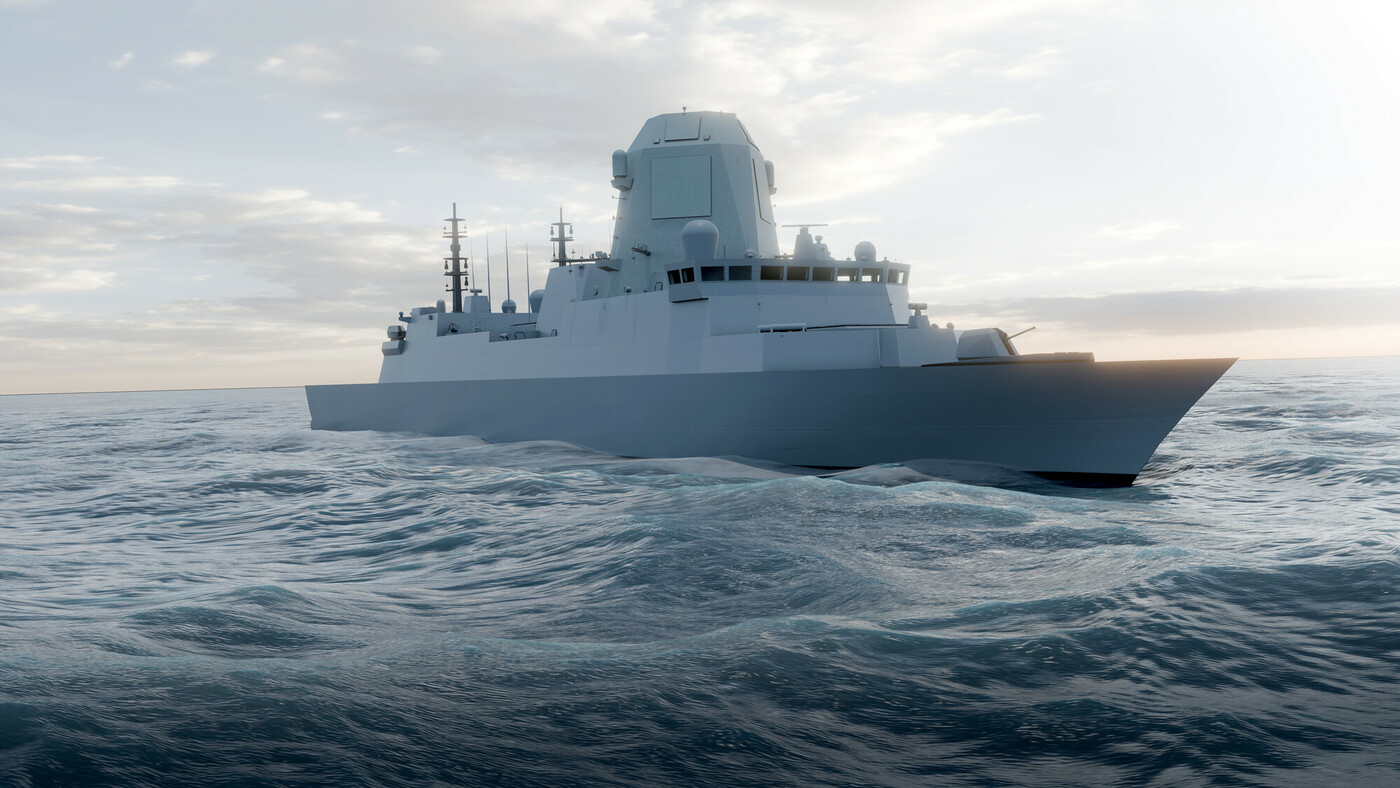
The Royal Navy’s planned Type 83 destroyer has been dropped in favour of at least six new Common Combat Vessels built to coordinate uncrewed systems in the air, on the surface and beneath it, under the government’s long-delayed Defence Investment Plan, the Sunday Times was first to report.
The six Type 45 air defence destroyers now in service had been due to be replaced by the next-generation Type 83 class, a concept that sat within the Future Air Dominance System and never moved beyond an early design phase. In its place, the department said the hybrid Common Combat Vessels would deliver more resilient air defence by acting as control hubs for drones across all three domains, and would extend the Navy’s “reach, resilience and firepower without a proportional increase in crew or cost.”
Delivery is expected from the early 2030s, and the ships are to be built in the United Kingdom.
Defence Secretary Dan Jarvis, as reported by the Sunday Times here, said the new class as a response to a changing threat, saying the vessels would give sailors “hybrid ships that are designed and built for the increasing threats we face.” He added that the ships would be “British-built, supporting jobs across the nation” and would hand the Royal Navy a capability built for modern warfare.
This a big one, a shift from large destroyers towards a distributed fleet in which fewer crewed warships orchestrate networks of autonomous platforms. It aligns with the Hybrid Navy direction set out in last year’s Strategic Defence Review, which spans Project Beehive’s uncrewed surface vessels and AUKUS work on underwater drones. Steve Reed, the Housing Secretary, said the full plan would be published within days, telling Sky News the country had to be ready for “any future war,” not the last one.
The Type 83 had long been named as the Type 45’s successor but stayed thinly funded. Defence minister Luke Pollard told Parliament earlier this year that around £1 million had gone on platform-specific design over three financial years, part of roughly £6.9 million of broader work under the Future Air Dominance System, and that the concept had been inherited in an underdeveloped state.
Industry thinking had pointed to the shape of the new vessel for some time. At DSEI 2025, UK Defence Journal reported, BAE Systems set out a system-of-systems vision for the future surface fleet built around a large Air Warfare Command Ship carrying sensors, missile batteries, guns and directed-energy weapons, paired with smaller, highly adaptable combatants. One concept, based on the Triton trimaran demonstrator, was shown as a lean-crewed sensor and effector platform fitted with Artisan radar, a 40mm gun, vertical launch cells and a towed sonar array, with full autonomy under study.
The future Air Warfare Command Ship and its drone escorts
Gavin Rudgley, a BAE design lead, pointed to reduced crewing as a central driver, telling the briefing that lower complements would come through “automation, autonomy and the embodiment of artificial intelligence.” Geoff Searle said the company was modernising its combat management system under the Re-Code contract to create what he called the “foundation of the sovereign core” capability, able to integrate partners, equipment and uncrewed systems. Asked by UK Defence Journal whether the future ship could evolve from the Type 26 frigate, given the resemblance of the concept, BAE representatives confirmed it was one option under review, with one official describing the proven design as “an obvious thing to build on.”
A competing route has come from Babcock, which has previously pitched its Type 31 frigate for the role. Under a concept it calls ARMOR Force, the firm would turn the Type 31 into a controlling node for a fleet of large autonomous surface vessels built by the United States shipbuilder HII, dispersing anti-submarine, air defence and strike capability across wide areas of ocean. The proposal centres on HII’s ROMULUS family of uncrewed surface vessels, fitted with swappable containerised payloads moved by a modular handling system that Babcock would develop at its Rosyth yard, and is presented as the industrial answer to the First Sea Lord’s call for a Hybrid Navy and an enabler of the Atlantic Bastion, Atlantic Shield and Atlantic Strike concepts.
Babcock pitches Type 31 frigate as command platform for uncrewed systems
Sir Nick Hine, chief executive of Babcock Marine, described ARMOR Force as “our response to the First Sea Lord’s call for a re-imagined Hybrid Navy,” built on open NATO standards to operate alongside allied forces, with the company saying its autonomous mission system would be deployable by the end of 2026.
The Conservatives attacked the wider plan as inadequate. James Cartlidge, the Shadow Defence Secretary, said the reported changes amounted to “too little, too late from Labour on Defence,” arguing the settlement carried barely more money than its predecessor and pointing to the resignation of former defence secretary John Healey, who he said had warned the funding would leave Britain “less safe.” Andrew Bowie, the Shadow Secretary of State for Scotland, said it was extraordinary that ministers did not accept the plan must “fund both drones and destroyers,” warned that failing to invest in the Navy would damage the shipyards on the Clyde and at Rosyth, and said his party would redirect money from the government’s agreement to cede the Chagos Islands to Mauritius towards a new frigate fleet.
Healey stood down earlier this month after a dispute over the plan, saying the government had not committed the resources needed to keep the country safe, before Jarvis secured around £1 billion of additional funding that took the settlement to at least £14.5 billion, short of the £28 billion officials had identified as required.
With the full Defence Investment Plan due before NATO leaders meet in Ankara on 7 and 8 July, the Common Combat Vessel now carries the weight of the Royal Navy’s future air defence, a role that until this weekend belonged to a destroyer the service has yet to design and that must be ready before the Type 45s are due to leave service in 2038.