
The Earth reaches the furthest point from the Sun all year and we have a fourth, consecutive, new supermoon.
The Sun begins the month in Gemini (The Twins) and ends in Cancer (The
Crab) and approaches by 241,528 km (0.002 AU). In between these times,
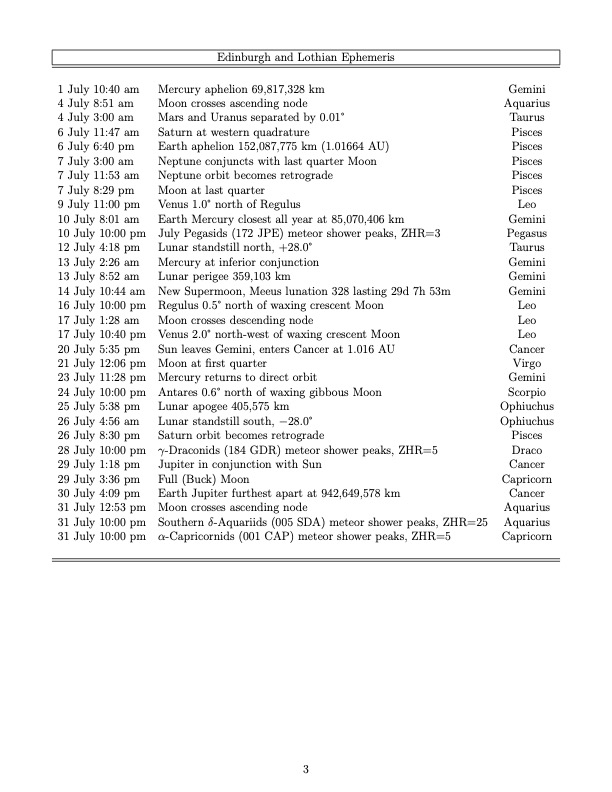
Earth and Sun reach aphelion or furthest apart. This occurs on 6 July at
6:40 pm when the Earth is 152,087,775 km (1.01664AU) distant. The moment
the Sun passes from Gemini (The Twins) to Cancer (The Crab) is on 20 July
at 5:35 pm. Post-Solstice, the nights get longer as the days get shorter.
Indeed, daylight shortens from 17:30 (17.498 hours) on 1 July to 16:07
(16.117 hours) on 31 July so we gain 1 hour and 23 minutes of night
time, by the end of the month. That said, we remain within astronomical
twilight all month long, at best, so reducing observing to the brighter
objects in the night sky.
The Moon begins the month in Sagittarius (The Archer) and ends in Aquarius
(The Water Bearer) and approaches by 11,450 km. The Moon enters last
quarter on 7 July at 8:29 pm in Pisces (The Fishes). Lunar perigee (closest
to Earth) on 13 July at 8:52 am finds the Moon some 359,103 km away from
Earth—around 25,297 km closer than average—subtending an angle of 33.3
arc-minutes. The new Moon appears on 14 July at 10:44 am in Gemini (The
Twins) beginning a new synodic month which will last 29 days, 7 hours and
53 minutes. It is the fourth new supermoon in a row so cannot be seen. The
first quarter of the new Lunar cycle shows up on 21 July at 12:06 pm in
Virgo (The Maiden). Lunar apogee (furthest from Earth) occurs on 25 July at
5:38 pm and takes the Moon to 405,575 km away from Earth—around 21,175 km
further than average—subtending an angle of 29.5 arc-minutes. The full
Buck Moon makes an appearance on 29 July at 3:36 pm in Capricornus (The Sea
Goat).
On 16 July, Regulus in Leo (The Lion) will be within half a degree or so of
the waxing crescent Moon as they set. On 24 July, Antares in Scorpio (The
Scorpion) will also be within 0.6 degrees of the waxing gibbous Moon at
very low altitude in the south.
For the inferior planets: Mercury inhabits Gemini (The Twins) all month but
recedes by 35,066,844 km (0.234 AU). The swift planet increases in
magnitude from 2.23 to 0.35 (5.66 times in brightness) over July. On 1
July, Mercury reaches another aphelion lying almost 70 million km from the
Sun. Mercury and the Earth are closest together all year on 10 July.
However, on 13 July Mercury reaches inferior conjunction so is lost in the
Sun’s glare. On 23 July, Mercury returns to a direct orbit from retrograde.
This is purely a visual selection effect as seen from Earth. Venus begins
the month in Leo (The Lion) and ends on the border of Leo (The Lion) and
Virgo (The Maiden) and approaches by 36,334,376 km (0.243 AU). The evening
star planet increases in magnitude from -4.05 to -4.27 (1.23 times in
brightness) over the month and is well placed for observation after sunset.
On 9 July, Venus will be about a degree north of Regulus, the brightest
star in Leo (The Lion). On 17 July, try to capture Venus and the waxing
crescent Moon close to the western horizon as they set in late evening.
For the superior planets: Mars remains in Taurus (The Bull) and approaches
by 16,304,684 km (0.109 AU). The red planet maintains a steady brightness
of 1.3 magnitudes during July. On America’s independence day, Mars will
conjunct very closely with Uranus in Taurus (The Bull) in the wee, small,
hours, low in the north-east. Jupiter remains in Cancer (The Crab) but
recedes by 13,182,066 km (0.088 AU). The gas giant decreases in magnitude
from -1.81 to -1.78 (1.03 times in brightness). On 29 July, Jupiter reaches
conjunction with the Sun so is lost for observing. The following day, Earth
and Jupiter are furthest apart at around 943 million km.
Saturn remains in Pisces (The Fishes) and approaches by 75,158,120 km
(0.502 AU). The ringed planet increases in magnitude from 0.78 to 0.63
(1.14 times in brightness) during July. Saturn reaches western quadrature
on 6 July making a right angle between Earth, Sun and planet. Saturn’s
orbit becomes retrograde in late July. Uranus remains in Taurus (The Bull)
and approaches by 59,420,926 km (0.397 AU). The green planet increases in
magnitude from 5.81 to 5.76 (1.04 times in brightness) over the month.
Neptune remains in Pisces (The Fishes) all month and approaches by
72,626,292 km (0.485 AU). The blue planet increases in magnitude from 7.76
to 7.71 (1.05 times in brightness) over the month. On 7 July, Neptune’s
orbit becomes retrograde and the planet will be close to the last quarter
Moon around 3 a.m. in the south-east. The brighter object nearby is Saturn.
Shooting star watchers will have a rum time of it in July. Four showers
will be visible but perpetual twilight and Moon illumination will spoil the
show. Still, hope springs eternal so you can try for the following. Weak
activity is predicted for the July Pegasids (175 JPE) peaking on 10 July.
They are radiant from Pegasus (The Winged Horse) near the star Markab. Only
3 meteors per hour are expected but the waning crescent Moon is only
illuminated to 20%. The parent body is thought to be comet C/1979 Y1
(Bradfield). On 28 July, we have the gamma-Draconids (184 GDR) radiant
from Draco (The Dragon) near the star Rastaban. The parent body is unknown
but the ZHR is a lowly 5 and the Moon, illuminated to 99.7%, doesn’t help
at all. On 31 July, we have both the southern delta-Aquariids (005 SDA)
and the alpha-Capricornids (001 CAP) which will also be hampered by the
waning gibbous Moon, illuminated to 97.7%. The delta-Aquariids are
radiant from Aquarius (The Water Bearer) near it’s namesake star. There may
be up to 25 meteors per hour but, as the name implies, viewing is much
better at southern latitudes. The parent body is thought to be comet
96P/Machholz. The alpha-Capricornids (001 CAP) are radiant from the
horns of the sea goat. The ZHR is, again, low at 5. Discovered in 1871, the
parent comet is 169P/NEAT but the Earth won’t pass through the main
cometary debris for another 2 centuries!
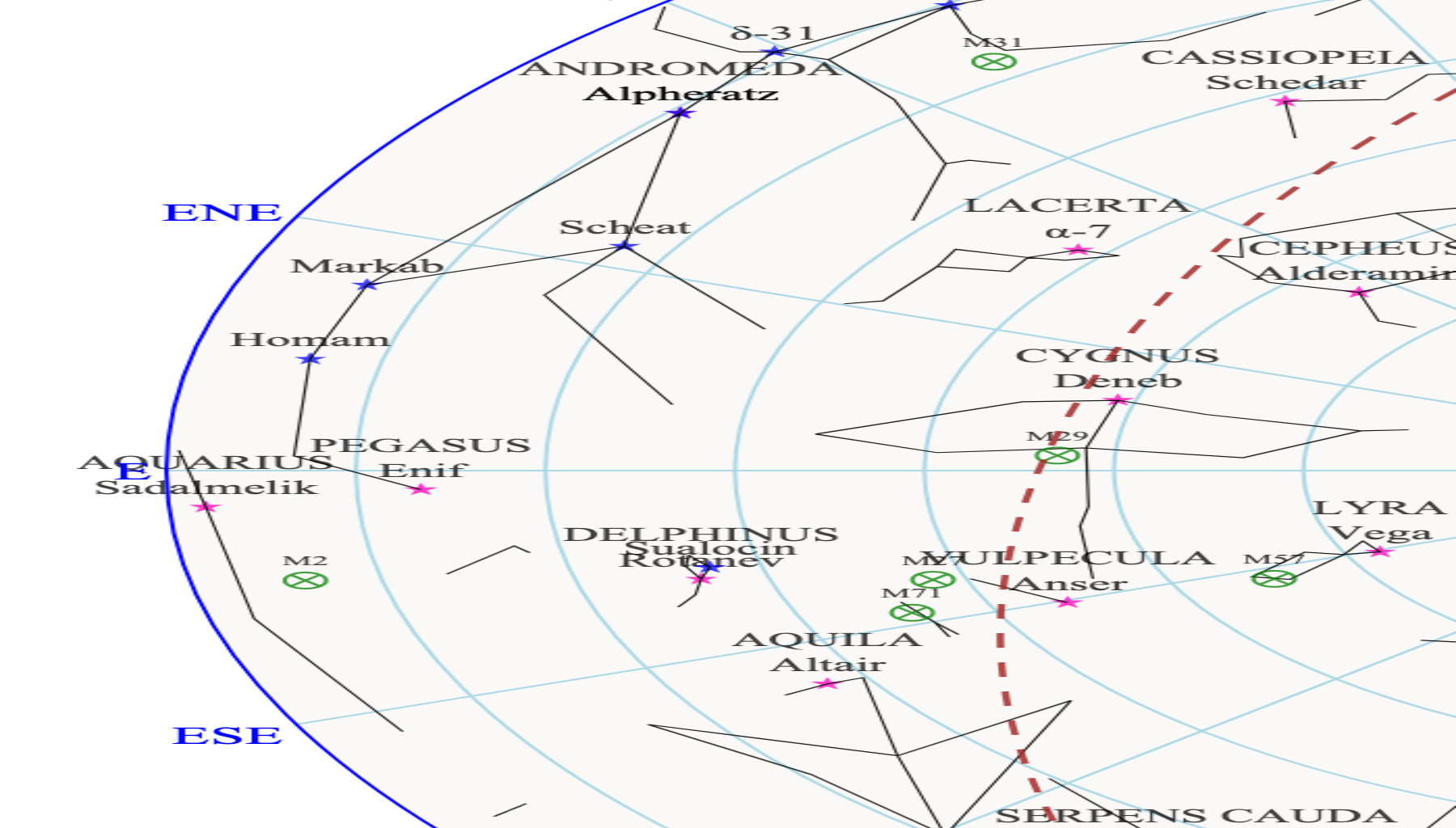
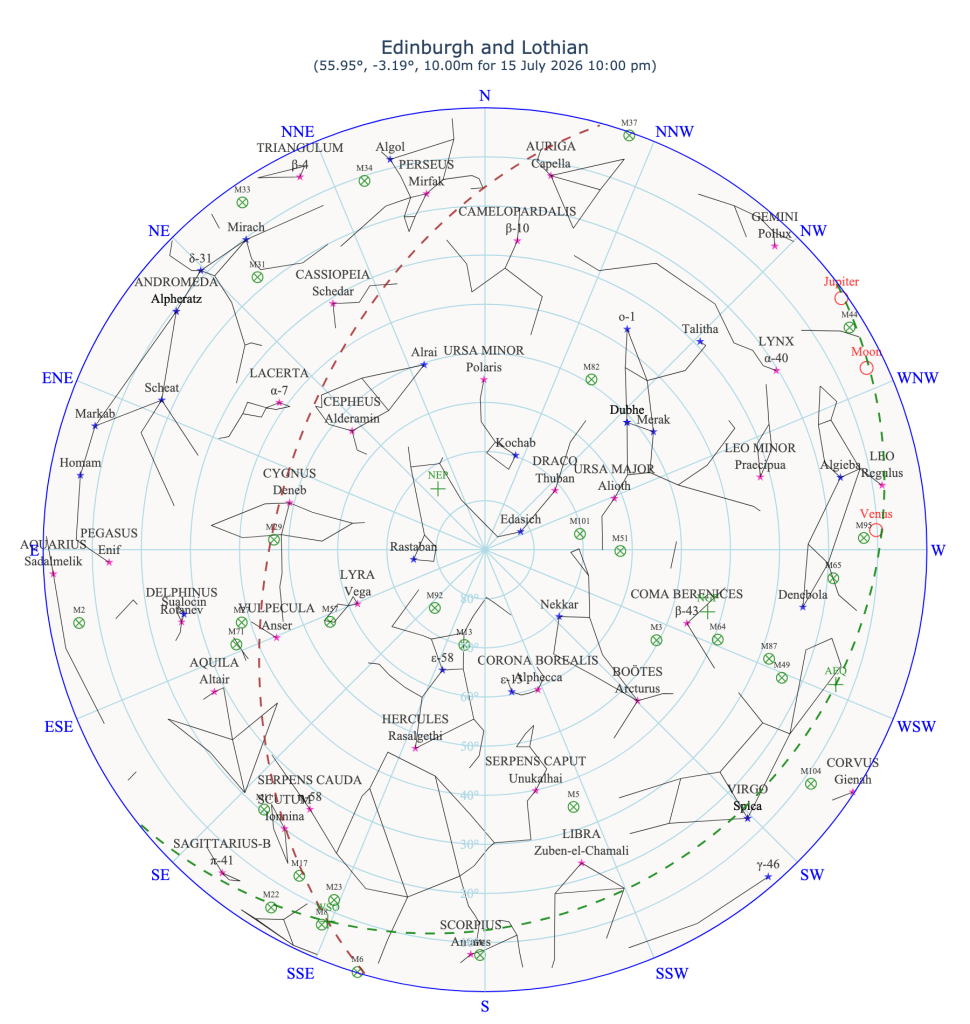
At the time of our sky map, some constellations visible are Draco (The
Dragon) at zenith, Camelopardalis (The Giraffe) in the north, Pegasus (The
Winged Horse) in the east, Coma Berenices (Berenice’s Hair) in the west,
and Serpens (The Serpent) in the south. The ecliptic hosts Sagittarius (the
Archer), Ophiuchus (The Serpent Bearer), Scorpio (The Scorpion), Libra (The
Scales), Virgo (The Maiden), Leo (The Lion) and Cancer (The Crab).
The ‘Summer Triangle’—Vega in Lyra (The Lyre), Altair in Aquila (The
Eagle) and Deneb in Cygnus (The Swan)—is prominent at mid-to-high
altitude in the south-east. The ‘Diamond of Virgo’—Arcturus in Bootes
(The Herdsman), Cor Caroli in Canes Venatici (The Hunting Dogs), Denebola
in Leo (The Lion) and Spica in Virgo (The Maiden)—is in the south-west.
Circumpolar constellations—always above the horizon for Edinburgh and
Lothian—include Cassiopeia (The Seated Queen), Cepheus (The King) and
Ursa Major (The Great Bear).


Related