
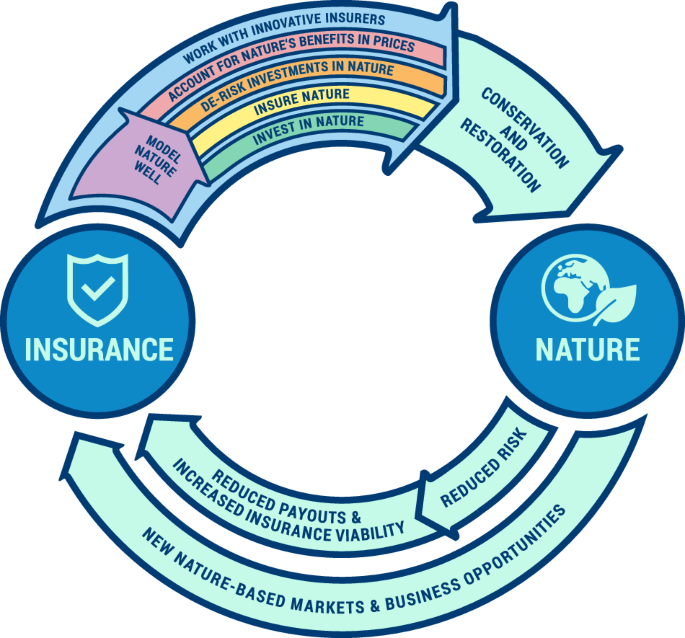
We identify five frontiers of nature-based insurance and share key challenges, examples of uptake (Fig. 3), and concrete actions to accelerate innovation and adoption to ultimately drive greater resources towards the protection of people and nature (Fig. 4).
Fig. 3: Nature-based insurance case studies and their impact.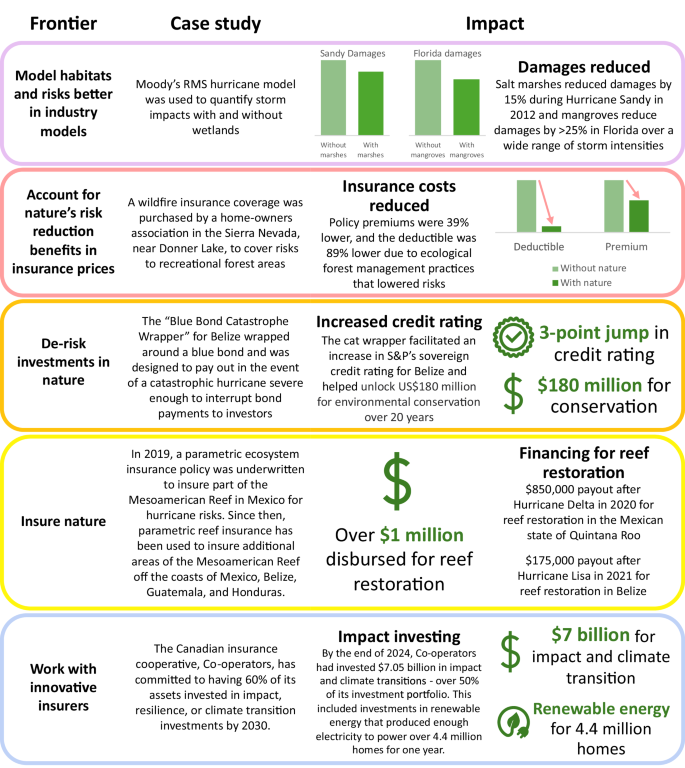
Each row describes an example of a project that has been implemented on-the-ground for one of the five frontiers of nature-based insurance and its impact. Data sources: top row case studies of modeling habitat benefits with industry models22,28, second row case study of wildfire insurance that accounts for nature’s risk reduction benefits in pricing58, third row case study of the Belize Blue Bond catastrophe wrapper59,106,107, fourth row case study of the Mesoamerican Reef insurance54,55, bottom row case study of Co-operators146,147.
Fig. 4: Actions to accelerate nature-based insurance.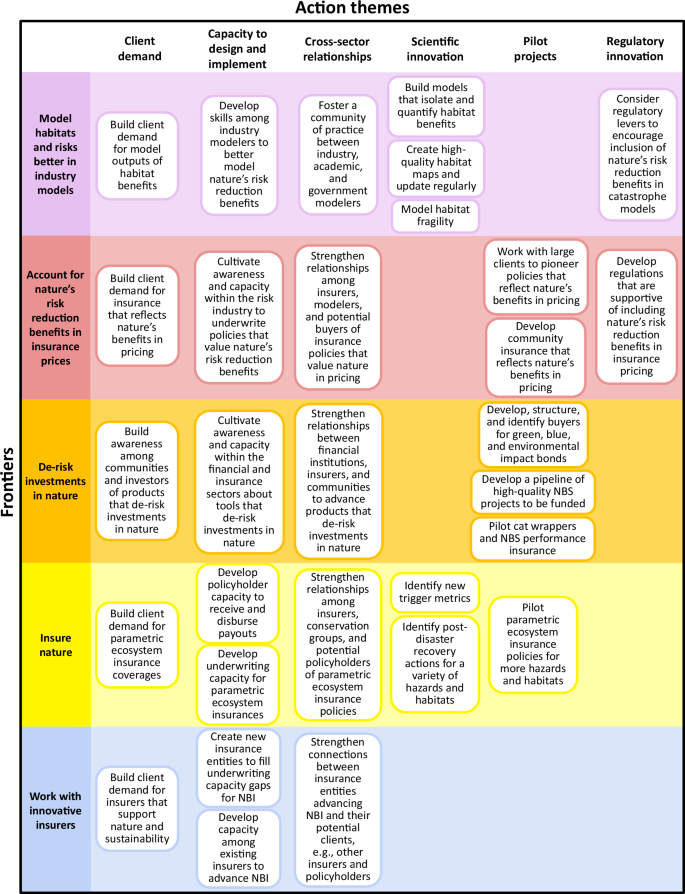
Actions are grouped into six categories: building client demand, building capacity to design and implement, strengthening relationships across sectors to support innovation and implementation, advancing scientific innovation, piloting projects, and creating a conducive regulatory environment. NBI nature-based insurance, NBS nature-based solutions.
Frontier 1: Model habitats & risks better in industry models
A critical technical need that underpins the success of many nature-based insurance tools is to improve how habitats are modeled within industry risk models. This is essential because, if the risk reduction benefits of habitats (e.g., storm surge reduction, wave attenuation, fire suppression, etc.) are not quantified within the models used and trusted by the risk industry, they will not be included in the design of insurance products. Importantly, because habitats can substantially reduce risks, improving habitat modeling is also necessary to generate accurate risk assessments in many parts of the world.
Despite their importance, habitats are rarely adequately modeled and quantified in industry models. Some insurance industry risk modelers have indicated that they do not see client demand for this kind of information57. If that client demand were to grow, it would strengthen the business case for investing the resources and time needed to improve habitat modeling. Therefore, to drive these changes, it is essential to build demand for information on habitat benefits among the clients of industry modelers, such as insurers, brokers, and financial firms. In turn, this will require building demand among their clients, and on down the chain to the consumers of insurance. Building this demand will require raising awareness about the effectiveness of habitats for risk reduction at every level of the risk industry and building capacity among risk industry professionals to design and implement insurance and financial tools that use information on habitat risk reduction. Another pathway is for regulators to require that industry risk models incorporate habitat risk reduction benefits so that risks are more accurately understood and quantified.
There are a variety of actions that modelers can take to better account for habitats and improve risk models. First, habitats need to be represented better in terms of spatial extent and habitat parameters relevant to risks. This is particularly true for certain neglected habitats, such as subtidal reefs (coral, oyster, worm, and rocky), which are often not included as land cover types and not assigned friction coefficients in flood risk models57. Some reefs may be included indirectly through bathymetric datasets, but the resolutions of those are usually too low to capture relevant structural features of reefs66. Global datasets exist for reef ecosystem extent at 5 m resolution67, which could be paired with established friction coefficients to improve modeling of flood risks and habitat benefits.
Industry risk models vary in how well they represent the relevant characteristics of included habitats. For example, the most advanced wildfire risk models allow model users, such as insurance underwriters, to adjust risk estimates to account for on-site nature-based risk reduction actions, such as fuel thinning68. However, many industry wildfire risk models do not have this capability, and many of the risk reduction benefits from ecological forest management practices are therefore not included. Mainstreaming these modeling advances and automating the inclusion of habitat information would substantially improve the modeling of wildfire risks and habitat benefits. Similarly, industry flood risk models are also highly variable in how well they represent habitats. For example, some industry models represent mangroves and salt marshes well using habitat extent and friction coefficients, while other models do not. Even when habitats are included in industry models, habitat data can be out of date due to infrequent updates of both habitat datasets and industry risk models. Coordination between risk modelers and scientific groups producing habitat datasets could help reduce these lags. Organizing habitat data into a single, regularly updated portal managed by a government, academic institution, or other objective third party could facilitate coordination and availability of habitat data to risk modelers. Additionally, efforts to compile high-quality, regularly updated habitat datasets would also support commitments that many governments have made around natural capital accounting69,70,71 and support businesses in reporting their nature-related dependencies under the Taskforce on Nature-related Financial Disclosures72,73 and Task Force on Climate-related Financial Disclosures74.
Second, it is important to isolate and quantify habitat benefits within risk models, but this is rarely done. In one example, researchers collaborating across academia, conservation, and the risk industry quantified wetland flood risk reduction benefits using industry models and found that salt marshes reduced damages from Hurricane Sandy in 2012 by 15%28. In another study using industry risk models, mangroves were found to reduce storm damages by >25% in Florida over a wide range of storm intensities22 (Fig. 3). In these cases, habitat benefits were quantified by running the models with and without habitats and then comparing the results. Alternatively, habitat benefits can be approximated by conducting post-facto calculations on model outputs, e.g., using habitat risk reduction ratios, which represent the percentage reduction in risk provided by a unit of area of a habitat (see this example from the Gulf Coast75).
A third way to improve risk models is to incorporate habitat fragility. Habitats can be damaged during extreme events, impacting their ability to mitigate risks, and accounting for this is important for generating accurate risk assessments. It is common to account for the fragility of hard infrastructure, such as levees, in probabilistic flood models76, and the same could be done for habitats that serve as natural infrastructure. Habitat fragility models estimate the degree of habitat damage that is likely for different intensities of a hazard. Some habitat fragility curves already exist (e.g., for mangroves77) and others could be developed through collaborations between industry, academic, and government scientists.
Finally, in some cases, the modeling of habitat benefits is limited by the modeling of other physical processes. For example, in coastal zones, many industry flood models focus on modeling storm surge, which is a critical driver of flooding in the high-value markets of the U.S. East and Gulf Coasts. They often focus much less on wave-driven flooding, which is more critical in areas with small or nonexistent continental shelves, such as islands and the western coasts of the U.S., Canada, Central and South America, Europe, and the U.K. This reduces the insurance industry’s ability to assess the benefits of habitats such as reefs and dunes, which provide coastal protection through wave breaking and attenuation. Therefore, in parts of the world where these habitats exist and waves are a major driver of risk, high-quality wave modeling is important to accurately model risks and habitat benefits23,25,41.
Frontier 2: Account for nature’s risk reduction benefits in insurance prices
One of the most impactful ways that insurance can support conservation and restoration of ecosystems is to explicitly incorporate the risk reduction benefits from nature when assessing risks and pricing insurance policies. Nature plays a critical role in reducing risks – from flooding, heat, and more – and it is an oversight that industry risk assessments often barely account for nature28,57. Considering nature’s benefits in the pricing of insurance could incentivize landowners to make investments in nature-based solutions to get lower premiums, and it would send a signal from the risk industry to risk managers that nature-based solutions are effective at reducing risks. Similarly, it could disincentivize activities that harm nature by identifying and accurately pricing higher risks due to the degradation and loss of protective habitats. Insurance has been shown to successfully motivate risk reduction in certain contexts through price signals and coverage availability. For example, insurance pricing has motivated the building of more hurricane-resistant homes78 and safer driving79. This same concept could work to advance nature-based solutions that reduce risks.
The theory of incorporating nature’s benefits into the pricing of insurance premiums has been proposed, e.g., in the concepts of resilience insurance53 and resilience bonds80,81, but it has not yet been widely implemented in practice. In 2025, the first-ever resilience bond was issued, covering losses from named storms in North Carolina with a US$600 million bond. The resilience bond is a form of catastrophe bond, a tool used by insurers and reinsurers to transfer some of their underwritten risks to capital markets. The bond issuer receives money from the bond only if damages from named storms reach a threshold that activates a payout. If the disaster does not occur and the bond payment is not triggered, then the investors who purchased the bond receive their principal plus interest. The innovation of the recent resilience bond is that the issuer pays an additional 0.35% each year into a designated resilience account. If annual losses are less than 60% of the deductible, the accumulated resilience payments and any interest are paid back to the issuer to fund resilience measures. If losses exceed 60% of the deductible, they are paid to bond investors, functioning as an additional coupon or extra compensation for investors since they are in a riskier position financially as the attachment point of the bond is approached82. Once the attachment point is surpassed, investors begin to lose their principal and interest. Also in 2025, the insurance industry collaborated with conservation practitioners and academics to create an innovative insurance policy that considers nature-based solutions in premium and deductible pricing. The policy is a wildfire insurance coverage in the Sierra Nevada, California purchased by a homeowner’s association to cover risks affecting recreational forest areas. Policy premiums were 39% lower, and the deductible was 89% lower due to ecological forest management practices that lowered fire risk58 (Fig. 3). On the public insurance side, the Federal Emergency Management Agency partly reflects nature’s benefits in the pricing of insurance from the National Flood Insurance Program through the Community Rating System. This program offers reduced insurance premiums to communities in exchange for implementing flood management activities, which can include open space preservation83. This falls short of explicitly incentivizing nature-based solutions because there are no requirements around habitat quality of the open space, but it could be expanded in the future to specifically incentivize projects that achieve measurable ecosystem benefits while reducing risks.
Valuing nature in the pricing of insurance holds many benefits, but it is challenging for a few reasons. First, insurers are not incentivized to make this change. Including nature-based solutions in the pricing of insurance premiums will require substantial commitments of time and resources by insurance companies, and many are not yet convinced there is a strong enough business case to make it worthwhile57,84. Second, there can be a mismatch in geographic scale between nature-based solutions and individual landholdings; some nature-based projects are implemented and deliver benefits across large areas, while many individual landholdings are comparatively small. Therefore, the risk reduction benefits and corresponding premium price adjustments that any one individual small landholder would receive from a nature-based adaptation project may not be enough to justify them paying the total cost of the project, and mechanisms to pool the costs and benefits across multiple landholders are not always in place. The difference in geographic scale between some nature-based solutions and insured properties also means that multiple different insurance companies may be operating within an area where a nature-based project is being considered, which could further complicate incorporating nature’s risk reduction benefits into premium prices.
To the first challenge, several approaches could incentivize insurers to invest the time and resources necessary to account for nature’s risk reduction benefits in their pricing. Insurers could be incentivized to make this change through regulations85. For example, state regulation has been used to incentivize insurers to continue covering high-risk properties in California86,87, and to require review of industry catastrophe models in Florida88. In these cases, to continue operating in the state, insurers were required to comply with certain state requests. A similar regulatory approach can be used to ensure that the benefits from nature-based risk reduction projects are reflected in insurance design and premium prices. For example, in 2025, Colorado passed a house bill requiring insurers to account for wildfire risk reduction activities, including nature-based approaches, in risk assessments and policy prices89. Another way to encourage insurers to make this change is to build client demand for these practices57. Building demand on a large scale will take time and effort and will require raising public awareness of nature-based solutions. As a starting point, it might be possible to make faster progress by targeting efforts on building demand among single, large clients of insurers, such as homeowners associations or municipal, regional, or national governments. Underwriting a large policy for a large client creates efficiencies and improves the business case for insurers, and could motivate them to change their underwriting practices.
The second challenge of mismatched scale between large nature-based solutions and small landholdings can also be addressed by working with large clients. Mechanisms exist to facilitate smaller landholders coming together to coordinate adaptation efforts, such as community insurance90,91, governance structures such as Geologic Hazard Abatement Districts92, and the newly established mechanism for forming Resilience Districts in California93. This work of engaging and unifying many smaller landholders to collaborate on adaptation efforts will take time and sustained effort. In the meantime, we recommend working with potential clients with large landholdings, such as governments, real estate investment trusts, hotels, resorts, agribusinesses with large operations, and universities with large campuses, to name a few. For these entities, the scale of nature-based solutions aligns with the scale of their landholdings, and they are unlikely to be working with multiple insurers. Therefore, working with large clients can address multiple challenges associated with incorporating nature’s risk reduction benefits into insurance pricing, and it is a promising strategy to jumpstart this work and drive greater investment in nature-based adaptation projects.
Due to the ubiquity of property insurance policies, there is large potential for this frontier to scale up and create widespread benefits for risk reduction and conservation. If this frontier could motivate property owners to redirect even a small fraction of the money they currently spend insuring their assets towards implementing nature-based risk reduction projects, it could generate large funding flows to nature. We estimate global property insurance premiums to be US$1.2 trillion annually. This is based on industry estimates that property and casualty insurance premiums are US$2.4 trillion and industry reporting that indicates property insurance accounts for approximately half of property and casualty premiums94. Therefore, if insurance price incentives motivated property owners to allocate a small percentage of what they currently spend on property insurance premiums to nature-based risk reduction projects, this could unlock tens of billions of dollars annually for nature and adaptation. Conceptually, the idea that property owners might spend money on nature-based solutions to protect their assets is grounded in science that shows nature can reduce risks by 10–25% or more depending on the context (e.g., for flood risk22,28,29,37,38). A study in coastal Alabama found that even modest cost incentives would effectively motivate residential landowners to consider restoring damaged bulkheads, a type of hard infrastructure, with nature-based solutions such as living shorelines95. This large potential for impact is further amplified by the efficiency of investing in adaptation – every one dollar spent on pre-disaster investments can reduce post-disaster recovery costs by up to thirteen dollars96. Additionally, valuing nature’s benefits in insurance pricing is aligned with national and international goals aimed at monetary valuation of ecosystem services to enable better policies and decisions around sustainable development and resource management35,70,71.
Frontier 3: De-risk investments in nature
Insurance can also be used to transfer risks associated with ‘green’ investments, catalyzing larger funding flows for nature and helping to meet international goals for nature finance. Massive increases in financing are needed to achieve the conservation and adaptation goals laid out in global agendas and frameworks such as the Sustainable Development Goals, the Global Biodiversity Framework, the Paris Agreement, and the Sendai Framework for Disaster Risk Reduction69,97,98,99. Interest in nature-based risk reduction projects is high in many countries100,101,102 as governments work to meet their own national environmental goals and international commitments, e.g., 30 by 3069 and Nationally Determined Contributions99. Private sector finance and insurance tools can play a critical role in helping to meet these goals and reverse the global nature loss crisis103 as long as appropriate incentives and safeguards are put in place to ensure that environmental benefits are not subordinated to financial gains104,105.
We discuss how risk transfer tools, such as catastrophe wrappers, environmental impact bonds, and nature-based solutions performance insurance, can play a role in expanding financing streams to help meet global nature finance goals. Catastrophe wrappers (‘cat wrappers’) are risk transfer tools that can de-risk green and blue bonds for investors, helping governments access greater funding from capital markets to fund environmental projects. A catastrophe wrapper is designed to provide a payout, often through a parametric mechanism, if a disaster occurs that is severe enough to interfere with a bond issuer’s ability to continue making payments to its bond investors. The payout from the cat wrapper can help the bond issuer continue making bond payments after a disaster, thus reducing the risk of default for investors. This is important because the ability of governments to raise money through bonds can be limited by their risk of natural disasters. A bond from a government with a high risk of natural disasters is seen as a riskier investment, decreasing its effectiveness as a fundraising tool. For a government in this position, purchasing a catastrophe wrapper can boost its credit rating, which can help it raise more funds through bonds and potentially achieve better interest rates. This approach was pioneered with the Blue Bond Catastrophe Wrapper for Belize, which wrapped around a blue bond and was designed to pay out in the event of a catastrophic hurricane59,106,107 (Fig. 3). This cat wrapper was critical to the development of a sovereign debt restructuring deal that reduced Belize’s annual debt payments by US$12 million per year, motivated Belize to commit $4.2 million per year on average to conservation for 20 years, and led to a three-point jump in Belize’s sovereign credit rating59,107. This process of restructuring a country’s debt in exchange for conservation commitments is called a debt-for-nature swap. Since 2016, $5.7 billion of debt has been restructured in such debt-for-nature swaps103, but Belize was among the first cases in which a cat wrapper was used to facilitate such a deal. Cat wrappers are not the right tool for every circumstance; they are best suited to places with high disaster risk and low credit ratings, including many developing countries and local governments that have been devastated by natural disasters. Scaling up this solution will take collaboration across (re)insurance companies, development organizations, conservation groups, financial firms, and governments. Key steps include identifying candidate buyers, identifying high-quality nature-based adaptation projects, designing green and blue bonds, and designing catastrophe wrappers.
Expanding the use of cat wrappers could increase financial flows to nature through green and blue bonds. Accurately estimating this amount of additional financing would require information that is not currently available on the number of green and blue bonds that fail to be issued due to high credit risk deterring investors, plus an analysis of the proportion of those failed bonds that could have been made viable through the use of cat wrappers. In the absence of that information, here we look to the size of the green and blue bond markets to get a sense of the scale of additional financing that could be unlocked through catastrophe wrappers. Because they are substantially different in size and design, we consider the markets of debt-for-nature swaps separately from other forms of green and blue bonds. In the last five years, debt-for-nature swaps have provided $86 million in funding for nature per year on average107,108,109,110,111,112 (see Supplementary Methods for more details). Meanwhile, the current annual issuance of nature-related thematic bonds is $113 billion103. These are a subset of the broader green and blue bond market and include bonds that fund nature-positive activities like pollution control and resource conservation. If cat wrappers could enable some small percentage of additional funding through these pathways, they could unlock millions of additional dollars for nature and adaptation through debt-for-nature swaps and potentially billions through green and blue bonds.
While cat wrappers can transfer risks associated with nature-based solution investments for investors, other tools can transfer risks for project owners. For example, environmental impact bonds are debt instruments that can be used to raise capital from investors for environmental projects where repayment of the principal and interest can be tied to the success of the project57,113. The terms of the bond can be written such that investors receive lower interest payments if the project is unsuccessful, thus making the project less risky for the project owner to undertake. However, environmental impact bonds entail a greater administrative burden of monitoring and verifying project success for the bond issuer. This structure has been implemented in D.C. to fund stormwater solutions such as rain gardens and permeable pavement114. They have also been proposed to finance wetland restoration in coastal Louisiana113 and could be developed for other places and types of nature-based adaptation projects. The current annual issuance of environmental impact bonds is $10 million per year on average115,116,117,118 (see Supplementary Methods for more details), and growth of this nascent financial mechanism could result in increased funding for nature on the order of millions of dollars per year.
We propose a novel type of insurance called ‘nature-based solutions performance insurance’ that could also transfer risks associated with nature-based solutions for project owners. This type of policy would cover the risk that a nature-based adaptation project, such as an ecotone levee or a wetland buffer, underperforms relative to the level of protection it was designed to provide, e.g., protection against a 100-year storm. This type of policy has not yet been underwritten to our knowledge, but it could help communities that have historically relied on gray infrastructure feel more comfortable trying nature-based solutions. This is an example of how insurance can address subjective risk119, i.e., the fear of risk felt by a policyholder. In this case, it would address the fear that a nature-based adaptation project might not fully protect the project owner even when engineering calculations and modeling results indicate that it will. Further study is needed to develop the details of how a nature-based solutions performance insurance would be structured and implemented to provide the greatest benefits and minimize potential risks, such as adverse selection and moral hazard. Adverse selection is when parties with higher risk are more likely to purchase insurance, and the insurer does not have full information about the risk profile120,121, and moral hazard is when an insured party acts in a riskier manner when they are insured122. Open communication and information-sharing between insurers and policyholders could help minimize these risks, e.g., sharing information about historical hazards and costs, current risk mitigation activities, and operations and maintenance efforts.
Frontier 4: Insure nature
There is a long history of insurance being used to transfer the financial risk of damage to buildings and gray infrastructure due to disasters. Like gray infrastructure, habitats can also be damaged during disasters and, in many circumstances, would benefit from insurance to help finance post-disaster habitat restoration. Yet until recently, insurance had never been used in this way, and even now, these kinds of insurance coverages have only been implemented in a small number of cases, mostly using parametric insurance policies to cover damages from hurricanes to coral reefs.
Parametric insurance is a newer form of insurance that can provide rapid payouts immediately after a disaster. Parametric insurance payouts are based on a pre-determined ‘parameter’ threshold being surpassed (e.g., wind speed during a hurricane). If the threshold is surpassed, the policy rapidly pays out, often within two weeks. Timely payments can help constrain the extent of damages caused by a disaster, potentially avoiding cascading harm and reorienting recovery trajectories123. For example, a parametric insurance policy in India provides payments to rural women farmers when extreme heat waves threaten their crops and livelihoods124. These payments can reduce the need for drastic measures and help keep basic needs met in the short-term.
Parametric insurance contrasts with the more common indemnity insurance, in which payouts are based on assessments of covered damages after a disaster. These assessments help minimize basis risk, which is the risk that payouts do not match actual damages, but assessments can be slow and delay payouts. As such, parametric policies tend to be faster but have higher basis risk than indemnity policies. Basing insurance payouts on a parameter also minimizes the risk of moral hazard – policyholders receive the same payout regardless of their actions, so they have more incentive to avoid risky behaviors with parametric insurance than with indemnity insurance125,126. Parametric and indemnity insurance policies can be used in combination, or “layered” together, to take advantage of their respective strengths. Parametric policies are currently only a small fraction of the insurance market – under 1% of policies – but there is potential to increase their use to help manage risks affecting people and nature127.
The first-ever parametric ecosystem insurance policy was created in 2019 to insure part of the Mesoamerican Reef off the coast of the Yucatan Peninsula in Mexico from hurricane damage55,128 (Fig. 3). The policyholder is the Coastal Zone Management Trust, which receives financial contributions from local hotels, state and municipal governments, and NGOs. This coverage inspired the governments of Guam129, Hawai‘i130, and California131 to pursue policies encouraging similar solutions in their waters. Since that coverage was underwritten in Mexico, parametric reef insurance has been used to insure additional areas of the Mesoamerican Reef off the coasts of Mexico, Belize, Guatemala, and Honduras54,55, as well as reefs in Hawai‘i56, Fiji132, and the Philippines84,133. If a triggering hurricane occurs, these policies will rapidly pay out funds for time-sensitive recovery actions, such as having trained divers reattach broken coral heads and remove debris from the reef. In addition, there is also now a parametric insurance policy covering hurricane damages to mangroves and local Mayan communities in the Yucatan, Mexico84.
Parametric insurance is often more flexible than indemnity insurance in terms of how payouts can be spent, which makes it particularly well-suited for building resilience in ecosystems. This flexibility is critical because, in some cases, rebuilding or restoring back to exactly the same thing that existed before a disaster is not the most resilient path. Parametric policies can help support ecosystems and the services they provide, while also allowing them to adapt to new climate and environmental realities. For example, in a parametric reef insurance policy, the payout could be used to plant thermally tolerant corals.
There are a variety of concrete actions that would support scaling up parametric ecosystem insurances to additional geographies, habitats, and types of hazards. It is important to identify new contexts where parametric ecosystem insurances can be useful and cultivate the community, scientific, and business relationships necessary to make them a reality. Scaling up will also require identifying effective post-disaster habitat recovery actions, which may not exist for every habitat and hazard, as well as identifying relevant trigger metrics that are measured by trusted, independent entities. In selecting new geographies, it is sensible to seek places where risks are not too high, so the insurance is not prohibitively expensive, and the recovery actions have a chance of sustaining the ecosystem into the future. Another important component of implementing parametric ecosystem insurance policies is identifying potential buyers to pay the premium, receive the payout if it occurs, and initiate the recovery actions. It may be necessary to cultivate interest and capacity among potential buyers and build their trust with insurers and other partners. It is not uncommon for multiple entities to pool resources to cover the insurance premium, since there may be many beneficiaries. With multiple buyers, it is also important to consider who is best positioned to receive the payout and quickly utilize the funds for recovery actions in the case of a triggering event.
Understanding the full potential of parametric ecosystem insurance to provide timely financing for nature is challenging because, so far, it has only been implemented in a limited set of cases56,84,132,133, and there are many possibilities for expansion to other contexts and hazards. To anchor our understanding of the potential scale of this frontier, we examine data on payouts from the Mesoamerican Reef insurance case. To date, $1,025,000 has been paid out under Mesoamerican Reef insurance policies that cumulatively cover storm risks for nearly 800 km2 of reefs57,134,135. Extrapolating this amount to the total global area of 80,000 km2 of coral reefs67 yields a potential average annual funding for reefs globally of $22.6 million through this mechanism (for more details, see Supplementary Methods). However, not all reefs are conducive to insurance solutions due to their geographic and social context, so this number is likely an overestimate. On the other hand, there is potential for parametric ecosystem insurance to expand to other habitats and hazards, such as fire coverages for forests, storm and pest coverages for urban forests, storm coverages for mangroves, and sedimentation coverages for coral reefs, to name a few. Therefore, if fully scaled up, this mechanism could potentially yield tens of millions of dollars annually in funding for habitat restoration, benefitting ecosystems and the individuals, communities, and businesses that are paid to carry out restoration after disasters.
Frontier 5: Work with innovative insurers to catalyze nature-based insurance
Some insurers are innovating nature-based insurance tools and practices, and they can play a key role in catalyzing industry-wide change, paving the way for other insurers to follow once the tools and practices have become more commonplace. Being at the forefront of industry innovations that are socially and environmentally beneficial can also create business advantages for industry leaders, such as price premiums from customers, better attraction and retention of high-quality employees, and overall greater social license136,137,138,139. Partnering with these innovators is an important strategy for advancing nature-based insurance. Further, there are certain types of insurance entities that can help overcome some of the obstacles to nature-based insurance, including nature-focused managing general agents, insurance facilities, and cooperative insurers.
Managing general agents (MGAs) are companies with expertise in underwriting insurance for specific markets or tools and they can help (re)insurers and brokers venture into new lines of business140. Because MGAs have specialized expertise, working with them can reduce the time, resources, and risks associated with entering new markets because (re)insurers do not need to build the necessary capacity in-house. For example, a managing general agent with expertise in forest risks was involved in the groundbreaking 2025 wildfire insurance policy in the Sierra Nevada mountains of California that accounted for risk reduction benefits from ecological forest management in the pricing of the premium and deductible58.
Insurance facilities are another type of entity that can catalyze change by providing a forum for insurers to experiment with new insurance tools and practices. Importantly, facilities can be financially separate from the entities that establish and fund them, which can include insurers, governments, and businesses, among others. Funders can control the amount of financial risk they assume by deciding how much money to put into the facility. Such a facility was established in 2007 to provide financial protection to Caribbean and Central American governments from natural hazards by underwriting parametric insurance policies141.
Nature-focused facilities could be established for specific geographies or types of nature-based solutions. These facilities could accelerate the frontiers of nature-based insurance outlined in this paper, such as including nature’s benefits in risk models, accounting for nature’s risk reduction benefits in insurance prices, and others. Facilities can help address the capacity needs associated with nature-based insurance because securing dedicated capacity for a facility that has a narrow coverage objective can be more straightforward than establishing a new dedicated line of business within an existing insurer. Further, a nature-focused facility could support nature through direct financial contributions (see this example142) and by aligning its investment portfolio to support nature143.
Insurance cooperatives, reciprocal exchanges144, and mutual insurers are other entities that could catalyze nature-based insurance because they have more freedom in their pursuit of longer-term sustainability goals than stock-traded insurance companies, which must navigate quarterly profit commitments to shareholders. These qualities have enabled entities with cooperative business models to be leaders in sustainable development145. Further, because insurance cooperatives are often non-profits, surpluses go back into providing affordable coverage for policyholders rather than going to shareholders, aligning incentives for cooperative insurers and their policyholders to work together to reduce risks. The Canadian company Co-operators is an example of an insurance cooperative prioritizing sustainability and resilience in their investments and underwriting (Fig. 3). At the end of 2024, Co-operators had invested $7.05 billion (>50% of their investment portfolio) in investments that are either impact investments or climate transition investments146, and recently announced a goal of increasing their climate solution investments from $2 billion in 2024 to $3 billion by 2030147. They also developed TomorrowStrongTM, an insurance product in Canada that helps policyholders rebuild to a higher standard of resilience after a covered climate-related loss148, departing from an industry norm of requiring policyholders to rebuild to a standard equivalent to what they had before the loss. Cooperative and mutual insurers currently make up roughly a quarter of the insurance market by volume of underwritten policy premiums149, indicating that this type of insurer can play a substantial role in shaping the insurance industry, but full transformation and uptake of nature-based insurance will also require uptake within for-profit and publicly traded insurers.
Concrete actions to advance this frontier include building awareness and interest in nature-based insurance among insurers and creating new nature-focused entities for regions and topic areas where they do not yet exist. For example, it would be beneficial to have a managing general agent with parametric insurance expertise and a nature-focused insurance facility in the Caribbean. To promote nature-based insurance tools and practices within insurance companies that are not yet nature- or sustainability-focused, we recommend raising awareness around these topics among their staff and clients and fostering personal relationships across environmental, engineering, insurance, and policy sectors and institutions. From these relationships can grow cross-sector knowledge and trust, which will be a critical foundation for the development and uptake of nature-based insurance practices, tools, policies, and projects.